Unclaimed Territory - by Glenn Greenwald

Name: Glenn Greenwald

I was previously a constitutional law and civil rights litigator and am now a Contributing Writer at Salon. I am the author of three books -- "How Would a Patriot Act" (a critique of Bush executive power theories), "Tragic Legacy" (documenting the Bush legacy), and "Great American Hypocrites" (examining the GOP's electoral tactics and the role the media plays in aiding them).

Wednesday, January 31, 2007

Various items

(updated below)

(1)
NSA expert James Bamford makes a vital point in a New York Times Op-Ed this morning: regardless of what happens with FISA issues going forward, George Bush violated the criminal law for the last five years by eavesdropping on Americans without warrants, and a federal court has already ruled that this is the case. Violations of FISA are felonies punishable by up to 5 years in prison and a $10,000 fine per offense.

Judge Taylor's court ruling is not tantamount to a finding of criminal liability (other issues, such as intent, would need to be demonstrated, and all sorts of other procedural safeguards would be due), but -- as I argued previously -- it is a binding ruling that the President's warrantless eavesdropping program violated the criminal law, and there is no justification for simply walking away from that and implicitly agreeing that there will be no consequences from the President's deliberate and continuous lawbreaking.

(2) As expected, the administration is attempting to persuade the Sixth Circuit (which has before it the Government's appeal of Judge Taylor's ruling) to dismiss the NSA lawsuit on the ground that it is now "moot." Marty Lederman details the status of those efforts, including the Government's odd request that the case not only be dismissed, but Judge Taylor's order be vacated -- a request Marty attributes to the desire on the part of the administration to preserve its ability to begin eavesdropping again in the future without warrants.

Along those lines, one hopes to see some genuine and aggressive follow-up on the demand by Pat Leahy and other Senate Judiciary Committee members to learn exactly what the administration is doing now with the FISA court. Jim Webb's refusal to be brushed off by the administration on the question of presidential authority to wage war against Iran ought to be the model used for this FISA issue and any other requests/demands for information made by the Congress. Genuine oversight is going to require vigilant, aggressive and relentless confrontation, not merely theatrics and earnest though inconsequential expressions of "concern."

(3) Terry "Nitpicker" Welch, who was formerly a Staff Sgt. and media affairs officer for the U.S. Army in Afghanistan, responds to the latest disgusting attempt by Michelle Malkin to cast a war journalist as an Al Qaeda ally. The target of Malkin's latest witch hunt is the courageous war correspondent for CBS News, Lara Logan (whose pointed and appropriately angry response several months ago to attacks by the Bush administration and Malkin-twin Laura Ingraham on journalists in Iraq was really superb -- if you haven't seen that, it is highly, highly recommended).

(4) Via Blue Texan, conservative blogger Austin Bay wrote a column in early December for the Austin-American Statesman which, in essence, voiced the accusations which right-wing bloggers at the time were making about the Associated Press and Jamil Hussein. Unlike most of them, Bay has now acknowledged that those accusations were unfouned, and he did the honorable thing -- published his own correction in the same paper, in which he wrote:

A columnist's mea culpa

In a column that ran in the American-Statesman on Dec. 1, I wrote that I doubted that an Associated Press source for a story originating in Baghdad existed. The story involved an allegation that six Sunni Arabs were murdered and set on fire. It turns out the AP source not only existed but had a two-year track record. The AP answered the questions raised on the two Web sites my column quoted. The Iraqi Ministry of Interior later admitted that police Capt. Jamil Hussein did work for the ministry in Baghdad.

The AP and other wire services are the backbone of truth on this planet. "New media" such as blogs still lack the reporting capacity of the wire services and major news operations. I am delighted to apologize to the Associated Press and congratulate the AP's Baghdad bureau for standing by their sources.

Bush followers wage war on any institutions which report facts, hence their hatred for the media, for Congressional oversight, for whistle-blowers. But as Bay notes, even with all of their flaws, we rely upon large media organizations to collect facts and keep us informed. That is particularly true for journalists in war zones (whatever you know about the Bush administration or Iraq or anything else that they did not want you to know, you know because journalists discovered and then reported it).

Those who want the media to improve criticize them. Those who want to block this truth-reporting function altogether wage war on the press and try to destroy their credibility completely. Most people do the former, while Bush followers (and the administration itself) do the latter. Bay, despite being a media critic, correctly ackonwledges what a critical function news organizations continue to perform. (And, just incidentally, congratulations are in order for Blue Texan, as he has picked up a new (or maybe not-so-new) reader).

(5) German prosecutors have issued arrest warrants for the individuals involved in what they are calling the kidnapping -- and that is what it was -- of Khaled al-Masri, a German citizen of Lebanese descent, who was abducted by the CIA and taken to Afghanistan and several other countries as part of our so-called "rendition" program, only to be released when it turned out he had nothing whatsoever to do with terrorism (as the Bush administration has privately admitted).

This is not a case of German prosecutors asserting universal jurisdiction in order to prosecute alleged war crimes that have nothing to do with Germany (a practice which, for reasons I set forth previously, I find objectionable). Instead, this is a German citizen who was kidnapped from Germany on his way from Germany to Macedonia with no due process whatsoever (and, needless to say, blocked by the Bush administration from obtaining justice in American courts). That is a crime and should be treated as one. (ADDED: It was Italy which previously issued arrest warrants for 25 CIA officers and an Air Force officer for kidnapping an Egyptian-born cleric off the streets of Milan and "rendering" him to Egypt for some torture).

(6) Hilzoy details the treatment of Chinese Uighur detainees at Guantanamo who are being held in round-the-clock solitary confinement even though, as Hilzoy says, they "were captured by bounty hunters nearly five years ago. They are in all likelihood innocent of any crime, and of any act against the United States; they have certainly never been tried and convicted of any." Hilzoy's discussion of this matter is characteristically thorough and well worth reading. One runs out of adjectives to describe things like this.

(7) In an obviously growing trend of political campaigns hiring bloggers, Pandagon's Amanda Marcotte has been hired by the John Edwards presidential campaign. That is part of a larger trend whereby the blogosphere is slowly ceasing to be its own closed, separate system and is instead seeping into, even merging with, all of the more traditional political and journalistic institutions. Whether that is something to celebrate or lament (and a case can probably be made for both), it is undoubtedly happening and will continue.

Time
's new blog, Swampland, illustrates that trend. I'm no fan, to put it mildly, of any of the four Time writers at that blog, but they deserve credit for being much more responsive to, and interactive with, both commenters and other bloggers than journalists of that type usually are.

That Joe Klein and Karen Tumulty now regularly and directly hear criticism of their work from Atrios and company and even periodically engage that criticism can only have positive effects. That Time took some of its most establishment journalists and basically stuck them in the middle of the blogosphere, and that those journalists almost seem to relish their role as bloggers (albeit ones who represent and defend traditional, mainstream journalism), is, I think, an important and (more or less) positive development.

Along these lines, I will have a significant announcement about this blog in the next day or two. I apologize for the substance-less teaser, but I can't announce it yet, but it also seemed inexcusably coy to make the point I just made about the blogosphere without making clear that a related development is occurring with this blog and will be finalized in a day or so. The development is purely positive and I'm excited about it.

UPDATE:

(8) One of the real downsides to Hillary Clinton's candidacy -- aside from the re-emergence of the dreadful egomaniac, Terry McAuliffe (h/t EWO) -- is that we're going to be subjected to all of the truly unpleasant psychological reactions which the Clintons generally trigger in people (especially journalists), but in this case, that will be severely exacerbated by all of the true psychological crises provoked by the possibility of a woman becoming the Chief Executive (and the "Commander-in-Chief") -- and not just any woman, but Hillary.

Digby examines -- in a hilarious though depressingly accurate way -- all of the issues revealed by Chris Matthews' discussion of the "Hillary joke," and included in the post is equally excellent analysis on the topic from the invaluable Bob Somerby.

(9) Now that Michelle Malkin and one of the blogger-employees she took along with her on her four-day, military-protected trip to Iraq have returned, they have begun claiming (the former implicitly, the latter explicitly) that they have special insight about the war and that nobody can disagree with their claims about the war who hasn't been there:

I’m not one to deploy the chickenhawk argument, but there really is something to the notion that unless you’ve seen a thing with your own eyes you may have a hard time understanding it. If you’re writing about a thing as often as Sullivan writes about the war, especially if you spend the bulk of your writings denouncing that thing, it’s irresponsible to stay as far away from that thing as possible. You have to, at some point, examine it for yourself.

Apparently, it's perfectly fine to cheer on the war without visiting Iraq (as they did for the last four years), but criticizing the war is terribly inappropriate for those who haven't paid that country a visit. D. Aristophanes at Sadly, No entertainingly gives that "argument" all of the respect it deserves.

(10) I highly, highly recommend this 1987 Bill Moyers PBS documentary on the Iran-Contra scandal specifically, and U.S. covert military operations generally. Moyers has a clear viewpoint that he does not try to hide, but the documentary is filled with indisputable and well-documented facts and superbly constructed. I linked to it yesterday, but only in a late update, so you may not have seen it.

(11) The German newspaper Spiegel has a must-read interview with Tyler Drumheller, the former chief of the CIA's Europe division, on issues ranging from rendition to the CIA's pre-war WMD conclusions (h/t MD). The interview speaks for itself, though it is amazing how little our own media reports things of this sort.

Tuesday, January 30, 2007

Republicans and Congress' war powers -- then and now

Russ Feingold today is chairing a Committee hearing in order to demonstrate that Congress has the Constitutional authority to compel the President to withdraw troops from Iraq, a power that is not merely confined to cutting off appropriations. Sen. Feingold is holding the hearing in the face of claims -- mostly from Congressional Republicans and their supporters -- that only the President has the power to make determinations about troop deployments, and Congress' only power is one of appropriations.

Back in September, when Chris Wallace falsely accused Bill Clinton of emboldening the Terrorists by prematurely cutting-and-running from Somalia (a favorite right-wing meme), it was documented here (as Clinton himself pointed out to Wallace) that it was actually Republican Senators who forced Clinton to withdraw troops by imposing troop withdrawal deadlines on him and threatening further restrictions on his ability to keep troops there. But if one goes back and reviews that debate, it is quite striking that Republicans back then certainly did not seem to believe that Congress lacked the ability to restrict the President's power to deploy troops. They argued exactly the opposite - that they had that power -- and they used it to force Clinton out of Somalia (all excerpts are available here, by searching "Somalia):

John McCain's stirring pro-withdrawal Senate speech about why it was urgent that the Senate force Clinton to leave Somalia is particularly interesting in light of all of his completely contrary claims today about Iraq:

Sen. John McCain - October 19, 1993

There is no reason for the United States of America to remain in Somalia. The American people want them home, I believe the majority of Congress wants them home, and to set an artificial date of March 31 or even February 1, in my view, is not acceptable. The criteria should be to bring them home as rapidly and safely as possible, an evolution which I think could be completed in a matter of weeks.

Our continued military presence in Somalia allows another situation to arise which could then lead to the wounding, killing or capture of American fighting men and women. We should do all in our power to avoid that.

I listened carefully to the President's remarks at a news conference that he held earlier today. I heard nothing in his discussion of the issue that would persuade me that further U.S. military involvement in the area is necessary. In fact, his remarks have persuaded me more profoundly that we should leave and leave soon.

Dates certain, Mr. President, are not the criteria here. What is the criteria and what should be the criteria is our immediate, orderly withdrawal from Somalia. And if we do not do that and other Americans die, other Americans are wounded, other Americans are captured because we stay too long--longer than necessary--then I would say that the responsibilities for that lie with the Congress of the United States who did not exercise their authority under the Constitution of the United States and mandate that they be brought home quickly and safely as possible. . . .

I know that this debate is going to go on this afternoon and I have a lot more to say, but the argument that somehow the United States would suffer a loss to our prestige and our viability, as far as the No. 1 superpower in the world, I think is baloney. The fact is, we won the cold war. The fact is, we won the Persian Gulf conflict. And the fact is that the United States is still the only major world superpower.

I can tell you what will erode our prestige. I can tell you what will hurt our viability as the world's superpower, and that is if we enmesh ourselves in a drawn-out situation which entails the loss of American lives, more debacles like the one we saw with the failed mission to capture Aideed's lieutenants, using American forces, and that then will be what hurts our prestige.

We suffered a terrible tragedy in Beirut, Mr. President; 240 young marines lost their lives, but we got out. Now is the time for us to get out of Somalia as rapidly and as promptly and as safely as possible.

I, along with many others, will have an amendment that says exactly that. It does not give any date certain. It does not say anything about any other missions that the United States may need or feels it needs to carry out. It will say that we should get out as rapidly and orderly as possible.

Sen Strom Thurmond (R-SC) - October 5, 1993

It is past time for the Congress to come to grips with this sorry spectacle and force the administration to find a way out of the quagmire--before Somalia becomes the pattern for future United States missions with the United Nations.

Sen. Phil Gramm (R-TX), October 7

The President's decision to extend our presence for 6 more months is totally unacceptable to me and totally unacceptable, I believe, to the Congress.

If the people of Texas--who are calling my phones every moment, who are sending me letters and telegrams by the hour--are representative of the will of the American people, the American people do not believe that we should allow Americans to be targets in Somalia for 6 more months. I cannot see anything that we would achieve in 6 more months in Somalia

Sen. Dirk Kempthorne (R-ID), October 5

Mr. President, it is time for our troops to come home. I would give this directive to the military leadership and that is that they are to use whatever means they determine necessary to secure the release of American POW's in Somalia, because to leave them behind would be to issue adeath sentence to those Americans, and that is absolutely unacceptable.

But, Mr. President, the longer we leave United States troops in Somalia under U.N. command, the longer we leave United States troops in unjustified danger. I owe my allegiance to the United States, not to the United Nations. It is time for the Senate of the United States to get on with the debate, to get on with the vote, and to get the American troops home.

Sen. Slade Gorton, October 6,1993 (R-WA)

We are in a disaster, Mr. President. If we had retreated earlier, we would have left fewer dead Americans behind. It is time to retreat now and leave no more dead Americans behind and to learn the lesson that American power should be used only where we have a clear stake in a conflict, a clear goal to be achieved, the clear means to reach that goal, and the potential of clear support on the part of the American people.

As none of those exist in Somalia today, it is time to leave. And for this body, it is time to debate this issue and not the nomination of an Assistant Attorney General.

Sen. Jesse Helms - October 6, 1993 (R-NC)

Mr. President, the United States has no constitutional authority, as I see it, to sacrifice U.S. soldiers to Boutros-Ghali's vision of multilateral peacemaking. Again, I share the view of Senator Byrd that the time to get out is now. We can take care of that criminal warlord over there. We have the means to do it and the capacity to do it. But it ought to be done by the United Nations. I do not want to play in any more U.N. games. I do not want any more of our people under the thumb of any U.N. commander--none.

As a matter of fact, while we are at it, it is high time we reviewed the War Powers Act, which, in the judgment of this Senator, should never have been passed in the first place. The sole constitutional authority to declare war rests, according to our Founding Fathers, right here in the Congress of the United States, and not on Pennsylvania Avenue. I voted against the War Powers Act. If it were to come up again today, I would vote against it. I have never regretted my opposition to it.

Sen. Alan Simpson (R-WY) - October 6

Let me close by saying I am willing to support our President, our Commander in Chief, if we have a policy either for decisive, potent, and powerful military action, without quarter, without reservation--or obviously for us instead to withdraw from Somalia.

What I cannot continue to support is the continuing endangerment of Americans in the service of a policy that remains absolutely mysterious and totally muddled.

Sen. Judd Gregg (R-NH) - October 4

And, thus, I hope that we, as a Senate, will proceed to discuss the issue of Somalia in the near future, in the immediate future, before any more American lives are lost; and that we shall put into definition and some focus what is our purpose there and, most importantly, how we intend to disengage or, if it is our decision, how we intend to engage pursuant to the laws which we, as a nation, have as a constitutional democracy.

In fact, one of the very few politicians who has been consistent in his views on this question is -- unsurprisingly -- Russ Feingold, who argued then what he argues now: namely, that the Constitution vests war-making power in the Congress and that Congress can (and, in both cases, should) restrict the President's use of military force:

Sen. Russ Feingold (D-WI) - October 5

In February, I declined to cosponsor the Senate resolution which was introduced and passed in 1 day because I thought the resolution was too vague in terms of the United States mission and duration of our commitment in Somalia. It was also because of the War Powers Act, because of a lack of congressional approval for this specific mission, that I, with six of my colleagues, voted against that resolution in the DOD bill. It turns out, I believe, that the original resolution, which mandated a withdrawal of U.S. troops within 30 days unless continuation was authorized by a specific act of Congress, was probably the correct position.

I join several of my colleagues who have spoken today to say that we should leave Somalia now: we should not increase the American troop level or increase our involvement. Our continued presence risks not only more American lives but also the possibility that the worldwide broadcasting of the mistreatment of U.S. prisoners will so inflame our national pride that it will be increasingly difficult to leave.

When Bill Clinton was President, most of the country's leading Republicans did not seem to have any problem at all with Congressional "interference" in the President's decisions to deploy troops (really to maintain troop deployments, since President Bush 41 first deployed in Somalia). There wasn't any talk back then (at least from them) about the burden of "535 Commanders-in-Chief" or "Congressional incursions" into the President's constitutional warmaking authority. They debated restrictions that ought to be legislatively imposed on President Clinton's military deployments and then imposed them.

And Sen. McCain in particular made arguments in favor of Congressionally-mandated withdraw that are patently applicable to Iraq today. And he specifically argued with regard to forcible troop withdrawal that "responsibilities for that lie with the Congress of the United States." The Constitution hasn't changed since 1993, so I wonder what has prompted such a fundamental shift in Republican views on the proper role of Congressional war powers.

Andrew Sullivan and the hollow "Conservative Soul"

(updated below)

There is a serious fraud emerging in the political landscape that, though easily predictable and predicted, is now being perpetrated with full force -- namely, that the so-called "conservative movement" is not responsible for the destruction wrought on the country by the Bush presidency and the loyal Republican Congress which followed him. Even more audaciously, the claim is emerging that the "conservative movement" is actually the prime victim here, because its lofty "principles" have been betrayed and repudiated by the President and the Congress which have ruled our country for the last six years.

This cry of victimization was the principal theme at the so-called "National Review Institute conservative summit" held this weekend, at which one conservative luminary after the next paraded on stage to lament that the unpopular President and rejected GOP-controlled Congress "abandoned" conservatism and failed for that reason. As but one illustrative example, here is National Review Editor Rich Lowry in his opening remarks, introducing Newt Gingrich, whom Lowry afterwards described as "inspiring, brilliant, creative, visionary":

It is, in all seriousness, it is a distressing and depressing time to be a conservative. I'm reminded of the old saying by Mao -- things are always darkest before they go completely black.

In recent years, we have watched a Republican Congress disgrace itself with its association with scandal, with its willful lack of fiscal discipline, and with its utter disinterest in the reforms that America needs. And at the same time, we watched a Republican President abet or passively accept the excesses of his Congressional party and, more importantly, fail to take the steps - until perhaps now - fail to take the steps to win a major foreign war. . . .

So we need to figure out a way how to make conservative policy and principles appealing and relevant again to the American public, and we need to do it together.

Note the passive tone Lowry uses to signify a lack of agency, even victimhood -- "we have watched a Republican Congress disgrace itself . . . " and "we watched a Republican President abet or passively accept the excesses of his Congressional party . . . . " Poor Lowry and his fellow movement conservatives: they have stood by helplessly and with such sadness as the country was damaged by a President and Congress which abandoned and violated their conservative principles and left conservatives isolated and with nowhere to turn.

But the deceit here is manifest. Lowry and his "conservative" comrades were anything but passive observers over the last six years. They did far more than "watch" as the President and the Congress "disgraced" themselves and damaged this country. It was self-identified "conservatives" who were the principal cheerleaders, the most ardent and loyal propagandists, propping up George Bush and his blindly loyal Republican Congress.

It was they who continuously told America that George Bush was the unified reincarnation of the Great American Conservative Hero Ronald Reagan and the Great Warrior Defender of Freedom, Winston Churchill, all wrapped up in one glorious, powerful package. It was this same conservative movement -- now pretending to lament the abandonment of conservatism by Bush and the Congress -- which was the single greatest source of Bush's political support, which twice elected him and propped up his presidency and the movement which followed it.

So why, after six years of glorifying George Bush and devoting their full-fledged loyalty to him and the GOP-controlled Congress are conservatives like Lowry and Gingrich suddenly insisting that Bush is an anti-conservative and the GOP-led Congress the opposite of conservative virtue? The answer is as obvious as it is revealing. They are desperately trying to disclaim responsibility for the disasters that they wrought in the name of "conservatism," by repudiating the political figures whom they named as the standard-bearers of their movement but whom America has now so decisively rejected.

George Bush has not changed in the slightest. He is exactly the same as he was when he was converted into the hero and icon of the "conservative movement." The only thing that has changed is that Bush is no longer the wildly popular President which conservatives sought to embrace, but instead is a deeply disliked figured, increasingly detested by Americans, from whom conservatives now wish to shield themselves. And in this regard, these self-proclaimed great devotees of Conservative Political Principles have revealed themselves to have none.

When he was popular, George Bush was the Embodiment of Conservatism. Now that he is rejected on a historic scale, he is the Betrayer of Conservatism. That is because "Conservatism" -- while definable on a theoretical plane -- has come to have no practical meaning in this country other than a quest for ever-expanding government power for its own sake. When George Bush enabled those ends, he was The Great Conservative. Now that he impedes them, he is the Judas of the Conservative Movement. It is just that simple and transparent.

* * * * *

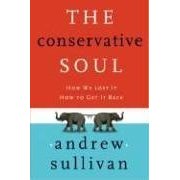
It is in this context that Andrew Sullivan's book, The Conservative Soul, is highly worth reading, both because of how revealing and frustrating it is at the same time. Sullivan was one of the very few conservatives who repudiated Bush and the Bush movement when Bush was still popular.


He did so based on the recognition that the Bush presidency never had anything to do with the Goldwater/Reagan "conservative principles" which one finds in textbooks and think tanks (but never in reality). Instead, the Bush movement is a rank fundamentalist and authoritarian movement which sought to vest virtually unlimited power in George Bush as Leader (and will do the same with its next Leader), and to expand, rather than contract, federal power in order to forcibly implement its view of the Good and to perpetuate its own power. That is what "political conservatism" in this country has become.

Sullivan's general critique of the Bush administration, and his specific complaint that it has fundamentally deviated from the abstract conservative principles to which people like Lowry profess fidelity, is both accurate and persuasive. Along those lines, Sullivan cites the borderline-religious belief in tax cuts, depicted not as sound policy but as a moral good, to be pursued "unrelated to any empirical context of consistent rationale," and thus imposed even in the face of suffocating deficits and the virtually unprecedented expansion of government spending.

And it was this same evangelical certainty in the movement's Rightness that not only led the administration to invade Iraq but to persist in the occupation and to insist that things were going well, even in the face of mountains of undeniable empirical evidence to the contrary:

In that worldview, what matters was the ideological analysis: good versus evil. What mattered was the assertion of the United States' right to act alone if necessary to defend its own security. What mattered was the zero-sum analysis that we had to choose between war against Saddam and a potential mushroom cloud in an American city. It was this rigid and abstract analysis that essentially abolished the idea that the war was subject to rational debate. . . . The fundamentalist makes his mind up instantly, makes the fundamental decision, and cannot, by necessity, stop short at a later date and ask himself if he's right. Such second-guessing undermines his entire worldview. It threatens his psychological core.

And this authoritarian mindset, as John Dean so ably documented, leads to all sorts of excesses and amoral behavior. As Sullivan put it: "Self-surrender to authority first; conscience and self-determination second."

So this is all well and good as far as it goes. Personally (and I'm aware that this is going to grate on a lot of sensibilities), I think Sullivan is an excellent writer and a commendable and insightful political thinker. As is evident from his book and his blog, he explicitly examines and frequently re-visits the first principles underlying his beliefs, which is why he is open to rational opposition and to changing his mind about his political views, even on fundamental questions. That is a trait that is all too rare.

That is what makes The Conservative Soul worth reading. It highlights the true philosophical and psychological roots of the Bush movement -- its first principles -- and reveals just how rotted those fundamentalist roots are. It does this as well as, if not better than, any other book has done. And it makes a unique and compelling case for the virtue of doubt, something from which anyone with strong political convictions would probably benefit.

As is true for many people who are driven by their passions, Sullivan himself is certainly prone to excessive, blinding emotion arising from his own self-righteous certainties. That is a flaw that has led him astray in the past into hysteria-based crusades and rather ignoble accusations against others who expressed certain political views, including anti-war and anti-Bush views which Sullivan himself has now come to embrace.

His admissions of error in that regard, while commendable, are less complete and repentant than one would like. He refers to his "analytical errors in the past few years" -- meaning, principally, his support for the war in Iraq specifically and the Bush presidency generally -- but then attributes those errors to a noble cause: "outrage at the atrocity of September 11."

But Sullivan was not merely wrong on the question of Iraq and related matters. He was really one of the leaders of the ugly lynch mobs which impugned not just the judgment, but the motives and patriotism, of Americans who did not succumb to the errors of judgment and raging hysteria which consumed Sullivan. And it's certainly understandable that some people, particularly those who were the targets of that bile, are unlikely ever to think positively about him.

On balance, though, I think the virtues of Sullivan as a political commentator easily outweigh his sins, and The Conservative Soul illustrates why. When he was cheering on George Bush and the Iraq invasion in 2002 and 2003, Sullivan was a virtual hero to Bush supporters. He was far and away the most popular right-wing pundit at the time, and he had a large and loyal constituency. He could have easily maintained and even expanded that popularity -- and preserved the material and other advantages which accompany it -- simply by adhering to his views.

But he didn't do that. He gradually recognized what the Bush movement really was and, as a result, turned on the President and repudiated the political movement which was his fan base. He did so even though he had to know that he would never really be welcomed by liberals, with whom he had been warring for a decade at least. Knowingly alienating oneself from one's core supporters, while being well-aware that it is likely to leave one isolated and without a real constituency, is a commendable act which requires courage. Courage is also required to publicly repudiate one's prior, emphatically advocated positions. That's something which most people, I think, would find very difficult, if not impossible, to do.

And, as an aside, because he has been such a polarizing figure, Sullivan's courage in other, even more important respects has been quite under-appreciated -- courage exemplified by being openly gay at a time when most people weren't, and as part of a political movement where that could only impede him; being one of the first public figures in America to openly disclose his HIV status and to talk openly about living with the virus; and advocating gay marriage long before it was anything remotely like a mainstream topic. Though most people have a strident and absolute view of Sullivan one way or the other, he is a complicated, intelligent, thoughtful and unpredictable political commentator -- open to modifying his views and admitting error -- all of which sets him apart -- and, I think, above -- the majority of the trite, standardized, lifeless pundits who dominate our political discourse.

* * * * * *

All of this brings us back to Rich Lowry and Newt Gingrich and the emerging deceit which the conservative movement is attempting to perpetrate. In contrast to the vast majority of so-called "conservatives" who loyally stood by and cheered on the Bush Presidency and the "disgraced" Republican Congress, there were a handful of conservatives who -- long before Bush's popularity collapsed -- were pointing out just how "un-conservative" the Bush movement was. Sullivan was one such person, along with people like Bruce Bartlett and Pat Buchanan and The American Conservative. And they were treated like blasphemers and pariahs by the Lowry/National Review/Gingrich/Weekly Standard conservatives, because the "Conservative Movement" became synonymous with the Bush Movement, and it therefore became impossible to repudiate the latter without being cast out of the former.

One of the principal flaws of Sullivan's book is that it speaks of "political conservatism" in a way that exists only in the abstract but never in reality. The fabled Goldwater/Reagan small-government "conservatism of doubt" which Sullivan hails -- like the purified, magnanimous form of Communism -- exists, for better or worse, only in myth.

While it is true that Bush has presided over extraordinary growth in federal spending, so did Reagan. Though Bush's deficit spending exceeds that of Reagan's, it does so only by degree, not level. The pornography-obsessed Ed Meese and the utter lawlessness of the Iran-contra scandal were merely the Reagan precursors to the Bush excesses which Sullivan finds so "anti-conservative." The Bush presidency is an extension, an outgrowth, of the roots of political conservatism in this country, not a betrayal of them.

All of the attributes which have made the Bush presidency so disastrous are not in conflict with political conservatism as it exists in reality. Those attributes -- vast expansions of federal power to implement moralistic agendas and to perpetuate political power, along with authoritarian faith in the Leader -- are not violations of "conservative principles." Those have become the defining attributes of the Conservative Movement in this country.

That is why the warnings from Sullivan and others that the Republican Party was acting in violation of "conservative principles" fell on deaf ears and even prompted such hostility -- until, that is, Bush's popularity collapsed. "Conservative principles" are marketing props used by the Conservative Movement to achieve political power, not actual beliefs. Sullivan's principal argument that the Bush presidency never adhered to conservative principles is true enough, but the same can be said of the entire American conservative political movement. That is why they bred and elevated George Bush for six years, and suddenly "realized" that he was "not a conservative" only once political expediency required it.

UPDATE: For a sense of just how much of a precursor the Reagan administration was with regard to the Bush administration's sheer lawlessness, I highly recommend this superb 1987 Bill Moyers documentary on the Iran-Contra affair (which features convict Elliot Abrams, a member of both administrations). Some of the parallels are quite astounding, really almost exact (h/t reader CW). Respect for the "rule of law" is, of course, included in the Pantheon of Conservative Principles.

George Washington and the Middle East

George Washington's 1796 Farewell Address is an amazingly prescient warning to the U.S. to avoid certain dangers with regard to foreign policy. As we become more and more entangled in the intricacies not only of regional politics in the Middle East, but also in the domestic political conflicts of virtually every significant Middle East country, it almost seems as though we have purposely set out to violate every principle of foreign affairs which Washington articulated:

Observe good faith and justice towards all nations; cultivate peace and harmony with all. Religion and morality enjoin this conduct; and can it be, that good policy does not equally enjoin it? . . . . .

In the execution of such a plan, nothing is more essential than that permanent, inveterate antipathies against particular nations, and passionate attachments for others, should be excluded; and that, in place of them, just and amicable feelings towards all should be cultivated. The nation which indulges towards another a habitual hatred or a habitual fondness is in some degree a slave.

It is a slave to its animosity or to its affection, either of which is sufficient to lead it astray from its duty and its interest. Antipathy in one nation against another disposes each more readily to offer insult and injury, to lay hold of slight causes of umbrage, and to be haughty and intractable, when accidental or trifling occasions of dispute occur. Hence, frequent collisions, obstinate, envenomed, and bloody contests.

The nation, prompted by ill-will and resentment, sometimes impels to war the government, contrary to the best calculations of policy. The government sometimes participates in the national propensity, and adopts through passion what reason would reject; at other times it makes the animosity of the nation subservient to projects of hostility instigated by pride, ambition, and other sinister and pernicious motives. The peace often, sometimes perhaps the liberty, of nations, has been the victim.

So likewise, a passionate attachment of one nation for another produces a variety of evils. Sympathy for the favorite nation, facilitating the illusion of an imaginary common interest in cases where no real common interest exists, and infusing into one the enmities of the other, betrays the former into a participation in the quarrels and wars of the latter without adequate inducement or justification.

It leads also to concessions to the favorite nation of privileges denied to others which is apt doubly to injure the nation making the concessions; by unnecessarily parting with what ought to have been retained, and by exciting jealousy, ill-will, and a disposition to retaliate, in the parties from whom equal privileges are withheld. And it gives to ambitious, corrupted, or deluded citizens (who devote themselves to the favorite nation), facility to betray or sacrifice the interests of their own country, without odium, sometimes even with popularity; gilding, with the appearances of a virtuous sense of obligation, a commendable deference for public opinion, or a laudable zeal for public good, the base or foolish compliances of ambition, corruption, or infatuation.

As avenues to foreign influence in innumerable ways, such attachments are particularly alarming to the truly enlightened and independent patriot. How many opportunities do they afford to tamper with domestic factions, to practice the arts of seduction, to mislead public opinion, to influence or awe the public council? Such an attachment of a small or weak towards a great and powerful nation dooms the former to be the satellite of the latter.

Against the insidious wiles of foreign influence (I conjure you to believe me, fellow-citizens) the jealousy of a free people ought to be constantly awake, since history and experience prove that foreign influence is one of the most baneful foes of republican government. But that jealousy to be useful must be impartial; else it becomes the instrument of the very influence to be avoided, instead of a defense against it. Excessive partiality for one foreign nation and excessive dislike of another cause those whom they actuate to see danger only on one side, and serve to veil and even second the arts of influence on the other. Real patriots who may resist the intrigues of the favorite are liable to become suspected and odious, while its tools and dupes usurp the applause and confidence of the people, to surrender their interests.

The great rule of conduct for us in regard to foreign nations is in extending our commercial relations, to have with them as little political connection as possible. So far as we have already formed engagements, let them be fulfilled with perfect good faith. Here let us stop. Europe has a set of primary interests which to us have none; or a very remote relation. Hence she must be engaged in frequent controversies, the causes of which are essentially foreign to our concerns. Hence, therefore, it must be unwise in us to implicate ourselves by artificial ties in the ordinary vicissitudes of her politics, or the ordinary combinations and collisions of her friendships or enmities.

One could, I suppose, debate the extent to which some of Washington's specific warnings are currently being ignored by our foreign policy and by our debates over that policy. But what seems beyond dispute is that our foreign policy is being driven by three principal goals -- (1) shaping, dictating and even changing (through various means) the governments of almost every Middle Eastern country that exists ("regime change" is a concise summary of the policy against which Washington most stridently warned); (2) what Washington called "inveterate antipathy" against a particular nation -- Iran -- notwithstanding its repeated efforts (all of which have been rebuffed by the Bush administration) to achieve rapprochement with the U.S.; and (3) equating hostility towards Israel with hostility, even threats, towards the U.S.

If one set out with the specific objective of creating a foreign policy in the Middle East that sought out as much as possible the dangers against which Washington warned -- "permanent, inveterate antipathies against particular nations, and passionate attachments for others" as well as "frequent collisions, obstinate, envenomed, and bloody contests" caused by "[a]ntipathy in one nation against another dispos[ing] each more readily to offer insult and injury, to lay hold of slight causes of umbrage, and to be haughty and intractable" -- one would end up with our current Middle East policy.

Monday, January 29, 2007

Our little Churchills

We've now arrived at the point where the White House and its followers reflexively characterize any criticism of the Leader's war of any kind as aid to the Enemy and an attack on our troops. They don't even bother any more to pretend that some types of criticism are "acceptable." It is now the duty of every patriotic American to cheer enthusiastically for the President's decisions. Anything else is tantamount to siding with the Enemy.

Yesterday, Hillary Clinton, whose criticism of the war has been as muted and restrained as can be, "accused President Bush of trying to pass the problems in Iraq on to the next president and described his actions as 'the height of irresponsibility.'" The White House's immediate response: that is a "partisan attack that sends the wrong message to our troops, our enemies and the Iraqi people." That's the only response the Bush movement now even bothers to make: those who speak against the Leader hate the troops and help the Enemy.

Here is Bill Kristol yesterday on Fox telling Sen. John Warner -- literally -- that his duty as an American and a Senator is to keep his mouth shut and cheer on the President's plan:

John Warner -- there's a great puff piece about my senator from Virginia on the front page of the Washington Post saying what do they want us to do in the Senate, do nothing? That's absolutely right. Absolutely right.

Support the troops. Appropriate the funds. Encourage them. Let Dave Petraeus have a chance to win this war. Don't pass a meaningless resolution that, as Joe Lieberman said -- on the one hand, it's non-binding so it's meaningless, but symbolically, it could only encourage our enemies.

That was preceded by courageous tough-guy Brit Hume's mockery of Chuck Hagel: "I would say there's one exception to that, and that's poor Chuck Hagel, who seems to -- who's getting grandiloquent about voting for a legislatively meaningless Senate resolution and calling it courage. That makes you kind of sad." And earlier in the show, Sen. Lieberman said -- again -- that anti-surge resolutions will "discourage our troops" and "encourage the enemy."

So Chuck Hagel needs courage lectures from Brit Hume, John Warner needs permission from Bill Kristol before he can express his views about the war, and we all need to listen to Joe Lieberman and the White House tell us that criticizing the Leader helps the Terrorists. These are the same people -- the President, Lieberman, Bill Kristol, the Fox warriors -- who never tire of dressing up in Winston Churchill costumes and spouting the only historical analogy they know in the most reductionist form possible ("Churchill = strong, war; Chamberlian = weak, anti-war; we must Be Churchill").

But Churchill would have recoiled -- he did recoil -- at their argument that criticism of the Leader and the war are improper and hurts the war effort. Churchill repeatedly made the opposite argument -- that one of the strengths of democracies is that leaders are held to account for their decisions and that those decisions are subject to intense and vigorous debate, especially in war. In January, 1942, Britian had suffered a series of defeats and failures (which Churchill candidly acknowledged and for which he took responsibility), and he therefore addressed the House of Commons and insisted that a public debate be held in order to determine whether he still had the confidence of the House of Commons in his conduct of the war (h/t MD):

From time to time in the life of any Government there come occasions which must be clarified. No one who has read the newspapers of the last few weeks about our affairs at home and abroad can doubt that such an occasion is at hand.

Since my return to this country, I have come to the conclusion that I must ask to be sustained by a Vote of Confidence from the House of Commons. This is a thoroughly normal, constitutional, democratic procedure. A Debate on the war has been asked for. I have arranged it in the fullest and freest manner for three whole days.

Any Member will be free to say anything he thinks fit about or against the Administration or against the composition or personalities of the Government, to his heart's content, subject only to the reservation, which the House is always so careful to observe about military secrets. Could you have anything freer than that? Could you have any higher expression of democracy than that? Very few other countries have institutions strong enough to sustain such a thing while they are fighting for their lives. . . .

We have had a great deal of bad news lately from the Far East, and I think it highly probable, for reasons which I shall presently explain, that we shall have a great deal more. Wrapped up in this bad news will be many tales of blunders and shortcomings, both in foresight and action. No one will pretend for a moment that disasters like these occur without there having been faults and shortcomings.

I see all this rolling towards us like the waves in a storm, and that is another reason why I require a formal, solemn Vote of Confidence from the House of Commons, which hitherto in this struggle has never flinched. The House would fail in its duty if it did not insist upon two things, first, freedom of debate, and, secondly, a clear, honest, blunt Vote thereafter. Then we shall all know where we are, and all those with whom we have to deal, at home and abroad, friend or foe, will know where we are and where they are. It is because we are to have a free Debate, in which perhaps 20 to 30 Members can take part, that I demand an expression of opinion from the 300 or 400 Members who will have sat silent.

I am not asking for any special, personal favours in these circumstances, but I am sure the House would wish to make its position clear; therefore I stand by the ancient, constitutional, Parliamentary doctrine of free debate and faithful voting.

Churchill then proceeded to give an account of the war and a defense of his strategic decisions (along with numerous admissions of grave error) far more detailed, substantive, lengthy and candid than any given by George Bush on any topic, at any time, during the last six years. He knew that he could and should continue in the war only if he had the support of the Parliament and his country for his decisions, and that support had to be earned through persuasion and disclosure. It was not an entitlement that he could simply demand.

Unlike our little Churchillian warriors today, the actual Churchill did not seek to stifle criticism or bully anyone into cheering for him by insisting that they would be helping the Enemy if they criticized him. To the contrary, he ended his 1942 address this way:

Therefore, I feel entitled to come to the House of Commons, whose servant I am . . . I have never ventured to predict the future. I stand by my original programme, blood, toil, tears and sweat, which is all I have ever offered, to which I added, five months later, "many shortcomings, mistakes and disappointments." But it is because I see the light gleaming behind the clouds and broadening on our path, that I make so bold now as to demand a declaration of confidence of the House of Commons as an additional weapon in the armoury of the united nations.

And several months earlier, in 1941, Churchill made the point -- in an address to the House of Commons -- that it would be absurd to turn Parliament into a mindless, rubber-stamping body given that parliamentary democracy was what England was fighting for in the war (h/t Sysprog):

The worst that could happen might be that they might have to offer some rather laborious explanations to their constituents. Let it not be said that parliamentary institutions are being maintained in this country in a farcical or unreal manner. We are fighting for parliamentary institutions. We are endeavouring to keep their full practice and freedom, even in the stress of war.

And, quite similarly, there is this letter from Abraham Lincoln, written while a member of Congress in 1848, to William Herndon (h/t FMD). Herndon had argued (echoing the claims from the White House and the likes of Joe Lieberman and Bill Kristol today) that the President had the unrestrained power to wage war against Mexico in order to defend U.S. interests regardless of the views of Congress or anyone else -- a view which Lincoln (accurately) found repulsive to the core principles of our political system:

But to return to your position. Allow the President to invade a neighboring nation whenever he shall deem it necessary to repel an invasion, and you allow him to do so whenever he may choose to say he deems it necessary for such purpose, and you allow him to make war at pleasure.

Study to see if you can fix any limit to his power in this respect, after having given him so much as you propose. If to-day he should choose to say he thinks it necessary to invade Canada to prevent the British from invading us, how could you stop him? You may say to him,--"I see no probability of the British invading us"; but he will say to you, "Be silent: I see it, if you don't."

The provision of the Constitution giving the war making power to Congress was dictated, as I understand it, by the following reasons: kings had always been involving and impoverishing their people in wars, pretending generally, if not always, that the good of the people was the object. This our convention understood to be the most oppressive of all kingly oppressions, and they resolved to so frame the Constitution that no one man should hold the power of bringing this oppression upon us. But your view destroys the whole matter, and places our President where kings have always stood.

The view of America as advocated by George Bush and his followers is as antithetical as can be even to the views of the individuals to whom they claim allegiance. They exploit historical events and iconic individuals as tawdry props, and they neither understand them nor actually care about their meaning. They turn them into cheap cartoons -- Churchill! Lincoln! America! -- drained of their actual substance and converted into impoverished, degraded symbols used to promote ideas that are the exact opposite of what they actually embody.

Churchill accomplished exactly that which Bush cannot manage -- namely, he convinced his country that the war he was leading was legitimate and necessary and that confidence in his war leadership was warranted. It's precisely because Bush is incapable of achieving that that he and his followers are now insisting that democratic debate itself over the Leader and the war is illegitimate and unpatriotic. One can call that many things. "Churchillian" isn't one of them. Nor, for that matter, is "American."

Sunday, January 28, 2007

Just "evolution in action"

(updated below - updated again)

Glenn Reynolds points to this article from The Independent which reports that a "leading Islamic doctor is urging British Muslims not to vaccinate their children against diseases such as measles, mumps, and rubella because they contain substances making them unlawful for Muslims to take." Reynolds' response:

JUST THINK OF IT AS EVOLUTION IN ACTION

I don't think there is any evolutionary theory that celebrates or finds purpose in the death of children as a result of stupid actions taken by their parents. This just seems instead like a good excuse for pointing out how primitive Muslims are and how they deserve death (what else does it mean to say "Just think of it as evolution in action"?).

And it would be one thing if the people at risk of death were the adults who refused vaccines for themselves on religious grounds, but what kind of person has this reaction to reading a story about the lives of children being endangered as a result of a denial by their parents of necessary medical precautions? "Evolution in action"? That's just deranged.

But beyond that, one does not need to go searching for isolated British Muslim doctors in order to find examples of the lives of children being endangered due to the religious beliefs of adults. Merck, among other pharmaceutical companies, developed a highly effective vaccine against the human papilloma virus (HPV) -- by far the leading cause of cervical cancer in women -- but an entire American political movement called "social conservatism" has been desperately trying to prevent its widespread approval -- or at least persuade parents not to have their daughters vaccinated -- because HPV is a sexually transmitted disease and they therefore believe that a vaccine will be seen as an endorsement of premartal sex:

A new vaccine that protects against cervical cancer has set up a clash between health advocates who want to use the shots aggressively to prevent thousands of malignancies and social conservatives who say immunizing teen-agers could encourage sexual activity. . . .

Groups working to reduce the toll of the cancer are eagerly awaiting the vaccine and want it to become part of the standard roster of shots that children, especially girls, receive just before puberty.

Because the vaccine protects against a sexually transmitted virus, many conservatives oppose making it mandatory, citing fears that it could send a subtle message condoning sexual activity before marriage. Several leading groups that promote abstinence are meeting this week to formulate official policies on the vaccine. . . .

The vaccine appears to be virtually 100 percent effective against two of the most common cancer-causing HPV strains.

And those opposing these vaccines are not isolated or fringe groups. Instead, they are the groups that lay at the core of the Republican Party, and have thus received high-level and influential appointments by President Bush, including positions that give them great power over health policy:

The jockeying reflects the growing influence social conservatives, who had long felt overlooked by Washington, have gained on a broad spectrum of policy issues under the Bush administration. In this case, a former member of the conservative group Focus on the Family serves on the federal panel that is playing a pivotal role in deciding how the vaccine is used.

"What the Bush administration has done has taken this coterie of people and put them into very influential positions in Washington," said James Morone Jr., a professor of political science at Brown University. "And it's having an effect in debates like this."

This is what one of James Dobson's doctors said in explaining opposition to the vaccine:

"Some people have raised the issue of whether this vaccine may be sending an overall message to teen-agers that, 'We expect you to be sexually active,' " said Reginald Finger, a doctor trained in public health who served as a medical analyst for Focus on the Family before being appointed to the ACIP in 2003.

And the Family Research Council had this to say:

In the US, for instance, religious groups are gearing up to oppose vaccination, despite a survey showing 80 per cent of parents favour vaccinating their daughters. "Abstinence is the best way to prevent HPV," says Bridget Maher of the Family Research Council, a leading Christian lobby group that has made much of the fact that, because it can spread by skin contact, condoms are not as effective against HPV as they are against other viruses such as HIV.

"Giving the HPV vaccine to young women could be potentially harmful, because they may see it as a licence to engage in premarital sex," Maher claims, though it is arguable how many young women have even heard of the virus.

Though the FDA finally approved the vaccine, social conservative groups continue to lobby for the right of parents to refuse the vaccine for their daughters and to advocate against the HPV vaccine, insisting that abstinence is the preferred course.

So, when American Christian girls die of cervical cancer in their teens and early 20s because James Dobson and the rest of the "social conservative" movement convinced their parents that giving them the HPV vaccine would turn them into sex-crazed whores -- and that it's therefore preferable to leave them vulnerable to a cancer-causing viral agent -- should we "just think of that as evolution in action" also?

And that's to say nothing of the unwanted pregnancies and cases of HIV transmission due to vigorous religious-based opposition to health programs designed to promote condom usage. When teenagers of Christian parents in the U.S. with no access to condoms have premarital sex and end up with HIV or other sexually transmitted diseases, should we "just think of it as evolution in action"?

What is really at play here is not hard to discern. If the deaths of children of devout Muslims should be considered nothing more than "evolution in action" -- something that is warranted, even deserved -- then we can start bombing them a lot more indiscriminately without much regret. That's just "evolution in action." Both the intensity and frequency of rhetoric like this directed towards Muslims -- whereby all sorts of theories are offered to justify their deaths -- are increasing rapidly.

UPDATE: As always, the point here is not Reynolds himself (who, like any specific blogger discussed here, is only illustrative). The important point is that Muslim-dehumanizing rhetoric of this type is becoming much more commonplace (that is the point, I believe, of the recent mini-controversy over Marty Peretz's blog of bigotry), and what that rhetoric is intended to justify is obvious. In that regard, one should compare Reynolds' commentary on this story to his notorious post from November, when he cited a reader e-mail and then added his own comments (emphasis added):

READER: The ball is in the Iraqis' court. We took away the obstacle to their freedom. If they choose to embrace death, corruption, incompetence, lethal religious mania, and stone-age tribalism, then at least we'll finally know the limitations of the people in that part of the world. The experiment had to be made.

REYNOLDS: . . . it's also true that if democracy can't work in Iraq, then we should probably adopt a "more rubble, less trouble" approach to other countries in the region that threaten us. If a comparatively wealthy and secular Arab country can't make it as a democratic republic, then what hope is there for places that are less wealthy, or less secular?

This is now an an emerging theme among war supporters looking for someone to blame for their disastrous war -- "we did everything we could for those people, but alas, they're too primitive and savage to take advantage of it, so it's time to start bombing them ("more rubble") with a clear conscience, knowing they brought it on themselves." If we do that, just think of it as evolution in action.

Some commenters have pointed out that, strictly speaking, the actions of a parent that result in the death of a child are part of evolution. Fair enough. But the point is that there are all sorts of comparable acts by American Christians and other religionists (including those above). Reynolds would never link to a story reporting on the death of a 19-year-old Christian girl who died of cervical cancer because James Dobson persuaded her parents to prohibit her from obtaining an HPV vaccine, and then say: "Just think of it as evolution in action." Reynolds' post reveals a way of thinking and speaking about Muslims that is, in equal parts, despicable and dangerous.

UPDATE II: Via Henry Farrell, this is about the most cogent explanation I have seen in awhile for what is going on with the anti-Muslim rhetoric arising out of the ash heap we created in Iraq. From Anatol Lieven's review in London Review of Books (sub. req'd):

One important aspect of Westad’s book is the complex connection he makes between the US and Soviet modernising projects and racism. While both regimes insisted on their right to dictate values and solutions to the benighted peoples of the Third World, both also claimed that those peoples were capable of adopting them, doing so rapidly, and thereby joining the ‘socialist community’ or the ‘free world’.

But because, in classic missionary style, both sides saw their truths as self-evident, their programmes as beneficial, and their own benevolence as beyond question, they often had no rational explanation to offer when their projects failed and their clients turned against them. In these cases, there was often an astonishingly rapid swing towards racist explanations. Currently, the neo-cons in America alternate between arguing that all Arab societies are capable of making rapid progress towards democracy (and that anyone who denies this is racist) and asserting that ‘Arabs understand only force.’"

That about sums up one of the most hopeless contradictions that lies at the heart of our neoconservative, warmongering missions -- the same people who want to convince us that they are doing nothing more than bringing peace, love, joy and freedom to the world with all of their bombings and invasions are also the first to insist that the people in the parts of the world we are invading are brute savages who get what they deserve.

That is how Reynolds went from piously accusing war opponents in 2003 of being "racist" for doubting whether we could export democracy to Iraq, to citing in 2006 the so-called "limitations of the people in that part of the world" as proof that the savages in Iraq are incapable of democracy and so it's time instead to start bombing. And when we do, we should just think of it as evolution in action.

Freedom is on the march

The following is a very revealing, and disturbing, video illustrating what is taking place in Baghdad (h/t Andrew Sullivan). The first part shows an almost exclusively Shiite group of Iraqi Army troops administering to handcuffed Sunnis what the watching, cheering American troops giddily refer to as the "Rodney King treatment." The second part documents various neighborhoods that were previously mixed with Sunnis and Shiites but which now are almost exclusively cleansed one way or the other:


And this morning's Guardian has an article featuring a "commander" of a Shiite militia (the Madhi Army) which earns great profit kidnapping and slaughtering Sunnis (even if their families pay ransom). The commander and his comrades "describe an intimate relationship with Iraqi security services, especially the commandos of the Iraqi interior ministry." They frequently go on their kidnapping and murder missions with security forces along for the ride, subordinate to the militia commanders.

So the best case scenario in Iraq -- what we achieve in the extremely unlikely circumstance that we accomplish our current, stated goals -- is to strengthen a government dominated by Shiite death squads and/or Iran.

Saturday, January 27, 2007

Public servant v. Military Commander

(updated below)

Garry Wills has an Op-Ed in the New York Times this morning criticizing the practice of constantly referring to the President as the "Commander-in-Chief":

The word has become a synonym for “president.” It is said that we “elect a commander in chief.” It is asked whether this or that candidate is “worthy to be our commander in chief.”

But the president is not our commander in chief. He certainly is not mine. I am not in the Army. . . .

The glorification of the president as a war leader is registered in numerous and substantial executive aggrandizements; but it is symbolized in other ways that, while small in themselves, dispose the citizenry to accept those aggrandizements.


Wills recounts that Dwight Eisenhower, "a real general," would not exchange salutes while President, because saluting was for those in the military, not civilian Presidents. The practice of presidential saluting was begun by Ronald Reagan, who -- like our current President -- loved ceremonial displays of warrior courage and military power even though (more likely: because) he had none in his real history.

The point Wills makes is an important one, but like most politically insightful points, my first exposure to this insight was in the blogosphere. Back in January, 2006, as part of its "reporting" on the NSA scandal, Newsweek's Evan Thomas and Daniel Klaidman labeled objections over President Bush's illegal eavesdropping program as "histrionics," and pronounced that "the debate was narrow and somewhat vacuous." After all, this was all that had happened with the NSA scandal:

The message to White House lawyers from their commander in chief, recalls one who was deeply involved at the time, was clear enough: find a way to exercise the full panoply of powers granted the president by Congress and the Constitution.

In response, Digby wrote (emphasis in original):

First of all, I'm sick of this bullshit about the president being the commander in chief all the time. This isn't a military dictatorship. Citizens, and even lawyers in the Justice department, don't have a commander in chief. We have a president. I know that's not as glamorous or as, like, totally awesome, but that is what it is. A civilian, elected official who functions as the commander in chief of the armed forces.

It was Digby's post which led me to include a passage on this topic in How Would a Patriot Act? (p. 84), and to note specifically that this was not some stylistic preference but a matter of constitutional division of powers:

Moreover, while President Bush's supporters are fond of referring to him as the "commander in chief" -- typically to insinuate that he should be beyond criticism or that his authority cannot be questioned, particularly in "times of war" -- the president under our system of government holds that position only with regard to those in the armed forces (see Article II, Section 2 of the Constitution: "The president shall be Commander in Chief of the Army and Navy of the United States"). With regard to Americans generally, the president is not our "commander" but instead our elected public servant, subject to the mandates of the law like every other citizen and subordinate to the will of the people.

This is much more than semantics. The constant, improper references to President Bush as "Commander-in-Chief" -- rather than what Theodore Roosevelt called "merely the most important among a large number of public servants" -- pervades the media and shapes how it talks about the President in all sorts of destructive ways. Just look at the January, 2006 Newsweek article on the NSA scandal to see the sickness that infects the perspective of those who see the President as the Supreme Military Leader.

According to Newsweek back then, there was nothing to be concerned about with regard to the President's lawbreaking and secret eavesdropping. Illegal eavesdropping was merely the by-product of a President "determined to stand tall in the war on terror" because he faced "a mortal yet invisible enemy." And Bush was doing what any Commander-in-Chief worth his salt would do: "a president will almost always choose to violate individual rights over the risk of losing a war." And what was the real worry which Evans and Klaidman had concerning the "histrionics" over the lawless NSA program? This:

The American public may be less than sympathetic to the targets of the Bush antiterror crackdown. But if the administration is shown to have violated the civil liberties of mainstream peace groups or (heaven forbid!) members of the press, the outcry could produce an overreaction. After the reformers got through with the intelligence community post-Watergate, Richard Nixon acerbically commented, "They cut the balls off the CIA." He was not entirely exaggerating.

These are journalists writing for one of our country's leading news magazines and they were mocking the concern that the Commander-in-Chief might abuse his secret and unlawful eavesdropping powers to spy on journalists ("heaven forbid!") . What the President ordered was merely an "antiterror crackdown" and the Commander-in-Chief was using all of his powers to protect the nation during War, as any good Commander does.

And, said Newsweek, if it did occur that the Commander abused his powers by eavesdropping on journalists and political opponents (and, just incidentally, we still don't know how the Bush administration used these secret eavesdropping powers, but one hopes we will be finding out soon), then their concern was not that it would constitute a grave abuse of power or threat to press freedoms. Instead, they were worried that such a revelation would "produce an overreaction" -- like the Watergate revelations did -- and take away too much of the Commander-in-Chief's powers.

These are journalists who lament Watergate -- not the break-in or the cover-up, but the revelations of that conduct -- because they "cut the balls off" the Commander-in-Chief (through emasculating measures such as oversight and the rule of law). That mindset -- President as War Commander -- leads directly to this, from Newsweek's Thomas and Klaidman:

The talk at the White House in the days and weeks after 9/11 was all about suitcase nukes and germ warfare and surprise decapitation strikes. . . .

Such chilling sights are not likely to inspire thoughtful ruminations about the separation of powers or the true meaning of the Fourth Amendment's ban on unreasonable searches and seizures. The message to White House lawyers from their commander in chief, recalls one who was deeply involved at the time, was clear enough: find a way to exercise the full panoply of powers granted the president by Congress and the Constitution. If that meant pushing the boundaries of the law, so be it. . . .

The Bush administration did not throw away the Bill of Rights in the months and years that followed; indeed, NEWSWEEK has learned, ferocious behind-the-scenes infighting stalled for a time the administration's ambitious program of electronic spying on U.S. citizens at home and abroad.

See, when you're the Commander-in-Chief, you can't afford "thoughtful ruminations about the separation of powers or the true meaning of the Fourth Amendment's ban on unreasonable searches and seizures." Lofty concepts like the "Constitution" and the "law" might be fine for effete law professors and whiny "histrionic" liberals to prattle on about, but a Commander-in-Chief -- "determined to stand tall in the war on terror" -- doesn't have time for those things, and that's understandable. He has a War to win, and he is therefore above such petty constraints. War is hell and all of that, and the Commander-in-Chief is our Leader in War.

Right after I read Wills' Op-Ed this morning, I just happened to read this article from Jonah Goldberg, expressing horror that Democrats did not stand and cheer loudly or frequently enough during the State of the Union, when the Leader -- to use Jules Crittenden's immortal words -- "address[ed] us . . . and show[ed] us the way forward." Jonah wrote:

But it is revealing. Indeed, the Democratic party's most honest moment Tuesday night came not in Webb's brusque words but in the Democrats' brusquer body language.

The president asserted that no one wants failure in Iraq. Understandably, the commander in chief wanted to avoid conceding how very real a possibility failure is, so he chose his rhetoric carefully. He spoke in the abstract about the bipartisan desire for victory and success.

And yet the Democrats for the most part sat on their hands, refusing to applaud, never mind rise in favor of such statements from a wartime president.

What kind of Americans don't "rise in favor" and cheer when their glorious Commander-in-Chief gives a war cry? To find the answer, let's turn the floor over again to Theodore Roosevelt, who apparently had some sort of future-travelling ability that enabled him to see and hear the Bush movement. Roosevelt, writing in the middle of a war, wrote:

[The President] should be supported or opposed exactly to the degree which is warranted by his good conduct or bad conduct, his efficiency or inefficiency in rendering loyal, able, and disinterested service to the Nation as a whole.

Therefore it is absolutely necessary that there should be full liberty to tell the truth about his acts, and this means that it is exactly necessary to blame him when he does wrong as to praise him when he does right. Any other attitude in an American citizen is both base and servile.

To announce that there must be no criticism of the President, or that we are to stand by the President, right or wrong, is not only unpatriotic and servile, but is morally treasonable to the American public.

In describing what he found "base and servile" -- not to mention "morally treasonable" and "unpatriotic" -- Roosevelt used words almost identical to those used by Jonah. Roosevelt said it was "base and servile" for someone "to announce that . . . we are to stand by the President, right or wrong." Jonah chided Democrats for failing to "rise in favor of such statements from a wartime president." Base. Servile. Unpatriotic. Morally Treasonable.

Most media flaws are so fundamental and systemic that they will take a long time to resolve, if they can be at all. But one quick, easy and critical step would be to cease speaking of the elected civilian President as our military Commander and instead treat him as the public servant that he is. There is no obligation or duty to support the President, fully including matters relating to war. Quite the contrary: he "should be supported or opposed exactly to the degree which is warranted by his good conduct or bad conduct, his efficiency or inefficiency in rendering loyal, able, and disinterested service to the Nation as a whole."

UPDATE: Jim Henley writes that he was posting about the improper references to the President as "Commader-in-Chief" all the way back in 2002, when virtually the entire country was paying homage to the President as monarch. And indeed Henley did make that point (emphasis in original):

The President is not “our Commander-in-Chief.” He is Commander-in-Chief of the armed forces. (You can look it up.) . . . If you ain’t in the uniformed services or the active duty militia, you ain’t got a commander-in-chief. It’s a republican thing, with a small ‘r.’

The very best kind.

By pointing to Digby's post, I was, of course, merely identifying the first time I read someone making this point, not purporting to identify the First Time Ever that it was made in the Whole World, though the fact that Henley was pointing this out as far back as 2002 only serves to bolster my claim that the "most politically insightful points" are typically found first in the blogosphere (though Henley has to then go ruin that point by admitting that he first encountered it in a 1991 book review in The New York Review of Books, also by Garry Wills, but that was The Pre-Blog Era).

Whatever its origins, this point is sufficiently clear, and it seems like a straightforward enough proposition that national journalists should have no difficulty ingesting it and adhereing to it.

Friday, January 26, 2007

Tale of two governments

(updated below)

Maher Arar is a computer engineer and Canadian citizen who was abducted by the U.S. Government in 2002 and sent to Syria for a year to be tortured despite having no terrorist ties of any kind. Back in September, the Canadian Government issued a report which concluded "categorically that there is no evidence to indicate that Mr. Arar has committed any offense or that his activities constituted a threat to the security of Canada."

Today, this is what the Canadian Government did about this grotesque travesty:

Canada's prime minister apologized to Maher Arar on Friday and announced the government would compensate him C$10.5 million (US$8.9 million) for its role in his deportation from the U.S. to Syria, where he was tortured while held in prison for nearly a year. . . .

"On behalf of the government of Canada, I want to extend a full apology to you and Monia as well as your family for the role played by Canadian officials in the terrible ordeal that you experienced in 2002 and 2003," Harper said. Arar and his wife, Monia Mazigh, and their young son and daughter now live in Kamloops, British Columbia.

"I sincerely hope that these words and actions will assist you and your family in your efforts to begin a new and hopeful chapter in your lives," Harper said, adding the compensation package would also pay for his estimated $1 million in legal fees.


Compare that to what the Bush administration has done to Arar as he sought some small amount of justice for having been wrongfully abducted and tortured by our government for almost a year:

Two lawsuits challenging the government's practice of rendition, in which terror suspects are seized and delivered to detention centers overseas, were dismissed after the government raised the secrets privilege.

One plaintiff, Maher Arar, a Syrian-born Canadian, was detained while changing planes in New York and was taken to Syria, where he has said he was held in a tiny cell and beaten with electrical cables. . . .

The United States never made public any evidence linking either man to terrorism, and both cases are widely viewed as mistakes. Arar's lawsuit was dismissed in February on separate but similar grounds from the secrets privilege, a decision he is appealing.

[The other case referenced there is that of Khalid El-Masri, a German citizen who alleges -- with the support of German prosecutors and the admission of the Bush administration -- that the U.S. Government abducted him, drugged him, flew him to multiple different torture-using countries (and shuttled him at least to Kabul, Baghdad, and Skopje, Macedonia) as part of the administration's "rendition" program, only to then release him after five months when the U.S. realized it had abducted the wrong person (El-Masri has a name similar to a suspected terrorist). The case El-Masri subsequently brought in our federal courts was also dismissed after the administration invoked the "state secrets" doctrine].

Not only did the Bush administration block Mahar's efforts to seek justice in our courts for having been abducted and tortured, but they continue to keep him on the no-fly list despite the whole case having been a mistake from the beginning and despite the increasingly angry protests from the Canadian Government. TPM Muckarcker has the details behind a letter sent last week by Attorney General Gonzales to the Canadians (TPM also has the conclusory, fact-free letter itself, insisting that the administration will keep Arar on the no-fly list).

The fact that the Bush administration simply refuses to remove him is generating significant tension with the Canadians. From the AP article:

Prime Minister Stephen Harper again called on the U.S. government to remove the Ottawa telecoms engineer from any of its no-fly or terrorist watchlists and reiterated that Ottawa would keep pressing Washington to clear Arar's name.

"We think the evidence is absolutely clear and that the United States should in good faith remove Mr. Arar from the list," Harper told a news conference in Ottawa. "We don't intend to either change or drop our position."

The report issued previously by the Canadian Government also concluded:

The American authorities who handled Mr. Arar's case treated Mr. Arar in a most regrettable fashion. They removed him to Syria against his wishes and in the face of his statements that he would be tortured if sent there. Moreover, they dealt with Canadian officials involved with Mr. Arar's case in a less than forthcoming manner.

By "less than forthcoming," what the Report is referring to is the fact that the "F.B.I. continued to keep its Canadian counterparts in the dark even while an American jet was carrying Mr. Arar to Jordan" because they knew the Canadians would object if they learned that their citizen was being sent by the U.S. to be tortured. So the Bush administration did it anyway and only told the Canadians afterwards.

Like the Jose Padilla case, it's difficult even to know what to say about this incident. I've written about it before, but one's anger is renewed each time there is a further development. There is absolutely no question that Arar is a completely innocent individual whom our government literally abducted and sent to be tortured -- for months, away from his family and everything he knew. Once this entire matter came to light, the administration simply dug its heels in further, insisting that national security required that his case be dismissed from our courts (which naturally obliged), and now -- almost out of spite and/or a pathological inability to admit error -- continues to keep him on its no-fly list.

This was the case that caused Pat Leahy to have a genuine and intense outburst of rage after Alberto Gonazles placidly recited his mindless buzzphrases to defend the administration's conduct here. It is hard to see how anyone doesn't have a similar burst of outrage when thinking about what our government has done, and continues to do, to Maher Arar (of course, the purposeful dehuminization of Arabs and Muslims allows us to not only bomb them free of any regrets, but also to subject them to treatment of this sort).

At least the Canadian Government seems to be run by people with a minimal sense of conscience and decency. The contrast with our own government, in this case at least, is depressingly glaring. A video regarding this case, including an interview with Arar, is here.

* * * * * * *

Welcome back, Jane Hamsher, reporting great news: "my doctors . . . tell me there's no reason I can't be in Washington DC on Monday morning, Febrary 5, sitting at the Prettyman courthouse getting ready to watch Dick Cheney sweat, just like I promised." On her blog, and watching Dick Cheney sweat, is where Jane belongs.

UPDATE: Via Attaturk and C&L, the Canadian report specifically recommended that the Canadian Goverment "review their policies governing the circumstances in which they supply information to foreign governments with questionable human rights records," and specifically urged that "information should never be provided to a foreign country where there is a credible risk that it will cause or contribute to the use of torture."

One of the most infuriating apsects of the Bush presidency and all of the complicity that has enabled it is that a rational person with pride in the history and values of the U.S. no longer has any basis for objecting to characterizaions like this of our country. Those descriptions aren't the by-product of some sort of reflexive anti-American sentiment or overwrought internationalist righteousness. They are just undeniably and objectively true characterizations of what our government has done. And it is infuriating to have to accept that.

The Meaning of Marty Peretz

(updated below - updated again)

I've written once before, several months ago, about the unbelievably overt anti-Arab/anti-Muslim bigotry that spews forth regularly from The New Republic Editor Marty Peretz, typically at his blog, Spine. The post I wrote was prompted by a particularly bizarre and factually false Peretz rant about how Muslims breed like rabbits because they're too "uneducated" to know that only small families can provide children with a loving environment.

In reality, one could write a post like that almost every day about Peretz. His blog, and apparently his political worldview, are devoted primarily to one argument -- that Arabs and Muslims are primitive savages and barbarians, and that the notion of a "moderate Muslim" or even a civilized Arab is all but a myth. The majority of Peretz's posts, with varying degrees of explicitness, is devoted to bolstering that claim.

I had not written more about Peretz because it seems as though there is some sort of tacit agreement that Peretz's hate-mongering won't be held against The New Republic, and that, for whatever reasons, Peretz will be accepted as a more or less mainstream figure despite spewing bigotry of the type one finds on white supremacist sites (albeit directed elsewhere). And since New Republic writers don't, to my knowledge, spout the same hate-filled diatribes, perhaps there was a sense that Peretz is even more irrelevant than the magazine itself and therefore does not merit any real discussion.

But now, an excellent article by Matt Yglesias discussing the highly dubious anti-semitism accusations launched against Wes Clark and others -- accusations fueled by Peretz himself and supported by some at The New Republic -- has led to a broader discussion of Peretz's overt bigotry. Specifically, Ygelsias has raised the question as to why Peretz's bigotry is met with such silence by New Republic writers, including those who diligently search high and low for any inferential hint of other forms of bigotry (particularly anti-semitism).

In response to Yglesias' question, TNR's Jonathan Chait -- one of those who was so deeply, deeply disturbed by Wes Clark's alleged anti-semitic comment -- yesterday leaped to his boss' defense, expressing shock that anyone would find Peretz's comments to be the least bit bigoted. To defend Peretz, Chait focuses on one post in which Peretz wrote that there could never be a "Muslim Martin Luther King" because "they'd break his windows. Imprison him. Or kill him. Finished." Chait insists that Peretz was merely saying "that most of the Muslim world is deeply illiberal" and that "seems indisputably true."

But as Yglesias pointed out, Peretz is "a man whose political opinions appear to be primarily driven by bigotry against Arabs and Muslims." It is hardly confined to that one post. In fact, last week I was almost prompted to write about Peretz again when I read this post:

Yes, I know: Muslims are nice cuddly people like the rest of us, the majority of them certainly. The problem is that at this moment in history you have to take the proposition on faith. No, not any particular faith, just faith.

So the world is divided into two categories: Muslims and "the rest of us." And while Peretz obligatorily parrots (really, mocks) the notion that Muslims are "nice cuddly people like the rest of us," he tells us that there is actually no evidence to support that claim. Therefore, one can only take it "on faith."

And here is Peretz explaining why he prefers the Berbers of Morocco over their Arab neighbors:

Some readers recall my posts about and from Morocco. It is a country I'be (sic) been to twice and a country I like. I've had a soft spot for the Berbers and for Berber culture.

The Berbers had been overwhelmed by Arab armies first in the 7th century, then in the 11th and finally after the 15th when Catholic monarchs of Spain threw the Muslims out of Andalucia. Berber comes from the same root as barbarian. But there is nothing barbarian about the Berbers. Their rugs and and especially their vases are so much more subtle than the glimmery (sic) ornate of their Arab neighbors.

Unlike "their Arab neighbors," Peretz assures us that "there is nothing barbarian about the Berbers." His evidence? The rugs they make are better than the loud, tacky ones which the Arabs churn out.

And here is Peretz explaining his theories about why Saddam Hussein was so evil:

But surely there are tests that could have been taken of Hussein about what makes for evil. A certain level of testosterone combined with certain genes. It's a promising field, these inquiries into the biological origins of cruelty.

The brutality of Hussein was due to "certain genes" and we should examine its "biological origins." Gee, I wonder what he means.

And his view of the Palestinians: "We see whom the Palestinians want as their savior. They want Saddam Hussein or, rather, his replica. That's why Palestine will be a wretched society, cruel, belligerent, intolerant, fearing, with no real justice (or justice system), and no internal peace." And what does Peretz think of Iraqis? The same thing, of course:

The Sunnis of Iraq were content with the tyrant's murderous rule. And, now, they must face Shi'a revenge. Which makes Shi'a Iraq also murderous and grotesque.

So, to recap, the Palestinians and Iraqis (at least the Sunnis and Shias) are collectively "a wretched society, cruel, belligerent, intolerant, fearing, murderous and grotesque." And Peretz's view of Arabs is by no means confined to the Middle East. Arabs are brutal savages wherever they go:

Dearborne [Michigan] is a largely Shia city, its Muslim population made up largely of Iraqi and Lebanese Shia. When Hezbollah was at war, the hearts of these Shi'a was with Nasrallah. Hate one madman, love another.

Here Peretz explains that Syria is so disgusting that diplomatic visitors can't bear to stay overnight and so they head to Jerusalem instead (emphasis in original):

John Kerry is back from Damascus. Apparently, there are no French restaurants left in the Syrian capitol. And, according to the country's Ministry of Tourism, there is only one first class restaurant in town. Maybe that's where Kerry and his companion, Chris Dodd, ate. Maybe not. And maybe they didn't stay overnight either. When Nancy and Henry Kissinger were doing shuttle diplomacy, they never stayed overnight. My guess is that even James Baker, so fond of Assad père, was content to retreat to the King David Hotel in Jerusalem every time dusk came.

Here is Peretz's response to suggestions that Israel negotiate with the Palestinians: "With which Palestinians? The ones who won't under any conditions negotiate with Israel except for a guarantee of the dissolution of the Jewish state? Or the other Palestinians who can't even run a post office?" Palestinians are either bloodthirsty murderers or stupid, inept fools.

And here Peretz mocks an article by The Boston Globe's Paula Broadwell in which Broadwell argued: "Equally as important, we should strive to give Muslim women across the globe other outlets for empowerment and the opportunity to contribute to countering terrorism in their societies." Nothing could be more absurd to Peretz than Broadwell's suggestion that we try to encourage Muslims to take advantage of opportunities and to oppose terrorism. After all:

If virtually entire Islamic societies have gone bonkers over jihad--not, mind you, the sweet personal struggle type--why should the women be different. Very realistic, Ms. Broadwell. I do hope you get your Ph.D. from Harvard's K School. And, then, given your balance and equanimity, James Baker might give you a job, along with the other fantasts he's employed. And you know a lot of them are women, too.

And finally, here Peretz attacks the claim by the NYT's Nicholas Kristoff that it is mere "stereotype" to depict Arabs and Muslims as violent, primitive savages. In response, Peretz demands to know:

So what are instances of the non-stereotype? Not certainly the desert Arabs. But the "maritime Muslims" who "have the edge." Who are these maritime Muslims? For one, they are the inhabitants of the Sultanate of Brunei, governed for six centuries by the same royals. He devotes four full paragraphs to Brunei. (Is that state as fabulous as Tom Friedman thinks Dubai to be?)

Is Brunei an instance of anything but Brunei? For God's sake, it has a population of barely 380,000 and one of the highest per capita incomes in the world. Desperate to bolster his idea of non-stereotypical Islam, Kristof dips into history. Haphazardly, as it happens, and also incorrectly. "These days, ferocious anti-Semitism thrives in some Muslim countries, but in the Dreyfus affair a century ago Muslims sided with a Jew persecuted by anti-Semitic Christians." Mr. Kristof, where did your research assistant dig up this nonsense?

Due to the Arab-Muslim character, Peretz insists that "the nation-state has failed utterly in much of the Muslim world" and his "guess is that they will never be nation-states. OK, not never. But not in a century or two, and maybe even three. Which means, come to think of it, not never, ever."

And those are all just from the last month or so. Pick any bundle of Peretz posts at random and you will find a series of claims that Arabs and Muslims are primitive and inferior and incapable of being civilized (the only thing one finds as commonly from Peretz are accusations of anti-semitism against people like Jim Baker and Wes Clark). At times, Peretz's method is the more indirect and commonplace one of implied argument by anecdote - the method used by, say, Charles Johnson, whereby he posts every single day virtually nothing but isolated stories in which Muslims (and nobody else) commit acts of violence, all in order to constantly re-enforce the idea that Muslims are inherently violent and primitive while allowing himself plausible deniability to claim that he never said any such thing.

Obviously, there is nothing at all wrong with discussing incidents of violence, including those committed by Muslims or Arabs. But when those are the only incidents one discusses to the exclusion of all others, and when one highlights those incidents over and over, there is obviously a point being made by the person engaging in that behavior. It would be as if someone created a website for the purpose of posting every story of every actual crime committed by African-Americans, or by Jews, or other minorities, but no others. There are such sites, of course, but one never hears about them, because they are white supremacist sites outside of the mainstream.

But Peretz, I guess to his credit, has more courage than people like Charles Johnson, in the sense that he barely bothers to hide, and at times clearly expresses, his view that Arabs and Muslims are generally and irreversibly primitive and violent. That's what renders so astounding and revealing Jonathan Chait's defense of Peretz, as well as the studied silence of TNR writers who search high and low for much more precarious and uncertain expressions of other types of bigotry.

Standing alone, Peretz is neither relevant nor entirely irrelevant. TNR is still considered in certain Beltway circles to be worth reading, and what is notable is that this is the case despite its being edited by such an overt bigot. I thought previously that this was attributable to the willingness to dismiss Peretz as some sort of idiosyncratic crank, but I actually think now -- particularly in light of Chait's defense of him -- that there is something more pernicious and significant going on here.

Tolerance for Peretz's explicit anti-Arab rantings -- set next to the extreme and pervasive outrage generated by much more precarious and inference-dependent accusations of other forms of bigotry (particularly, though not only, anti-semitism) -- strongly suggests that all sorts of sentiments which would otherwise be vigorously condemned are perfectly permissible when directed against Muslims and Arabs. That has been partially caused -- and exploited -- by the Bush administration's constant conflating of all sorts of distinct and disparate Muslim and Arab groups as "The Enemy," even though they have nothing in common other than the fact that they are Arab or Muslim.

The danger of tolerating such sentiments is underscored by The Washington Post's report this morning that the Bush administration has authorized and encouraged not merely the capture, but also the assassination, of Iranian military and intelligence officials inside Iraq, and that its actions are geared toward a broader Middle East agenda of stopping not just the Iranians, but also Hezbollah, Hamas and all sorts of other groups and issues wholly unrelated to Iraq and, for that matter, to the U.S. (Chris Floyd has a superb discussion of the real meaning of the Bush order).

That's the real significance of the blithe acceptance of the fact that The New Republic is led by someone who harbors -- and routinely expresses -- what can only be described as pure bigotry towards Arabs and Muslims. Those sentiments are the basis for many of the foreign policy views of the standard Bush follower and neoconservative, and to one degree or another, fuel many of the claims emanating from the White House about "The Enemy."

Peretz might express these sentiments a bit more nakedly than most others who share them, but his views are by no means unique to him. That is why they do not create anywhere near the controversy which they merit, and it's also why the tacit acceptance of Marty Peretz highlights some issues far more significant than Peretz himself.

UPDATE: From former TNR writer Spencer Ackerman, responding to Chait:

Jon. You know very, very well Marty, um, isn't really fond of the Arabs. For instance, he likes to flirt with descriptions of Arabs as subhuman. Everyone who works at TNR knows Marty is a racist. Don't make me tell stories. You shouldn't really be contesting this point with Matt. And, if you insist on it, you certainly shouldn't write about how someone else "wants to pretend he doesn't know that's the case."

This is the point. It is common knowledge that Peretz is an anti-Arab bigot. One barely needs to make the case because he makes it himself in almost everything he writes (I only documented it this extensively because Chait was denying it and because if an accusation of bigotry is made, it should be accompanied by proof -- something, incidentally, which Peretz and other casual purveyors of that accusation rarely provide)). Yet this well-known fact doesn't seem to generate many ripples. Peretz's magazine is deemed more or less acceptable and, in most mainstream circles, so is Peretz. The fact that such a well-known bigot can be so accepted in so many places obviously has meaning.

UPDATE II: To be fair, Peretz has made some enthusiastic fans since he began blogging. John Podhoretz called him "Rookie of the Year" and said: "You know who's a genuinely great blogger? Martin Peretz."

Days earlier, Podhoretz wrote a column for The New York Post lamenting that the West might be too burdened by "humanitarian concerns" to win wars in the Middle East, and further "pondered":

What if the tactical mistake we made in Iraq was that we didn't kill enough Sunnis in the early going to intimidate them and make them so afraid of us they would go along with anything? Wasn't the survival of Sunni men between the ages of 15 and 35 the reason there was an insurgency and the basic cause of the sectarian violence now?

Admiration for Peretz's views of Arabs and Muslims, and a desire for more unrestrained and indiscriminate slaughter in the Middle East, are not unreleated, to put it mildly. That is why tolerance for Peretz is so significant. If there is a prevailing view of Arabs and Muslims as hopelessly primitive savages, is it really all that bothersome if we slaughter lots of them? One could even say it's their fault for having brought it on themselves.

Thursday, January 25, 2007

Our Supreme General has spoken

(updated below - updated again)

There is nothing like a feeling of besiegement and desperation to make a political movement -- one that knows it is in its "last throes" -- show its true colors. The Supreme General-Commander has now decreed that any opposition to the "surge" helps The Enemy. Therefore, according to Bush followers -- beginning with the Vice President and moving down -- it is now the solemn duty of every patriotic American, especially those in Congress, to refrain from voicing any objections to the decision made by the Leader and the General. We must merely ask ourselves only one question: how can we lend the greatest support possible to our Leader's glorious plans? Everything else should be cleared away quietly and peacefully from our minds.

As usual, Bill Kristol was ahead of the authoritarian curve, last week proclaiming that war critics are "so irresponsible that they can’t be quiet for six or nine months." Yesterday, Party loyalist Hugh Hewitt unveiled what he and his comrades are calling "The Pledge" -- a creepy, Soviet-sounding declaration of loyalty, all based on Gen. Petraeus' decree, that vows to repudiate any Republican who opposes the "surge," and even refuses to donate to the NRCC unless they agree "in writing" that none of the contributions will go to any "surge" opponents. As Hewitt instructed:

Yesterday General Petraeus testified that the Biden/Warner resolutions and those like them encourage the enemy. . . . Don't believe me. Believe General Petraeus.

Bush followers across the Internet are now huddled in strategizing conference calls, and leading right-wing luminaries such as Glenn Reynolds have endorsed The Pledge. Reynolds' case is particularly instructive because, in order to defend the Leader and Don Rumsfeld, Reyonlds previously and continuously opposed sending more troops to Iraq, insisting that we had the exact right amount there. As but one example:

I think that calling for "more troops" is a way to criticize while not sounding weak, and that it thus has an appeal that overcomes its uncertain factual foundation.

But that was when the Leader said we had enough troops. Now, the Leader and the General have spoken, and that settles that -- now, not only do we need more troops, but it is unpatriotic to suggest otherwise. Yesterday, this is what Reynolds said when explaining the "rationale" for his support of The Pledge:

I think that Hugh's right to start this drive. Opposition to the surge is wrong (see what Petraeus said) and it's also political suicide for the Republicans.

Opposition to the "surge" is "wrong" because Gen. Petraeus said so, said that it would help The Terrorists. What is most notable about this duty of mindless submission to the General is that it emanates from the very top of the Bush movement. In his amazing interview with Wolf Blitzer yesterday, the Vice President dismissed away the notion that things were going badly in Iraq, but -- citing Gen. Petraeus' exchange on Tuesday with Joe Lieberman -- Cheney did identify the one truly grave threat that we face in this war: democratic debate:

Q How worried are you of this nightmare scenario, that the U.S. is building up this Shiite-dominated Iraqi government with an enormous amount of military equipment, sophisticated training, and then in the end, they're going to turn against the United States?

THE VICE PRESIDENT: Wolf, that's not going to happen. The problem that you've got --

Q Very -- very -- warming up to Iran and Syria right now.

THE VICE PRESIDENT: Wolf, you can come up with all kinds of what-ifs. You've got to deal with the reality on the ground. The reality on the ground is, we've made major progress, we've still got a lot of work to do. There are a lot of provinces in Iraq that are relatively quiet. There's more and more authority transferred to the Iraqis all the time. But the biggest problem we face right now is the danger that the United States will validate the terrorist strategy, that, in fact, what will happen here with all of the debate over whether or not we ought to stay in Iraq, with the pressures from some quarters to get out of Iraq, if we were to do that, we would simply validate the terrorists' strategy that says the Americans will not stay to complete the task --

Q Here's the Nouri al Maliki --

THE VICE PRESIDENT: -- that we don't have the stomach for the fight.

Q Here's the problem.

THE VICE PRESIDENT: That's the biggest threat right now.

Sectarian warfare? Militias and death squads? Sprawling anarchy and mass deaths? None of that is a problem. Everything is going great in Iraq -- everything, that is, except for one thing. The "biggest threat" is the debate taking place in the U.S. over whether our Leader is doing the right thing -- the true threat to the Glorious War in Iraq is Jim Webb's response to the Leader and Sen. Hagel's disobedience and Sen. Warner's criticisms of the Leader's plans and opposition to the war (shared by an overwhelming majority of Americans). That's what Cheney argued (and A.L. has an excellent discussion of the well-deserved problem for the Republican Party posed by the mindless loyalty to the President's war rhetoric which they have bred).

The idea that Americans should refrain from debating the propriety of using military force is about as foreign to our political traditions as anything can be. The Constitution -- while making the President the top General in directing how citizen-approved wars are fought -- ties the use of military force to the approval of the American citizenry in multiple ways, not only by prohibiting wars in the absence of a Congressional declaration (though it does impose that much-ignored requirement), but also by requiring Congressional approval every two years merely to have an army. In Federalist 26, this is what Alexander Hamilton said in explaining the rationale behind the latter requirement (emphasis in original):

The legislature of the United States will be obliged by this provision, once at least in every two years, to deliberate upon the propriety of keeping a military force on foot; to come to a new resolution on the point; and to declare their sense of the matter by a formal vote in the face of their constituents. They are not at liberty to vest in the executive department permanent funds for the support of an army, if they were even incautious enough to be willing to repose in it so improper a confidence.

As the spirit of party, in different degrees, must be expected to infect all political bodies, there will be, no doubt, persons in the national legislature willing enough to arraign the measures and criminate the views of the majority. The provision for the support of a military force will always be a favorable topic for declamation. As often as the question comes forward, the public attention will be roused and attracted to the subject, by the party in opposition; and if the majority should be really disposed to exceed the proper limits, the community will be warned of the danger, and will have an opportunity of taking measures to guard against it.

Public opposition is the key check on the ill-advised use of military force. In Federalist 24, Hamilton explained that the requirement of constant democratic deliberation over the American military is "a great and real security against military establishments without evident necessity."

Finding a way to impose checks on the President's war-making abilities was a key objective of the Founders. In Federalist 4, John Jay identified as a principal threat to the Republic the fact that insufficiently restrained leaders "will often make war when their nations are to get nothing by it, but for purposes and objects merely personal, such as a thirst for military glory, revenge for personal affronts, ambition, or private compacts to aggrandize or support their particular families or partisans. These and a variety of other motives, which affect only the mind of the sovereign, often lead him to engage in wars not sanctified by justice or the voice and interests of his people."

There are countries where citizens have a duty to affirm the Leader's decisions and submit to the Supreme General's decrees about war. The U.S. isn't one of those countries (although, revealingly enough, that belief in submission to the decrees of authority and infallabile wisdom of Supreme Leaders is one of the defining attributes of "The Enemy" whom we are fighting). But as usual, the dwindling band of authoritarian extremists propping up this presidency don't believe in American values of any kind. Those values are merely props they use to justify their endless wars and their endless demands that the Leader's will be followed.

UPDATE: In Comments, David says:

Senator Hagel's impassioned plea was refreshing and I don't know if I've ever seen a politician speak with such candor and passion. His Vietnam experience, as well and true conservative principles, were shining through.

In the past week Hagel has (1) claimed that the GOP is not the same party as the one he voted for on a tank in the Mekong Delta in 1967, and (2) made an almost tearful plea to his colleagues that to fail to honestly debate the "surge" when so many lives are at stake is to "fail" the country. While this is refreshing and entirely in line with the foundations of this country, what's troubling is this veteran's comments, rather than sparking a true debate, seem to have started a movement to purge him from the party and cut off his funding.

Like true Machiavellians, they are cutting off the head of the flower that dares to stick its head up, to set an example and quell any other "rebels."

So it looks like the "surge" plan is rapidly growing into a "purge" plan: you either agree with it or we remove your command and even accuse you of treason. You ask for a debate, claiming that you don't doubt the President's motives, and we develop a Loyalty Oath against you.

The Bush following warriors do always seem to reserve their most vicious and patriotism-impugning attacks for the veterans and combat heroes who disagree with the Leader. In his CNN interview, Cheney said several times that the only question is whether we have the "stomach for the fight" in Iraq. As always, it's just a matter of who has the courage and who doesn't.

Apparently, Dick "other priorities" Cheney has the sufficient courage for war, but Vietnam veterans Chuck Hagel (and Jim Webb and Jack Murtha and on and on) lack that courage, the "stomach." It's amazing how often it works out that way.

UPDATE II: It's been around the Internet for some time, but as Mona points out, this 1918 observation from Theodore Roosevelt, written in an Op-Ed for The Kansas City Star, couldn't be more applicable:

The President is merely the most important among a large number of public servants. He should be supported or opposed exactly to the degree which is warranted by his good conduct or bad conduct, his efficiency or inefficiency in rendering loyal, able, and disinterested service to the Nation as a whole.

Therefore it is absolutely necessary that there should be full liberty to tell the truth about his acts, and this means that it is exactly necessary to blame him when he does wrong as to praise him when he does right. Any other attitude in an American citizen is both base and servile.

To announce that there must be no criticism of the President, or that we are to stand by the President, right or wrong, is not only unpatriotic and servile, but is morally treasonable to the American public. Nothing but the truth should be spoken about him or any one else. But it is even more important to tell the truth, pleasant or unpleasant, about him than about any one else.

Base. Servile. Morally treasonable. That about covers it. And Roosevelt was writing in 1918, so he understood that the country would be at war sometimes. Just as is true for the framers of the Constitution, Roosevelt did not provide an exception to these principles for war time. If anything, the rationale behind Roosevelt's argument strongly suggests that this obligation and freedom to criticize the President is stronger, not weaker, when it comes to matters as consequential as war.

Wednesday, January 24, 2007

The toxicity of Joe Lieberman's treason accusations

(updated below - updated again with possible correction - updated again)

Joe Lieberman has probably become the single most poisonous Beltway voice when it comes to the war in Iraq. The Bush administration's principal rhetorical tactic for the last five years, of course, has been to equate opposition to its policies and criticism of the Leader with love of the Terrorists. But when it comes to the debate over Iraq, Lieberman -- time and again -- has managed to descend even further into the rhetorical sewer than the administration itself.

Lieberman, of course, spent several years warning Americans not to criticize their Leader with regard to the War. Just two weeks ago, Lieberman went on Meet the Press and prompted an angry outburst from Chuck Hagel after Lieberman sat there smugly accusing Hagel and anyone else who opposes the Glorious Surge of wanting the U.S. to lose in Iraq. In the same appearance, Lieberman also looked straight into the camera and said that the U.S. was "attacked on 9/11 by the same enemy that we’re fighting in Iraq today" -- a claim so transparently false that even the President long ago abandoned it.

But yesterday, Lieberman reached what might be a new low. During the confirmation hearings of Gen. David Petraeus, Lieberman provoked this truly reprehensible exchange with Gen. Petraeus, as summarized by The Washington Post's Thomas Ricks:

Sen. Joseph I. Lieberman (I-Conn.) asked Army Lt. Gen. David H . Petraeus during his confirmation hearing yesterday if Senate resolutions condemning White House Iraq policy "would give the enemy some comfort."

Petraeus agreed they would, saying, "That's correct, sir."

Using the terms to" give comfort" and the "enemy" in the same phrase has no conceivable objective other than to invoke accusations of treason. The Constitution's definition of "treason" is exactly that -- giving "Aid and Comfort" to the enemy. For Lieberman to purposely track the Constitution's treason language when describing opponents of the "surge" plan -- and to invite the new Iraq War Commander to agree with his accusation -- reveals so inescapably what Lieberman is. That's just the basest and most despicable smear one can imagine.

The Post also re-prints the response to this exchange from Sen. John Warner -- who, as a newly announced surge opponent and co-sponsor of one of the enemy-comforting resolutions in question, is now one of the many whom Lieberman is accusing of being "some" type of a traitor. Warner warned Petraeus of how ill-advised it is for Petraeus to associate himself with the toxic sentiments of Joe Lieberman:

I hope that this colloquy has not entrapped you into some responses that you might later regret. I wonder if you would just give me the assurance that you'll go back and examine the transcript as to what you replied with respect to certain of these questions and review it, because we want you to succeed.

Warner's response illustrates an interesting point. War opponents have been the target of smears of this type for years, beginning in 2002 when the country became intoxicated with Iraq war fever and every war opponent had their character attacked and motives called into question. Nobody seemed to mind too much back then.

But now the Washington Establishment has arrogated unto itself the right to oppose the war and criticize the President. As a result, many of the same groups and even same individuals who spent the last three years accusing war opponents of "undermining the Commander-in-Chief in a time of war" and thereby weakening America have themselves become vocal war opponents as the war lay in ruins (though it should be noted, from what I can tell, that Sen. Warner himself never engaged in that sort of smearing rhetoric and even expressly opposed it, one of the very few in his Party who did). What was subversive and unserious in 2002, 2003 and 2004 has now become perfectly acceptable, even noble, among the elite political and journalist classes.

The Washington Establishment has not only changed its view on the war, but has also -- not coincidentally -- dramatically changed its view on the propriety of opposing the President and his war, i.e. whether it's now allowed to do so. As the superb Jim Webb recently told Robert Gates at a recent Senate hearing:

There's really nothing that's occurred since the invasion and occupation that was not predictable and in fact, most of it was predicted. It was predicted in many cases by people with long backgrounds in national security...and in many cases there were people who saw their military careers destroyed and who were personally demeaned by people who opposed them on the issues, including members of this administration. And they are people in my judgment, who will be remembered in history as having had a moral conscience.

To Joe Lieberman, anyone who opposes whatever Iraq plan he happens to be currently favoring is a frivolous, defeat-hungry traitor -- giving "some comfort" to the "enemy." He's really the Senate's modern-day Joe McCarthy, smearing everyone's character and impugning everyone's motives who doesn't march faithfully along behind the President. What makes it all the more deceitful is that he never ceases to piously masquerade around as the Beacon of Civility and Honor, a disguise long propped up by an adoring Beltway media.

But now, Lieberman's behavior has become so toxic and ignoble that even decorous, restrained Senate Republicans -- no strangers to the art of the political smear -- have begun condemning him in unusually strong terms. What is more pernicious than for a politician, in a Senate hearing with the country's new top General in Iraq, to expressly equate disagreement with their war views with treason? Not much.

UPDATE: Relating to the last point about the shift in the rules imposed by the Washington Establishment, The Washington Post's Glenn Kessler this morning identifies numerous inconsistencies and incoherent claims in the President's speech last night. In particular, Kessler documents that "President Bush presented an arguably misleading and often flawed description of 'the enemy' that the United States faces overseas, lumping together disparate groups with opposing ideologies to suggest that they have a single-minded focus in attacking the United States."

Kessler's points are all correct and well-stated, but the article nonetheless provokes mixed feelings. None of the manipulative falsehoods which Kessler criticizes are new. These are the same tactics the administration has been using continuously for the last six years to bludgeon all of its opponents and to render all opposition subversive and pro-terrorist.

And while it is encouraging, I guess, that the media is beginning to point out these fundamental flaws more expressly, it's hard to avoid the conclusion that this scrutiny is due more to the President's pervasive unpopularity than it is to any re-awakening by national journalists with regard to their responsibilities. Kicking a President with Nixon-level approval ratings is easy. Americans have already figured out that the President is a fraud. The real need for this scrutiny was back when 70% of Americans cheered on the invasion -- and the subsequent occupation -- because they had been led to believe that it was Saddam who helped fly those planes into the buildings along with his good friend, Osama bin Laden.

UPDATE II: Several people in comments have noted that other media outlets have quoted Lieberman's question to Petraeus differently than it was quoted by Thomas Ricks in The Post -- specifically, some media outlets quote Lieberman as asking whether the resolutions would "give the enemy some encouragement" (and not, as Ricks had it, "comfort" to the enemy). But Sarah Wheaton, on her New York Times blog The Caucus, also quotes Lieberman's question as asking whether the resolutions “would give the enemy some comfort” (though it's possible she was using Ricks' article as her source for that).

I haven't found anything definitive yet, but I did receive an e-mail from a very reliable source from a well-known political/media group (whom I'll identify once I get permission), and he advises me that he obtained and listened to the video of the hearings and Lieberman used the word "encouragement" and Ricks therefore misquoted Lieberman. If that is so, then Lieberman's smear here is just the standard, garden-variety one used by war advocates to equate war opposition with helping The Terrorists, and not the more extraordinary version that purposely tracks the treason language from the Constitution. Once I have something more definitive one way or the other, I will post it.

UPDATE III: Whether Lieberman accused "surge" opponents of giving "comfort" to the enemy or merely "encouraging" them (and it looks increasingly like it was "encouragmenet," though still nothing truly definitive), Chuck Hagel's impassioned response applies just as potently -- not only to Lieberman, but to all of those war supporters who think that what is one of our country's greatest strengths -- the fact that we debate important issues, rather than meekly submit to the Leader's will -- is something we should suppress because the Terrorists are emboldened by our disagreements.

Tuesday, January 23, 2007

Investigating, rather than reciting, Bush claims re: Iran

(updated below)

Something odd occurred this week: Fox News -- spewing filth churned out by the lowest depths of right-wing innuendo swamps -- was "reporting" the two-pronged falsehood that Barak Obama attended a "madrassa" as a child and that it was Hillary Clinton's campaign which maliciously disclosed that story. There is, of course, nothing at all odd about any of that.

But in response, the national media -- rather than merely passing those accusations along -- decided instead to subject them to critical scrutiny, investigate the claimed basis for the accusations, found that there was no basis, and then reported that the story was completely unfounded. Or, to put it another way, they fulfilled their most basic and defining function as "journalists" by investigating, rather than reciting, other people's claims.

Encouragingly, the media is beginning to engage in a similar exercise concerning the President's war-pushing accusations towards Iran. And they are finding that those accusations have about as much basis as Fox's Obama/Hillary story did.

In his "surge" speech two weeks ago, the President claimed that "Iran is providing material support for attacks on American troops." As a result, he vowed: "We will disrupt the attacks on our forces. We'll interrupt the flow of support from Iran and Syria. And we will seek out and destroy the networks providing advanced weaponry and training to our enemies in Iraq." By all accounts, he intends to repeat that accusation and those threats against Iran in his State of the Union speech.

If this were 2003, every front page headline and lead-in to every television news programs would declare: "Iran responsible for attacks on U.S. troops." The more conscientious ones might add the phrase ", the President reveals." But all of the stories would contain one paragraph after the next asserting the administration's claims about Iran as fact, and would include no investigation of those claims or any real contrary assertions. That was government propaganda masquerading as "independent reporting" -- entire stories, day after day, published as fact based on nothing other than the claims of the government ("Bush officials said"; "senior administration officials today disclosed", etc. etc.).

But, at least in some notable places, the opposite is occurring with Bush's provocative Iran claims. Back in October, The Washington Post published an excellent article by Ellen Knickmeyer -- headlined: British Find No Evidence of Arms Traffic from Iran -- which detailed the fact that the British military in Southern Iraq, where one would expect to find evidence of Iranian arms traffic if it actually existed in any substantial form, has found nothing of the sort:

Since late August, British commandos in the deserts of far southeastern Iraq have been testing one of the most serious charges leveled by the United States against Iran: that Iran is secretly supplying weapons, parts, funding and training for attacks on U.S.-led forces in Iraq. . . . . There's just one thing.

"I suspect there's nothing out there," the commander, Lt. Col. David Labouchere, said last month, speaking at an overnight camp near the border. "And I intend to prove it."

Other senior British military leaders spoke as explicitly in interviews over the previous two months. Britain, whose forces have had responsibility for security in southeastern Iraq since the war began, has found nothing to support the Americans' contention that Iran is providing weapons and training in Iraq, several senior military officials said.

"I have not myself seen any evidence -- and I don't think any evidence exists -- of government-supported or instigated" armed support on Iran's part in Iraq, British Defense Secretary Des Browne said in an interview in Baghdad in late August.

Today, The LA Times published a similar article -- headlined: Scant Evidence Found of Iran-Iraq Arms Link. Detailing the (largely futile) efforts to find evidence of Iranian arms shipments in the Southern border province of Diyala (a highly likely locale for such activity, if it existed), the Times reports that while the U.S. military claims to have found some Iranian mortars and antitank mines in Iraq, "there has been little sign of more advanced weaponry crossing the border, and no Iranian agents have been found." The article added:

For all the aggressive rhetoric, however, the Bush administration has provided scant evidence to support these claims. Nor have reporters traveling with U.S. troops seen extensive signs of Iranian involvement. During a recent sweep through a stronghold of Sunni insurgents here, a single Iranian machine gun turned up among dozens of arms caches U.S. troops uncovered. British officials have similarly accused Iran of meddling in Iraqi affairs, but say they have not found Iranian-made weapons in areas they patrol.

The lack of publicly disclosed evidence has led to questions about whether the administration is overstating its case.

And, to the extent there is any evidence of Iranian involvement in Iraq, it is to aid Shiite factions (such as The Supreme Council for Islamic Revolution) which "are not those that have led attacks against U.S. forces. Instead, they are nominal U.S. allies."

The gradual revelation of the total lack of any credible evidence to support the Bush administration's claim that Iran is all but fueling a war on the U.S. inside Iraq coincides with increasingly absolutist claims by Bush officials that Iran is guilty of such acts. Here is what CIA Director Michael Hayden said at a recent Congressional hearing:

I've come to a much darker interpretation of Iranian actions in the past 12 to 18 months . . . There is a clear line of evidence that points out the Iranians want to punish the United States, hurt the United States in Iraq, tie down the United States in Iraq.

But when Bush officials claim they have "evidence" of Iran's violent behavior towards the U.S. in Iraq, what they mean by "evidence" is the same kind of "evidence" on which the pre-war Iraq claims of WMDs and Iraq-Al Qaeda alliances were based: namely, wild, unverified claims from Chalabi-like, AEI-touted, pro-Iran-war "sources" -- the kind who rant recklessly to Michael Ledeen and other warmonger pundits.

As Justin Raimondo pointed out, there is a critical difference between "intelligence" and "evidence." In the Bush world, "intelligence" includes "anything said by 'sources' no matter their credibility or agenda," and they then characterize those unverified claims as "evidence" (as in: "There is a clear line of evidence that points out the Iranians want to punish the United States, hurt the United States in Iraq").

But as was true for the administration's pre-war Iraq claims, they have "intelligence" but no "evidence" (despite extensive searching) to support what they hope are their pre-war accusations against Iran. And no rational person -- and, apparently, even fewer journalists this time around -- are going to accept Bush accusations towards Iran without "evidence."

While it is certainly encouraging to see national media outlets subjecting Bush claims to genuine scrutiny, that alone is not going to defuse the grave threat posed by the President's clear intent to confront Iran one way or the other. It is highly doubtful that the administration believes it can roll out some grand marketing campaign for a new war against Iran similar to the one it unleashed for Iraq. That is not what it is attempting here.

Instead, the administration wants to take a more circuitous route to creating a conflict with Iran -- by provoking the Iranians, contriving a pretext for an attack, fostering war-generating miscalculation, etc. These increasingly bellicose accusations against Iran are designed to create and fuel that climate. Exposing the utter falsity of the President's statements regarding Iran is an important and valuable exercise, but it is not sufficient to impede an American attack of some sort on Iran.

The President's desire for war with Iran doesn't depend upon convincing Americans and the Congress as part of some grand debate of the need for a new war. They know they can't achieve that. The plan depends upon the hope (and belief) that nobody and nothing can stop the administration as it finds a way to escalate what we are doing in Iraq until it gradually includes Iran.

The administration and its allies have already begun aggressively asserting that the President does not need Congressional authorization or anything else in order an outright attack on Iran. When it comes to their war plans, they don't care about public opinion anymore. For that reason -- as was amply demonstrated by the President's now already underway "surge" plan -- merely winning the public debate over Iran will not be anywhere near sufficient to impede the President's plans regarding Iran.

* * * * * * *
I will be on Air America with Sam Seder this morning at 9:20 a.m. EST to discuss the testimony of Alberto Gonzales last week before the Senate Judiciary Committee. Local listings are here and you can listen by audio feed here.

UPDATE: Via Steve Clemons, this is a somewhat disturbing (though not at all surprising) account from The Financial Times' Gideon Rachman of an event (attended by Rachman) held in Herzliyah, Israel in which Iran War fervor was everywhere (h/t Freedom). The participants included John McCain and Rudy Guiliani (by satellite) and, in person: Newt Gingrich, Ehud Olmert, Benjamin Netanyahu, Richard Perle, James Woosley, the State Department's Nicholas Burns, and the Defense Department's Gordon England. John Edwards will appear by satellite, too. Anyone who doubts that an Iran-U.S. military confrontation is possible should read Rachman's account.

Monday, January 22, 2007

The road to Iraq

(updated below - updated again)

Long-time Bush and Iraq war supporter John Warner today announced his support for a resolution opposing the President's "surge" plan. While looking for a document relating to Sen. Warner's announcement, I came across this transcript from March 6, 2003, where Warner appeared on CNN with Larry King, along with Sen. Chris Dodd and Bob Woodward, to talk about the imminent invasion of Iraq. I don't have any particularly new observations to make about this, but nonetheless, it really never ceases to amaze what was said during this time period.

The behavior of our political and journalistic elite in the lead-in to the war is truly one of the dark and shameful periods in our history -- truly embarrassing, even painful, to read:

KING: What if Saddam Hussein tonight in a fit of sanity decides he totally wants to cooperate. That's it. Whatever Bush ask for short of exile. What does he do?

WARNER: You asked me what does he say, and my reply to that would be, he has no credibility.

KING: But he can't -- that's nothing.

WARNER: But he could establish credibility with quick and prompt actions.

KING: Like.

WARNER: And they'd have to manifest themselves as compliance with the Security Council resolutions all of them. But especially 1441. I am going to disarm, here it, is go find it. Not hide-and- seek. . . .

You know, I asked George Tenet, CIA director basically what you just stated, and he's written a letter, it arrived in my office an hour ago. And he states, we have now provided all of the information that we could to the inspectors. Yet they have not uncovered anything.

Because Saddam Hussein from the very beginning after 1991, decided that he's going have to endure some type of inspection regime as he continues to build weapons and he's become very skillful to keep these manufacturing base of weapons of mass destructions active, mobile and beyond the ability of any inspections to really catch it. And this is proof of it. We've given them all the information, they can't find it.

KING: What's his purpose, he's inviting war. . . .

WARNER: The group of nations agreed on [the inspections], and I think Hans Blix tried to make it work. But he's been outsmarted.

That reasoning is so Orwellian it's actually scary, even four years later. The less evidence we found that Saddam had WMDs, the more that meant we had to go to war. That's because the failure of Hans Blix to find the weapons meant that Saddam had hidden them very deeply, nefariously and deliberately -- he had outsmarted Blix -- and that "proved" that Saddam harbored ill intentions, which meant we had to go to war against him, otherwise he would use those weapons against us. Warner actually used the word "proof" to describe the failure of U.N. inspectors to find WMDs - that was "proof" that WMDs had been hidden by Saddam.

And then there was this:

CALLER: Hello. This question's for the panel. What evidence, if any, is there that Saddam Hussein is linked to the 9/11 attacks in New York City?

KING: Bob, have they linked it?

WOODWARD: They have not. There has been some very fuzzy intelligence on that, but there's nothing substantial. And in fact, if you look at what Secretary of State Powell said at the U.N. on February 5 he never alluded to any connections between Iraq and 9/11.

KING: You agree, Senators?

WARNER: But apparently Saddam Hussein has links with a number of the terrorist organizations, including al Qaeda. Now whether it was a direct linkage to 9/11 has still not been established.

Saddam has links to Al Qaeda, but -- and this in March, 2003, -- whether he was involved in 9/11 was an open question. The linkage was supported by "fuzzy intelligence" but "nothing substantial" yet (said Woodward); whether there is a "direct linkage" (as opposed to indirect) has "still not been established" (yet) (said Warner).

Moments later, Warner and Dodd argued a little bit over the expected cost (both in terms of lives and money) of the war, and Bob Woodward chimed in with this:

No war is a walk in the park. And I served during Vietnam, and you learn that the unexpected always occurs. The military thinks they have a good plan. We obviously have much more sophisticated weaponry. We have better intelligence. There is talk about two-week war, three-week war. But who knows? . . .

In the midst of this lovefest -- that there is a certain partisan edginess here. That is probably going wind up not serving anyone particularly well, particularly if we get into. . .

The few efforts to debate whether this war was advisable were attacked -- including by journalists such as Bob Woodward -- as unfortunate "partisan edginess" which would not "wind up serving anyone particularly well."

One finds things like this in almost every media "debate" from that time. Any random selection will include some of the most profoundly erroneous, incoherent, and misguided claims, one after the next, from our most trusted political figures and journalists. The level of irrationality and sheer war intoxication which prevailed during that time is almost impossible to overstate. Despite all of that, this is how CNN's Dana Bash today described Sen. Warner (accurately) when reporting on his announcement: a “very influential voice when it comes to military matters.” Still.

UPDATE: The logic used by Warner was hardly unique to Warner. From the first paragraph of a January 15, 2003, CNN article, headlined Rumsfeld: Lack of Evidence Could Mean Iraq is Hiding Something: "The failure of U.N. arms inspectors to find weapons of mass destruction 'could be evidence, in and of itself, of Iraq's noncooperation' with U.N. disarmament resolutions, U.S. Defense Secretary Donald Rumsfeld said Wednesday."

Rumsfeld was often fond of pointing out that "an absence of evidence is not evidence of absence" (one of his many platitudes that made the media swoon), and that claim was applied to excuse away not only the "absence of evidence" concerning WMDs but also Saddam's ties to Al Qaeda. But in this rendition -- "The failure of U.N. arms inspectors to find weapons of mass destruction 'could be evidence, in and of itself, of Iraq's noncooperation'" -- Rumsfeld took a significant step further with that reasoning by actually arguing that absence of evidence could "in and of itself" be construed as the presence of evidence.

Not only did they not need evidence to start the war, but the fact that they had none actually proved -- "in and of itself" -- how urgent it was that the war be started (h/t R. Porrofatto).

UPDATE II: I didn't necessarily intend to host a little retrospective on misleading pre-war claims of war advocates, but we have had far too little of those, so why not proceed. One of the myths propagated by the political and media elite is that the false pre-war claims from Bush officials were comprised almost exclusively of claims about WMDs, which were in turn merely a by-product of "bad intelligence" and therefore excusable and understandable (at least in terms of judging those who advanced those claims).

But inducing a belief in the public that Saddam had WMDs was probably less important than inducing the belief among the overwhelming majority of Americans that Saddam played an active role in planning the 9/11 attacks. As Dover Bitch points out in Comments, this CBS News report from September, 2002 (when Congress was preparing to vote on the AUMF) highlights just how culpable the administration was in disseminating that total fiction:

"There clearly are contacts between al Qaeda and Iraq that can be documented; there clearly is testimony that some of the contacts have been important contacts and that there's a relationship here," [National Security Advisor Condoleezza] Rice said.

"We clearly know that there were in the past and have been contacts between senior Iraqi officials and members of al Qaeda going back for actually quite a long time," Rice said. "We know too that several of the (al Qaeda) detainees, in particular some high-ranking detainees, have said that Iraq provided some training to al Qaeda in chemical weapons development" . . . .

"No one is trying to make an argument at this point that Saddam Hussein somehow had operational control of what happened on Sept. 11, so we don't want to push this too far, but this is a story that is unfolding, and it is getting clearer, and we're learning more," Rice said.

As D.B. said: "As if there was a mountain of evidence that was just missing one or two tiny pieces to seal the deal. And all the momentum was moving towards that inevitable conclusion."

That might be one of the worst statements from any government official over the last six years, which is saying a lot. The fact that 69% of Americans -- 69% -- believed that Saddam was personally involved in the 9/11 attacks even as late as September, 2003 -- six months after the invasion -- is one of the most shameful political facts in our country's modern history. It is just a staggering fact. Deliberately misleading statements such as this one from Rice were designed to bolster those beliefs and they succeeded.

Sunday, January 21, 2007

Nancy Pelosi - "Damaged Goods"?

Before Nancy Pelosi was even inaugurated as Speaker, the super-smart Washington punditocracy had all but declared her an absurd failure -- a figure far too weak, vindictive and just generally ridiculous to be able to get anything done. After all, she backed Jack Murtha rather than Steney Hoyer for Majority Leader and decided she didn't want Jane Harman as Intelligence Committee Chair, so her whole Speakership had unraveled before it even began.

CNN's Wolf Blitzer spoke behind onscreen text that read: "Damaged Goods"? Blitzer inquired: "how badly is Nancy Pelosi damaged politically?" In U.S. News & World Report, Gloria Borger accused Pelosi of "demeaning" her "exalted position" and said she "look[s] like a girl eager to 'get back' at the guy she didn't like." MSNBC had a lengthy giggling session devoted to nothing but hilarious mockery over what a silly failure Pelosi was (as Digby, who watched that segment, put it: they "have just spent half an hour discussing the fact that Nancy Pelosi ruined her own honeymoon and now it is really questionable whether she can lead").

Slate's Timothy Noah decreed: "Let Pelosi remain speaker for now. But let her know that, before the new Congress even begins, she has placed herself on probation." Noah warned her: "One more strike—even a minor misstep—and House Democrats will demonstrate that they, unlike Speaker-elect Pelosi and President Bush, know how to correct their mistakes." And the very-in-the-know New Republic commentators agreed heartily that Pelosi's first week had been a "real embarrassment" and a "disaster" and fretted in unison: "How can Pelosi recover?"

On and on that went for weeks -- the hapless Democrats burdened with this vindictive, bitter woman who had alienated everyone with her petty bickering to the point where her "ability to lead" was in question. And all of that wisdom solidified in mid-November, almost two full months before Pelosi was even Speaker.

Now that she has actually begun, how do those prognostications look? About as good as the punditocracy's prognostications about Iraq. From AP today:

New House Speaker Shows She's Boss

Sworn in just over two weeks ago as the first female speaker of the House, Nancy Pelosi wasted no time showing who's boss.

The California Democrat rammed six major bills through the House at breakneck speed, stomped out smoking privileges near the House floor, partially sidelined a powerful Democratic committee chairman and decided she liked traditionally Republican office space so much she claimed it for herself.

By Democrats' timekeeping, she did it all in far under the 100 legislative hours she had allotted. . . .

Pelosi's initial agenda, completed Thursday, included measures with wide popular support: increasing the minimum wage, broadening stem cell research, allowing government bargaining on Medicare drug prices, cutting student loan costs, putting in place terrorism-fighting recommendations from the Sept. 11 commission and rolling back energy company tax breaks.

Each bill passed with bipartisan majorities and Pelosi triumphantly gaveled down the votes, at one point banging the gavel so enthusiastically that it left a small dent in the podium. . . .

Pelosi is held in higher regard than the president or her colleagues in the Congress. An AP-AOL News poll taken Jan. 16-18 put her approval rating at 51 percent — much higher than that of Congress (34 percent) or Bush (36 percent).

Rep. George Miller, D-Calif., a close ally, called Pelosi's performance "spectacular."

"What the Democrats in the caucus are telling me is that this is the best three weeks of their life," he crowed.

The article goes on to detail that even "Blue Dog" Democrats have nothing but good things to say about Pelosi, that she has been vigilant about complying with her various promises, and has even attracted the respect and compliments of various House Republicans, notwithstanding their being upset about their lack of influence:

Newly demoted Republicans have been able to do little but watch unhappily from the sidelines, echoing the complaint often made by Democrats during their 12 years in the minority: that they are being shut out of the legislative process.

Yet several GOP lawmakers said it hardly is surprising that Pelosi is flexing her muscles now that she is leading the Democrats' return to power.

"Speaker Pelosi worked a long time to earn this opportunity to be elected speaker, and she is totally enjoying her first month on the job," said Rep. Tom Reynolds, R-N.Y.

"It's not that she's the first woman, it's her style," he added. "She's a risk taker."

I wonder if Tim Noah took her off her two-strike probation yet.

The point here is not that Pelosi is the Greatest Speaker Ever. She has only been in office less than a month and any judgments about her Speakership would be absurdly premature (though less absurdly premature than the tidal wave of condemnations and even death sentences before she even began). But what is notable is just how vapid and ill-informed all of that chatter was that filled up the airwaves and conventional-wisdom-spouting newspaper and magazine columns for weeks and weeks after the midterm election.

As I wrote in November when the Pelosi-is-Damaged-Goods theme was in full force: "Nancy Pelosi, and really everyone, would be well-advised not to listen to them and, above all, never adopt as a goal trying to please or satisfy them. They are frivolous and out of touch with everything that matters and should be treated as such." Obviously, Pelosi has learned that lesson a long time ago and it has served her quite well. There really are few things less reliable and more wrong than the country's predominant pundit class.

Our country's tough guys and their moms and dads

Prompted by my post from yesterday about Bill Kristol and Fred Kagan, I want to raise an issue which I think receives far less attention than its significance warrants. Among the country's most influential neoconservatives, one finds extremely pervasive nepotism. Beyond that, a conspicuously high percentage of them have had their careers created, shaped and fueled by their parents. They have been dependent upon the accomplishments of their parents, especially their fathers, whose political views they end up reciting almost without deviation. Just look at the intertwined axis that spawned the two leading "surge" advocates, Kristol and Kagan:

Bill Kristol's parents are Irving Kristol, the so-called "godfather of neoconservatism," and Gertrude Himmelfarb, whose defining political act was a homage paid at the AEI to the virtues of Victorian morality. Bill followed in his parents' footsteps almost completely - the same career, the same political circles, the same exact political beliefs as his mother and father, and had his career shaped by them from the start.

Fred Kagan did exactly the same thing as Bill Kristol -- copied the career and mindset of his father. Just like Kristol's father, The Washington Post labelled Kagan's dad, Donald, "a beloved father figure of the ascendant neoconservative movement." Fred Kagan even went so far as to co-author a 2000 book with his dad entitled While America Sleeps: Self-Delusion, Military Weakness and the Threat to Peace Today, a book which -- pre 9/11 -- advocated many of the very same militaristic policies which today are "justified" by the 9/11 attacks. Fred Kagan's brother, Robert, is exactly the same as Fred and Bill Kristol. Along with Kristol, Robert co-founded the Project for the New American Century which, of course, spent the years prior to the 9/11 attacks urging regime change in Iraq, among other things.

This sprawling nepotism web goes on and on even as one descends to the lower levels of the neoconservative ranks of importance and influence. Jonah Goldberg's career was created and shaped by his mother, Lucianne, whose political beliefs he copies. He came to be known by attaching himself to his mom as she milked her role in the Lewinsky scandal (at the time, Jonah, 29, was "vice president" of his mom's company). John Podhoertz is a poor man's version of his dad, Norman, and his mom, Midge Decter, two of the most revered neoconservative figures around. White House neoconservative (and Iran-Contra convict) Elliot Abrams married one of Decter's daughters (from her first marriage), and one of his first key jobs in the neoconservative movement was when he was chosen by Norm Podhoretz, Decter's husband, to write for Commentary (Abrams was also a major contributor to (Bill) Kristol and (Robert) Kagan's PNAC).

In one sense, this is all just a strain of a general and I think rather damaging aristocratizing of our political process. Last month, Digby wrote extensively about this in the context of the Bush family, the catalyst for which was Digby's observation that a Bush family photo includes our current President, his brother the Governor of one of our largest states, their father the former President who, in turn, is the son of a former Senator. And that clan continuously uses its political power to propagate itself, exploiting its vast power network to strengthen the careers and wealth of its family members and continuously breeding new heirs to the throne.

It is true that neoconservatives and Republicans do not have a monopoly on the political exploitation of family connections. The Kennedys still pervade the political system at all elected levels, and the political careers of Jesse Jackson Jr., Andrew Cuomo, Bob Casey, Al Gore, and Harold Ford, Jr. -- to name just a few -- clearly benefited from the political accomplishments of their fathers. And Hillary Clinton's status as a leading presidential candidate is derivative, first and foremost, of the fact that she is married to a former President.

But the neoconservative attachment to and dependence upon their parents goes beyond mere exploitation of one's parents or other relatives for political career gain. So many leading neoconservatives end up following in their parents' footsteps -- remaining attached to them and becoming carbon copies of them -- to an extent that is quite unusual and clearly significant. To have the top level of an entire highly influential political movement be so dependent upon their parents for their careers and worldview seems, at the very least, to be worth some commentary.

Separation from one's parents is just a basic rite of passage of becoming an adult. In that regard, rebellion against one's parents is -- to invoke an emerging cliche -- a feature, not a bug, of adolescence. Repudiating control by one's parents and finding one's own way in life is a critical part of becoming a fully-formed adult, and so is an effort to have one's accomplishments exist independently of ones' mommy and daddy. Someone who decides to choose the exact same careers as their parents, fueled by their parents' friends and accomplishments, and who ends up reciting virtually the exact views of their parents, is someone who seems to be reliant on their parents in the extreme.

Rebellion for its own sake -- against one's parents or anything else -- is adolescent in nature and, if it doesn't balance out, is just as mindless as those who remain slavishly attached to their parents. And all of these dynamics exist as generalities with all sorts of exceptions. But in general, choosing to live in the shadows of one's parents -- where everything copies their path and is shaped and molded by them -- would seem to create very stunted and coddled personalities.

Many, perhaps most, of the leading neoconservatives don't seem to have arrived at their political worldview through much or any intellectual struggle or independence, nor do they seem to have had to make their own way in building their careers. Quite the opposite -- they seem to have been bred into their lives, and they just marched, like good little boys, along with their parents' views and plans for them. And they not only willingly accepted, but seem to have eagerly sought, all sorts of help from their parents in building their careers, all in exchange for fully embracing their parents' views almost without deviation.

It's rather ironic (and almost certainly not coincidental) that neoconservatives love, more than anything else, to strut around spewing tough-guy Chruchill warrior rhetoric and to sermonize on the virtues of self-reliance -- and are characterized in their political views by a total lack of empathy for the plight of others -- even though they have chosen extremely coddled, privileged lives feeding off the accomplishments and directives of their mothers and fathers. And quite significantly, the political Leader they found to represent their belief system, to personify their contrived warrior pose, and to implement their radical agenda -- George W. Bush -- is the most extreme version of that coddled and father-dependent personality one can find.

The embrace by the President of the "surge" plan of Kagan and Kristol -- father-controlled figures all -- is really nothing more noble or elevated than a petulant refusal to accept the consequences of their failure and responsibility for their actions. It's a foot-stomping exercise, whereby they feel entitled to satisfaction and personal vindication, and that personal desire trumps everything -- hence, their eagerness to ignore the damage they have wrought by inventing new war theories and fantasies to continue their wars that don't affect them in any way, for which only other people pay a price. It's the behavior of people who have developed an extreme sense of personal entitlement by virtue of allowing, even urging, their fathers and mothers to shape their lives far beyond what is normal or healthy.

I realize that there are some people who have an aversion to raising issues of this sort on the ground that it constitutes some sort of unknowable pop psychology and that one ought to confine oneself only to the substance of the "issues." I don't agree with that view at all.

It is glaringly apparent that the twisted and bloodthirsty tenets of neoconservatism which are dominating our country -- this insatiable craving for slaughter that is as endless as it is pointless, and an equally insatiable desire to expand the government power of their Leaders -- are not rooted in some rotted, coherent geopolitical doctrine as much as they are rooted in rotted personality disorders. All of that is sociopathic and authoritarian and those are phenomena far more psychological than political.

For that reason, the Bush Movement at its core -- the true, hard-core, reality-denying, warmongering, dead-ender True Believers -- is much more of a psychological movement than it is a political movement, and to ignore the former makes it impossible to understand or meaningfully discuss the latter. There is no reason to ignore the impulses and personality types of the people who for the last six years have governed, and continued to govern, our country, nor is there any reason to pretend that this all stems from sterile and elevated good faith political disputes when it doesn't.

Saturday, January 20, 2007

Bill Kristol and Fred Kagan's war games

(updated below)

In a new jointly written Weekly Standard article, Fred Kagan, the AEI think tank military genius behind President Bush's "surge" strategy, and Bill Kristol, one of the Chief Propagandists behind this war from the start, condemn Democrats for daring to question the military judgment of Gen. Petraeus, who agrees with Kagan and Kristol that more troops are needed:

Why, above all, would [Sen. Clinton] or anyone else imagine that it is appropriate for a committee of 535 people to micromanage a war by setting a precise (and arbitrary) figure for the number of soldiers the commander on the spot can deploy?

There is one man who should be recommending the size of American forces in Iraq, and that is the incoming commander, General Petraeus. Neither the Bush administration nor any collection of congressmen should preempt his professional evaluation of the situation and of the forces necessary to accomplish his mission. It is foolish and absurd for politicians to propose resolutions on American troop strength in Iraq before even hearing General Petraeus's voice in the debate. And when he has spoken, Senator Clinton and her colleagues should carefully weigh the burden they will take on themselves if they dismiss his advice.

So only blind obedience to the decrees of Gen. Patraeus is acceptable because he is the commander on the ground and thus Knows Best. And, of course, unquestioningly cheering on the "surge" plan is the only thing which responsible, serious and patriotic people would do:

Republicans should not hesitate to point out how irresponsible their Democratic colleagues (and some Republicans) are being. Senator Clinton's troop cap is dangerously foolish. The nonbinding resolution of disapproval Senator Biden has proposed is irresponsible. The fact is that President Bush has, as he was widely and correctly urged to do, changed strategy. He's put a new commander, General Petraeus, in charge. Petraeus thinks the new plan can work, with the support of additional troops. He'll be confirmed by the Senate and sent out to the theater this week. Members of Congress should ask themselves, "What can we do to help Petraeus succeed?" Or would Senator Clinton and the Democrats just as soon lose?

We have here the standard tactics of the warmonger -- namely, anyone who opposes Bill Kristol and Fred Kagan's latest video game fantasies are, by definition, unserious, irresponsible and want America to lose. But what is uniquely and appallingly dishonest about their new rhetoric tactic -- that we must all defer to the General -- is that Kristol and Kagan have spent the last two years, at least, insisting that Generals Casey and Abaziad, the commanders on the ground, had no idea what they were talking about because they resisted the neonconservative demands for escalation. Just last November, these twin warriors wrote:

Abizaid and Casey haven't rethought these views even as they've been mugged by the reality that lack of security does more damage than a heavy footprint, and that failure is more of a threat to responsible Iraqi behavior than dependency. But, just as important, they underestimate the changes that have occurred in Iraq since the February bombing of the Golden Mosque in Samarra--changes that threaten to unravel the successes achieved so far. In response to the clear fact that sectarian violence is unhinging the effort to turn responsibility for security over to the Iraqis, Abizaid simply demands an acceleration of that transition. This is a recipe for disaster.

In the same article, they went on to brand Abazaid's view as "wholly inadequate" and "unrealistic," insist that his optimism about the current strategy is "misplaced," and then unleashed this:

In fact, most serious people now concede we need more troops.

"Most serious people now concede we need more troops." Fathom the sheer quantity of self-delusion and rank disregard for the most basic constraints of truth-telling in order to make such a claim (and just incidentally, the use of term "serious" to mean "those who agree with my war views" has become one of the most potent indicators of mindlessness). But this is who has been running our foreign policy, and our wars, and still are. In fact, their grip on power is tighter than ever because they are the only ones who have not abandoned the President. And their ongoing loyalty is conditioned on the President's continued commitment to their twisted and bloodthirsty goals, not just in Iraq, but beyond.

Recall that, according to the neocon-friendly New York Sun, Bill Kristol was urging the White House back in September to obtain from Congress an Authorization to Use Military Force against Iran when the Republicans still controlled Congress, and he even argued that doing so was the only way to swing the election in favor of the Republicans. The people who want a surge are the same people who want a war against Iran, and the latter is what is driving the former. It is all part of the same worldview and agenda and it is one the President has embraced. Here is Kagan last August in an AEI article where he first laid out his "surge" plan in detail:

The United States has ground and air forces stationed on both the western and eastern borders of Iran at a time of crisis over Iran's nuclear programs. In principle, that presence should give the United States leverage in Tehran; the Iranians clearly feared this in the immediate wake of the invasion of Iraq in 2003.
But the oft-repeated American determination to withdraw from Iraq and Afghanistan as rapidly as possible, together with the continuing violent insurgencies in both countries, has turned the tables. . . .

As we consider the alternatives, with the possibility of conflict with Iran ever on the horizon, it would be well to ensure that we are not overlooking the option that would best serve our strategic needs.

The military establishment, the political establishment, the American public, and increasingly elected officials in both political parties have abandoned this war and oppose the surge. The war -- literally -- is basically being run by a handful of war-hungry extremist ideologues out of the American Enterprise Institute who are driven by an insatiable appetite for endless war on various Middle Eastern countries and little else. They are backed up by Weekly Standard and Fox News (starring John McCain and Joe Lieberman), and that is all that's left -- a tiny band of fringe war-obsessed extremists who are highly unrepresentative of the American public. But that is more than enough to ensure the pointless, wasteful, and tragic continuation, even escalation, of this war because they are the ones to whom the President listens.

The same people who spent the last many months, if not longer, urging the replacement of Casey and Abazaid because of their foolish, ignorant and misguided resistance to the Glorious AEI Escalation Plan now say that the only patriotic and responsible thing to do is to blindly accept the judgment of the Commander on the Ground (who was appointed as such because he agrees with escalation) and that the only thing to do is to ask oneself how to be most loyal to "his" plan.

The reason our foreign policy has been so incoherent, amoral and bloodthirsty is because the people behind it are. And until Democrats and other opponents of this extremist group commit themselves to stopping them and figuring out how to do that (and so far, at least, they've done neither), nothing will deter them in their insane militarism.

UPDATE: Greg Djerejian deconstructs the incoherence and series of internal inconsistences in which Kagan's "surge" plan is grounded. What Djerejian really demonstrates is that treating Kagan's surge as some sort of "plan" to win the war is to give it far more credit than it deserves. None of the details or even "substance" of the plan matter. Its only real objective is to provide an excuse for continuing the war ("hey, we found a great new plan to succeed! You owe us a chance to try it") and, more importantly, to ensure that we continue to increase, rather than contract, our military presence in the Middle East. As long as that is achieved, nothing else matters, which is what accounts for Kagan's embrace of multiple contradicatory premises.

Also, on an unrelated note, Jane Hamsher has long been one of my favorite people in the blogosphere and one of the most impressive bloggers around. I think she personifies the ethos of the blogosphere -- genuine and intense passion accompanied by sophisticated insight and the willingness (and ability) to develop knowledge of the nuts and bolts of political issues which surpasses that of any commentators anywhere. You probably know that Jane is battling her third bout of breast cancer, and doing so with predictable fortitude.

No matter how strong someone is, that is an extremely difficult battle, and here is one way to support the work Jane and FDL do. And a new publishing company created by Jane and Markos Moulitsas has just published a new book by blogger and Plamegate expert Marcy Wheeler which I read in galley form and which -- particularly in light of the imminent Lewis Libby trial -- I highly recommend as the definitive account of that scandal.

Thursday, January 18, 2007

The Grave and Epic War -- Spending time with Alberto Gonzales, Orrin Hatch and Russ Feingold

The inanities one observes when watching Congress in action exceed those which one finds anywhere else on the planet outside of the right-wing blogosphere. At today's Senate Judiciary Committee hearing to which I am currently (and quite temporarily) subjecting myself, starring Alberto Gonzales:

Orrin Hatch spent the first two minutes of his time "questioning" Gonzales by lauding Gonzales' extreme integrity and diligence during this Grave and Epic War on Terrorism that America faces, explaining that everything they've done is critical to protecting us and describing the time in which Gonzales is Attorney General as one of the most difficult and important in history -- Hatch emphasized that he means not only U.S. history, but in the history of the whole, wide world. That is really what he said. He did not ask one question about anything the DOJ is doing with regard to this Most Important Matter Ever.

Hatch then spent the rest of his time (all 6 minutes) demanding that Gonzales and the Justice Department devote much more of its resources and attention -- including FBI agents, other law-enforcement resources and a new task force -- to enforcing anti-obscenity laws against people in the U.S. who produce pornography, particularly those who sell it over the Internet, and urged that whole new laws be created to criminalize Internet pornography. Hatch praised the anti-pornography law passed last year called "The Adam Walsh Act" (guided through Congress by its main sponsor, Republican Congressman Mark Foley), but then insisted that whole new laws and far more substantial efforts were required to battle the perverse and destructive wickendness of sex films. Gonzales assured him they were devoting many investigative resources to enforcing obscenity laws.

Or, to put it another way, the Terrorists pose such a grave danger to our Republic that it is the most threatening and important time Ever, justifying whole new expansions of government power and total government secrecy in order to protect us and to win this War because the Terrorists want to kill us all, and our law enforcement resources should therefore be poured into imprisoning people who make adult films and putting an end to pornography. That's what Orrin Hatch said today.

* * * * * * * *

This is what I have learned so far: All of the Senators are very "concerned" and sometimes even "disturbed" about many things, almost all of them different for each Senator. Gonzales definitely shares their concerns about everything, and assures them he takes it very seriously and he is happy to sit down with them and explore ways to fix/improve/think about it.

For any information the Senators want, Gonzales does not have it, but he will definitely endeavor to get it for them. When pointed out that he has made the same promises many times before and told them nothing, he assures them them he is working diligently to get it, but that it is a very complex matter, and they are entitled to it and will have it (sometimes he politely denies ever having promised it before but then says he will get it anyway).

Sen. Feingold is starting now so I am hoping matters will take a more susbtantive and consequential turn.

* * * * * * * *

Feingold began by pointing out that the administration, including Gonzales, has many times accused opponents of the "Terrorist Surveillance Program" -- meaning those who insisted that eavesdropping take place within the law, within the FISA framework -- of "opposing eavesdropping on terrorists" (I can find 20 examples in 5 minutes of that).

Feingold's first question - "do you know of any one in the country who opposed eavesdropping on terrorists?"

Gonzales: Sure - if you look at blogs today, there is a lot of concern about all types of eavesdropping, who don't want us eavesdropping at all.

Feingold: Do you know anyone in government who ever took that position?

Gonzales: No, but that is not what I said.

Feingold: It is a disgrace and disservice to your office and the President to have accused people on this Committee of opposing eavesdropping on terrorists.

Gonzales: I didn't have you in mind or anyone on the Committee when I referred to people who oppose eavesdropping on terrorists. Perish the thought.

Feingold: Oh, well it's nice that you didn't have us "in your mind" when making those accusations, but given that you and the President were running around the country accusing people of opposing eavesdropping on terrorists in the middle of an election, the fact that you didn't have Congressional Democrats in "mind" isn't significant. Your intent was to make people think that anyone who opposed the "TSP" did not want to eavesdrop on terrorists, even though that was false. No Democrats oppose eavesdropping on terrorists.

Gonzales: I wasn't referring to Democrats.

So, apparently, all those speeches Bush officials and their supporters have spent the last year giving accusing people of opposing eavesdropping on terrorists, and all the television commericals making the same accusations throughout the months leading up to the election, were not about Democrats at all, but were about random bloggers who are against all eavesdropping. Where? Maybe on Smirking Chimp and Democratic Underground. That is who they meant when they were talking about opposing eavesdropping on Osama bin Laden. They didn't mean Democrats in Congress. The entire campaign and all of those accusations were directed only to the bloggers who don't want them eavesdropping at all.

I confess to finding that exchange deeply revolting though satisfying at the same time. Can't they just all yield all of their time to Feingold?

* * * * *

Their chat ended with Gonzales solemnly assuring all Americans that even though the "Terrorist Surveillance Program" has ended, they are still engaging in full-scale eavesdropping and, as a result, Americans are "no less safe" today than they were before.

In response, Feingold pointed out the painfully obvious -- that that was the whole point all along -- that there was no need whatsoever to eavesdrop outside of FISA and the adminstration's claims that our security depended upon FISA-violating eavesdropping was completely and entirely false.

* * * * *
Schumer begins by making clear that he is not satisfied with this FISC agreement - he says "Clearly, 'the agreement' is better than 'Cheney,' but we don't know what 'this agreement' is."

First question - Do you continue to believe that you have the right to eavesdrop outside of FISA ? You said you did have that power still, so what stops you from just starting to eavesdrop outside of FISA again a month from now?

Gonzales: What we did in the past was lawful.

Schumer: Then you can, at will, just as you instituted this program, you could just go back to it if you get a decision you don't like.

Next question: Is the FISC order you got a case-by-case basis order, a program-wide basis, or something broader? If it is a very broad-brush approval, it doesn't do any good. There is no way to compromise security interests by answering the question.

Gonzales: I am not at liberty to talk about those specifics. To do so requires disclosure of operational details. What I will tell you is that everything is in compliance with FISA. All members of the House and Senate Intelligence Committee have been briefed.

Schumer: Sen. Rockefeller said you didn't brief him. Even Republicans have said in newspapers that the briefing was inadequate and that these are program warrants, and we have to assume that they are program warrants, and it doesn't do anything to satisfy constitutional protections. Are there any specificity in these warrants?

Gonzales: I can tell you everything complies with FISA (i.e., I won't tell you anything).

Schumer: You claim it took you two years to negotiate these new FISA rules. That was more time than you took to plan the war on Iraq. Why would it possibly have taken so long to get these rules in place if you were really trying?

Gonzales: It's very, very complex. It took a long time. We've been trying the whole time to find a way to get it into FISA.

Gonzales keeps saying that they gave these great briefings to everyone on the Intelligence Committee about the new FISA process, but here is what the Times reported this morning:

The administration said it had briefed the full House and Senate Intelligence Committees in closed sessions on its decision.

But Representative Heather A. Wilson, Republican of New Mexico, who serves on the Intelligence committee, disputed that, and some Congressional aides said staff members were briefed Friday without lawmakers present.


I know the answers from Gonzales seem comically non-responsive, even robotic, but I am fairly summarizing them. That is how he testifies - he comes prepared with a menu of empty, platitudinous buzzphrases that he repeats over and over no matter the question. They really could easily devise a very simple Alberto Gonzales Testifying computer program. He doesn't have very many phrases in his arsenal so nothing more complex than DOS-era technology would do the trick, literally.

Leahy said they were going to try to get the FISC order from the head FISC judge and pointed out that Gonzales keeps saying how great the briefings were but everyone who was briefed said they learned nothing (just as was true for everyone who watched these hearings). He also pointed out that all of this doesn't obscure the fact that "the law is the law." They definitely seem angry and diligent, but we'll see if that is followed up by real action.

* * * * * *

What seems to have happened is that they convinced one single FISA judge whom they like to sign a broad, sweeping Order allowing them to do everything they were doing before but declaring it all to be in compliance with FISA. That is why the Committee Democrats are so eager to get the Order. But, as Schumer pointed out, they could just start eavesdropping without FISA warrants again any time they want because they continue to insist that they have that power. And if they did, we would never know (unless someone told Jim Risen again).

That seems like a very compelling reason why the court should continue to decide whether they, in fact, broke the law. The question is not moot even though they are claiming to have stopped warrantless eavesdropping because the conduct in question is both capable of reptition and likely to evade review (because it will be done in secret).

I also think Gonzales has made them sufficiently angry that it will ensure investigations into the program, engendering battles to get information about what they are doing now and, most importantly, what they did before. The administration, needless to say, has not changed one iota as a result of the election and they will not change one iota unless they are forced to. It remains to be seen whether Democrats are up to that.

* * * * * *
I was on Democracy Now this morning with Amy Goodman briefly talking about these matters and the transcript is available here. I also have an article in Salon today concerning the FISA story which is, in essence, a summary of the two posts I wrote about it yesterday.

* * * * * *
The one important fact which I neglected to mention was that Gonzales -- in order to placate Hatch's deep and intense pornography "concerns" -- proudly touted what he called "the Girls Gone Wild prosecution," the epic criminal case where the DOJ prosecuted the producer of that series for failing to keep his paperwork in compliance with the onerous document provisions imposed by one of Mark Foley's many new pornography laws.

So in the middle of the Epic, Overarching, Greatest and Most Important War of Civilizations of this Time and Any Other Time, Alberto Gonzales and Orrin Hatch spent their time at a Congressional hearing designed to exercise Justice Department oversight talking solmenly about Girls Gone Wild.

* * * * *

The Washington Post's Dan Froomkin finds some excellent examples where the President previously (a) insisted that he could not protect the country if he were forced to eavesdrop within the FISA framework and (b) accused Democrats -- not bloggers, but Democrats -- of opposing eavesdropping on terrorists:

"When it comes to listening to the terrorists, what's the Democrats' answer? It's, just say no. When it comes to detaining terrorists, what is the Democrats' answer? Just say no. When it comes to questioning terrorists, what's the Democrats' answer?

AUDIENCE: Just say no!"

The claim that people who opposed warrantless eavesdropping were "opposed to eavesdropping on terrorists" was always an outright lie - one of the very, very few times I have ever applied that term when analyzing or arguing political debates. To say that Democrats (and other critics of the "TSP") opposed eavesdropping on terrorists is not spin. It is just a lie. Democrats favored eavesdropping on terrorists, which is what FISA permits. And the administration knew that. Yet they continuously said otherwise.

And now that Gonzales has to face the people whom he and his Leader falsely accused, he cowardly claims that he never meant them at all, but instead was only referring to some random unnamed blogger who supposedly opposes all eavesdropping, even on The Terrorists. Pretending that the accusation wasn't directed at Democrats when he has to answer them face-to-face is as cowardly as the original accusations were dishonest.

Wednesday, January 17, 2007

Nothing to celebrate

(updated below - updated again with correction)

My specific analysis of the legal and political issues surrounding the FISA story is here, but I want to make one broad point. Having read around the blogosphere and elsewhere, what emerges is that there is no way to discern exactly what this new framework is between the administration and the FISA court because the only evidence describing it is Gonzales' letter, which is quite vague in a number of respects about exactly what has happened.

But ultimately, there are only two options -- (1) the administration is now complying fully and exclusively with FISA when eavesdropping, in which case all of its prior claims that it could not do so and still fight against The Terrorists are false, or (2) the administration has changed its eavesdropping program some, but it is still not fully complying with FISA, in which case nothing of significance has changed (at least on the lawbreaking issues) because the administration is still violating the law.

The FISA court and the administration cannot reach an agreement for proceeding that deviates from the FISA law itself. So it is only one or the other of the two options, neither of which reflect well on the administration.

Having said that, I have to say that I find the celebratory tone that I have seen here and there to be quite odd and unwarranted. There is nothing to celebrate here. We shouldn't be grateful when the administration agrees to abide by the law. That is expected and required, not something that occurs when the King deigns that it should and we then celebrate that he has agreed to comply with the laws we have enacted. Moreover, the administration has been violating the criminal law -- i.e., committing felonies -- for the past five years in how they have been eavesdropping on us.

I know that everyone except for the shrill, partisan hysterics has all implicitly agreed that it's impolite and overheated to talk about the criminality involved here -- "hey, whatever the President did, he had a good faith basis for doing (after all, there are lawyers who say so!) and, anyway, he just did it to protect us" -- but the President has been breaking the criminal law on purpose and systematically because he wanted to.

The fact that he might have decided he should stop -- now that his loyal servants no longer control the Congress, a federal judge already ruled he violated the Constitution and the criminal law, an appellate court was about to hold arguments about that decision, and there might actually be consequences now springing from his behavior -- does not excuse his lawbreaking in the slightest and must not be allowed to shield him or anyone else from accountability.

There is no repentance here, nor (more importantly) is there any rescission of their claimed powers of lawbreaking. Quite the contrary. Gonazles' letter affirms, as one would expect, their belief that they were legally entitled to violate this law. That means (a) that they can violate it again at any future point when they want to, (b) they can violate other laws under the same theories, and (c) whatever other lawbreaking is already occurring as a result of those theories is not going to stop.

This "reversal" merely proves what we already knew -- that there was never any legitimate reason to violate FISA in the first place, and that all of the claims about how they had to in order to stop The Terrorists were complete fiction (claims which, just incidentally, they tried to use to win the last election; if you wanted to make them comply with FISA, it meant that you loved the Terrorists).

But this is the same President and the same administration wielding their same theories of lawbreaking and oozing disregard for any limitations on their power. This seems designed to placate anger and to make everyone believe that our crisis is over. In our gratitude that the President relented, we're all supposed to forgive and forget.

They have been doing this all along. Every time they are about to face consequences for their conduct, they stop doing what they are doing and find another way. When the Supreme Court was about to rule on the legality of their detention of Jose Padilla, they transferred him to a criminal court and finally charged him, then told the court that the questions were "moot." When the Supreme Court in Hamdi ordered them to give Hamdi (a U.S. citizen) a venue to charge him with a crime and prove his guilt, they simply let This Extremely Dangerous Terrorist go free instead of charging him.

This is what they do and how they always operate. They have not conceded anything and they have certainly not done anything which mitigates their lawbreaking -- their crimes -- over the past five years with regard to eavesdropping without warrants.

UPDATE: Or, as a pleasantly (surprisingly) clear-thinking and resolute Chuck Schumer put it, from Salon's Tim Grieve:

Sen. Chuck Schumer takes a significantly different tone in a statement of his own, saying that Bush's decision "flies in the face of the fundamentals of American justice, which, when the balance of power is divided, require that these things should be done with full debate, and with full review." Schumer says the Gonzales announcement "can give little solace to the American people, who believe in the rule of law and ask for adequate judicial review. And why it took five years to go to even this secret court is beyond comprehension."

It sounds like Schumer might have decided to stop listening to the Beltway Democratic geniuses who kept telling them that they have to let the President break all the laws he wants and trample all over Congress otherwise Americans will think they are weak.

UPDATE II: Sen. Schumer is not a member of the Judiciary Committee that will be hearing from Attorney General Gonzales tomorrow, but as Senator Feingold is. Here is Feingold's reaction (via e-mail):

For more than five years, the President has conducted an illegal program, including more than a year during which he publicly asserted that this violation of the law was absolutely essential to protecting the public from terrorists. I am pleased that the President has been forced to return to the law and that this program has been terminated.

I continue to have many questions about what the Foreign Intelligence Surveillance Court has decided and intend to scrutinize carefully how the Court has interpreted the FISA statute. In addition, while I welcome the decision to stop conducting surveillance without judicial approval, the President now needs to respond fully to legitimate congressional questions about the complete history of this now-terminated illegal program.

As Feingold (unsurprisingly) recognizes, the President's claimed willingness to abide by FISA from now on does not even slightly obviate the need for a full-scale investigation into the last five years of illegal eavesdropping activities (and he's also right that much more information is needed about this still quite vague "agremeent" between the FISA court and the administration).

The reason we don't allow Presidents to eavesdrop without judicial oversight is because when Presidents were free, pre-FISA, to eavesdrop in secret, they invariably abused that power -- all of them. Therefore, it only stands to reason that having enacted a law (in response to these discoveries of abuse) which permits broad eavesdropping but only with judicial oversight, and having learned that the President disregarded that law and instead eavesdropped on Americans in secret (for five years), it is imperative that we find out whether that power was abused.

UPDATE III: Orin Kerr, among others, is speculating that perhaps the FISC-Bush agreement means that the FISA court has given its approval to the warrantless eavesdropping program as a whole -- i.e., that it has ruled that the "Terrorist Surveillance Program" (as is or in some slightly modified form) is authorized by FISA and that the FISA court need not scrutinize individual, case-by-case warrant applications. Instead, so this suggestion goes, the FISA court has simply given its blessing to the entire "TSP" by ruling that the program, in its current form, meets the requirements of FISA (Kerr excitedly lauds this possibility as "a very clever move by the DOJ"). Others who (unlike Kerr) are not impressed but angered by that manuevering also think that is a possibility (and Wired's Ryan Singel has what perhaps appears to be the most likely possibility -- along with some astute analysis -- here).

Kerr (and everyone) is simply speculating about what happened, as he acknowledges, but it is a possibility. As I indicated, the only evidence we have of what happened here is Gonzales' letter and it is quite vague (there is also Tony Snow's "responses" on this issue in his briefing, which were completely bereft of substance and add nothing helpful).

What is important to note is that if this event had happened in January, 2006 -- rather than January, 2007 -- we would never know what the secret FISC-Bush agreement was, because the Congressional Republicans would not have wanted to know -- they'd be perfectly happy, even grateful, to be kept in the dark -- and they would have prevented any inquiry. But they have now been removed from power (in part because of their gross abdication of their oversight responsibility). As a result, the administration will not be able to keep their secret little deal secret for long. We don't need to speculate about it because, as a result of the last election, we have a semblance of open government again and we will learn soon enough what really happened here. That is what Feingold means when he says "intend[s] to scrutinize carefully how the Court has interpreted the FISA statute."

Though Kerr can barely contain his delight (see below) at the prospect that this whole thing is one big illusory concession because all that happened was that the FISA court approved of the TSP (he gives four reasons why such a move would be so "very clever"), Congress isn't going to just sit passively by (the way it has for the last six years) and allow the President free rein over the country.

If what happened here is what Kerr is hoping -- some sort of agreement to give broad authority to the President's plainly illegal program -- then that is an agreement which would be plainly inconsistent with both the letter and spirit of FISA. Congress will have many options in that case and it seems clear, at least from the reactions of Feingold and Schumer, that the agreement which Kerr thinks is such a "very clever move by the DOJ" will -- if that is really what happened -- prompt more problems for the administration than it solved.

UPDATE IV: Kerr emailed to say that my statement above -- in which I indicated that he would be "delighted" if the agreement is what he speculated it to be -- was inaccurate, because he believes such an agreement may violate FISA and, if that were so, he would not support it. My belief that he seemed to support the agreement was based upon his praise for its cleverness, but one can find something to be "very clever" and still oppose it. He is right that there was no real basis for concluding that he would be "delighted" by that outcome, so I rescind that characterization of his views and apologize for the inaccuracy.

In a new post, he also offers an alternative theory, based on a DOJ briefing -- that "it sounds to me like the FISA Court judges have agreed to issue anticipatory warrants" (whereby the court agrees in advance that where "a specific set of triggering facts occurs," eavesdropping is permitted). Such a framework would seem unnecessary given the 72-hour window for warrantless eavesdropping, and would also seem to conflict with FISA (the premise of which is that a court should oversee the eavesdropping itself and scrutinize the claimed need, not simply promulgate standards and leave it to the Executive to interpret and apply them), but we should know soon enough once Gonazles testifies what the basis for this agreement is.

FISA and the President -- together again

(updated below - updated again - and again)

Everything I know about the FISA story is contained in this AP article, which I just read, and in this letter from Attorney General Gonzales to Senators Leahy and Specter. Writing full analytical posts is not something that my put-upon, book-addled brain is going to permit today, so I will rely upon the comment section to learn the answers to these questions:

(1) Why couldn't the new rules simply have been instituted years ago, as part of a newly amended FISA (which the administration requested and obtained from Congress in 2001 and which Congress repeatedly asked to do multiple times both prior and subsequent to revelation of the President's lawbreaking)?

(2) If, as Attorney General Gonzales claims, they were seeking to develop new rules as early as the Spring of 2005 to enable eavesdropping under FISA, why didn't they say so when the controversy arose over their lawbreaking?

(3) For those who claimed that our national security was jeopardized and that The Terrorists were given our state secrets when The New York Times revealed that the President was eavesdropping without warrants, didn't Alberto Gonazles just "give the terrorists our playbook" by telling them how we are eavesdropping, i.e., that we are doing so with warrants?

(4a) Could they possible think that this "concession" (what we call "obeying the law") is going to forestall or preclude Congressional investigations into all of the eavesdropping they have been doing over the last five years without anyone watching?

(4b) And relatedly, is this magnanimous assent to comply with the law supposed to relieve them of the consequence from their lawbreaking?

(4c) And related further, are they now going to tell the Sixth Circuit that there is no reason to bother with figuring out if Judge Diggs Taylor was correct when she ruled that the President violated both the Constitution and the law by eavesdropping on U.S. citizens without the warrants required by law?

UPDATE: In January, 2006, current CIA Director and former NSA director Michael Hayden warned that even discussing eavesdropping issues helps the Terrorists because it reminds them that we eavesdrop:

GEN. HAYDEN: You know, we've had this question asked several times. Public discussion of how we determine al Qaeda intentions, I just -- I can't see how that can do anything but harm the security of the nation. And I know people say, "Oh, they know they're being monitored." Well, you know, they don't always act like they know they're being monitored. But if you want to shove it in their face constantly, it's bound to have an impact.

And so to -- I understand, as the Reverend's? question just raised, you know, there are issues here that the American people are deeply concerned with. But constant revelations and speculation and connecting the dots in ways that I find unimaginable, and laying that out there for our enemy to see cannot help but diminish our ability to detect and prevent attacks.

Alberto Gonazles said this repeatedly, too -- that merely by raising the issue of eavesdropping, we remind the Terrorists that we eavesdrop. As a result, the ones who forgot that we eavesdrop won't make the calls that they otherwise would have made to talk about their plots, and we won't know what they're doing and we won't be able to catch the Terrorists. That's how the administration explained how our national security had been so gravely harmed by the Times article that "told" the Terrorists that we were eavesdropping without warrants.

Yet here the administration is -- not just reminding the Terrorists that we eavesdrop but detailing their new eavesdropping procedures in public.

UPDATE II: There is one crucial point (at least) that reveals the core falsity behind the administration's claims today. Contrary to their central point, their complaints about FISA were most assuredly not confined merely to procedural obstacles -- i.e., that the process of obtaining warrants was too slow and cumbersome. They complained as much if not more about the substantive requirement under FISA for obtaining a warrant - i.e, they claimed that the requirement to show "probable cause," rather than mere "reasonable basis" (the standard under their illegal program), meant that they could not do the eavesdropping they needed to do in order to stop The Terrorists. Here is an exchange from Hayden's Press Briefing:

HAYDEN: The president's authorization allows us to track this kind of call more comprehensively and more efficiently. The trigger is quicker and a bit softer than it is for a FISA warrant, but the intrusion into privacy is also limited: only international calls and only those we have a reasonable basis to believe involve al Qaeda or one of its affiliates. . . .

QUESTION: Just to clarify sort of what's been said, from what I've heard you say today and an earlier press conference, the change from going around the FISA law was to -- one of them was to lower the standard from what they call for, which is basically probable cause to a reasonable basis; and then to take it away from a federal court judge, the FISA court judge, and hand it over to a shift supervisor at NSA. Is that what we're talking about here -- just for clarification?

GEN. HAYDEN: You got most of it right. The people who make the judgment, and the one you just referred to, there are only a hand.

Identically, a month earlier, when the scandal first broke, Hayden -- in response to a question asking him to explain why FISA was inadequate -- said:

GENERAL HAYDEN: One, the whole key here is agility. And let me re-trace some grounds I tried to suggest earlier. FISA was built for persistence. FISA was built for long-term coverage against known agents of an enemy power. And the purpose involved in each of those -- in those cases was either for a long-term law enforcement purpose or a long-term intelligence purpose.

This program isn't for that. This is to detect and prevent. And here the key is not so much persistence as it is agility. It's a quicker trigger. It's a subtly softer trigger.

That was supposedly why they had to eavesdrop outside of FISA -- not because warrants took too long to get, but because they did not want to have to show probable cause in order to eavesdrop.

Thus, it would not matter what procedures they changed with the FISA court. The problem they claimed existed with FISA was that it required too stringent a showing in order to obtain a warrant (of course, that excuse for lawbreaking never made sense either, since the Senate wanted to lower the standard of proof required under FISA and the administration refused, but that is another story).

The point here is that there is no way that any new secret streamlined procedures with the FISA court could possibly fix the problems which they claimed inhered in the law and which prevented them from keeping all of us nice and safe, because the supposed problem with FISA was not the procedures but its substance (the President's FISA reversal appears to have rejuvinated my brain temporarilly).

UPDATE III: Via Marty Lederman, here is part of a statement today from new House Intelligence Committee Chair Silvestre Reyes:

This announcement does not end our Committee’s interest in this matter. Until our Committee has the opportunity to review the Court orders and conduct in-depth oversight over this program, I am withholding judgment on whether it is effective and whether it protects the rights of the American people.

Regardless of what the Court Orders say and regardless of what the "new program" provides, we ought to see an emphatic statement that there will still be an investigation into how these powers were used in secret for the past five years, specifically on which Americans they eavesdropped with no oversight. I don't know enough about Reyes to know if he will be as diligent as he should be in that regard (and his statement is slightly vague about his future intentions), but I do know enough about Pat Leahy, his Senate counterpart, to preclude real concern about whether needed investigations will occur.

UPDATE IV: Defense Tech quotes Patrick Keefe as wondering whether this "agreement" includes some sort of retroactive approval by the FISA court for prior eavesdropping. I find that extremely difficult to believe for several reasons (and retroactive approval beyond 72 hours of eavesdropping is, in any event, barred by the statute).

Not-very-coincidentally, Gonzales will be testifying tomorrow before Leahy's Senate Judiciary Committee. The title of the hearing is the pleasing "Oversight of the U.S. Department of Justice." And The Post's Dan Eggen reports
that "Justice officials also released statistics today showing improvements in the amount of time it takes to obtain warrants from the surveillance court," though presumably that occurred before implementation of these new procedures, so it is unclear what that proves. Presumably, this will all be much clearer once Gonzales answers some questions tomorrow.

UPDATE V: One is constrained to admit that Mark Levin has a valid point here:

Is there no principle subject to negotiation? Is there no course subject to reversal? For the Bush administration to argue for years that this program, as operated, was critical to our national security and fell within the president's Constitutional authority, to then turnaround and surrender presidential authority this way is disgraceful. The administration is repudiating all the arguments it has made in testimony, legal briefs, and public statements. This goes to the heart of the White House's credibility. How can it cast away such a fundamental position of principle and law like this?

If you were a Bush follower, and you were told (and, of course, by definition, believed) that the President's violations of FISA were not just legal but critical to our Survival and Ability to Defeat The Terrorists, and then suddenly one day, the administration, once Democrats took over Congress, announced that they could, after all, comply with FISA, wouldn't you feel betrayed, too, as though everything the administration was telling you all along about what is vital for our security was . . . . completely false and insincerely expressed?

For Bush followers who kept insisting that (a) The New York Times "blew the cover" on a vital national security program and (b) our ability to stop The Terrorists would be impeded by compliance with FISA, where does this leave them? If Levin's reaction is any indication, they won't be happy.

UPDATE VI: Like Levin, Captain Ed was a supporter of the administration's warrantless eavesdropping and apparently believed them when they claimed that security required operating outside of FISA. As a result, he seems disillusioned:

This change of policy will surely raise a few eyebrows. One of the arguments the Bush administration made was that it could not reach accommodation with the FISA court on expedited authorizations for wiretaps on international conversations with one point inside the US, on phone numbers already flagged as potentially related to terrorists. It discouraged Congress from drafting legislation mandating a process for such actions, stating that the authorization for the use of military force (AUMF) granted them all of the authorization needed for such surveillance. . . .

On one hand, having this process remain in our counterterrorism arsenal is great news. However, for those of us who supported the White House on this contentious point, the speed in which they reached accommodation with FISA will call into question that early support. By my count, we've had ten entire weeks since the midterms and they've managed to scale a mountain that they claimed was insurmountable for the previous five years.

Perhaps more explanations will be forthcoming. I, for one, will be waiting.

It's worth noting that there are Bush supporters (like Ed) who genuinely believe when the administration says that they have to do X because it is necessary to protect Americans, and they then support X in reliance on those representations (in much the same way that many Americans supported the invasion of Iraq in reliance on the administration's representations).

For those people (as opposed to the Bush followers who support anything the administration does no matter what and cheer on any expansion of power), this is going to be a hard pill to swallow and then digest. There is simply no way to reconcile (at least honorably) the adminsitration's prior insistence that our security depended upon eavesdroppping outside of FISA with their sudden willingness to comply with it (now that, as Ed notes, the Democrats control Congress).

* * * * * *

Additional observations are here.

Several issues

(1) This exchange between Kevin Drum and Atrios is quite revealing. I wish I had more time to add some thoughts, but I will just note that in the course of all the reading I did for my book of the pre-Iraq War "debates" this country had both on television and in print, what is most striking in retrospect is the casual and breezy tone which America collectively now discusses and thinks about war as a foreign policy option, standing inconspicuously next to all of the other options. There is really no strong resistance to it, no sense that it is a supremely horrible and tragic thing in all cases to undertake -- and particularly to start. Gone almost completely from our mainstream political discourse is horror over war. The most one hears is some cursory and transparently insincere -- almost bored -- lip service to its being a "last resort."

There are probably numerous reasons for this. Many claim that the senseless Vietnam disaster instilled in Americans an exaggerated resistance to war, a refusal to recognize it as necessary even when it really was. Whether that is true or not, I think the "wars" the U.S. fought in the 1980s and 1990s led Americans to the opposite extreme. The wars fought by the Reagan administration were covert (in Central America) or absurdly easy and bloodless (in Grenada). But the most consequential force pushing Americans to lose their instinctive resistance to war was probably the First Persian Gulf War -- everyone's favorite. It was the first fully televised war, and it made war seem like nothing more significant than killing bad people by zapping them from the sky with super high-tech, precision weaponry that risked nothing -- war as video game, cheered on safely and clinically from a distance.

We started getting to feel the power and strength that comes from triumph with none of the costs (the fact that "war" is the word we use for almost everything - on terrorism, drugs, etc. has cetainly helped to desensitize us to its invocation; if we wage wars on everything, how bad can they be?). The things that make war tragic and vile were all whitewashed away. That is why the American media never shows truly graphic photos of carnage in Iraq, why the Bush administration bars photographs of American war coffins, and why the few truly brutal though commonplace events that were captured partially on film or video -- Abu Grahib or the Saddam hanging -- resonated so strongly. We are able to forget or pretend that those things are the consequences of the wars we cheer except when we are forced to see them.

In our political discourse, there just no longer is a strong presumption against war. In fact, it's almost as though there is a reverse presumption -- that we should proceed to wage wars on whatever countries we dislike or which are defying our orders in some way unless someone can find compelling reasons not to. The burden is now on those who would like not to engage in a series of endless wars to demonstrate why we should not.

(2) In an interesting development, the legal counsel for the U.S. State Department, John Bellinger, is blogging this week at Opinio Juris, an excellent blog devoted to international law written by international law professors and other assorted experts. Bellinger's post today is devoted to a defense of the "unlawful enemy combatant" designation.

I've been invited by them, along with several others, to write responses to Bellinger's posts (to which he then responds), but unfortunately have not been able to do so yet because of the time constraints imposed by my book deadline. I hope to post something within the next day or two, particularly in response to what Bellinger wrote today. As radical and destructive as the positions are that he's defending, it is commendable that the State Department has sent its top legal official to participate in a blog debate of this sort. The discussion there is worth reading.

Tuesday, January 16, 2007

Today

(updated below)

Today is book deadline day, which is what explains my absence for the last couple days. I've been blissfully unaware of basic news events over the past several days, though the mountains of e-mails issuing all sorts of assignments for me for posts that need to be written suggest that there has been the usual amount of lawless mischief during that time. Regular blogging will resume tomorrow or after some small brain recuperation period. Feel free to use the comment section to this post for whatever moves you.

In the meantime, Psychology Professor Bob Altemeyer -- on whose research John Dean heavily relied in writing about the authoritarian mindset for Conservatives without Conscience -- has placed a free copy of his new book, The Authoritarians, online (or at least Chapter 1). I haven't had a chance to look at any of it, but based on Altemeyer's work that I have read, I have no doubt that it is worth reading.

Also, in writing the book, I spent much time reading through the television and newspaper "debates" which our country had in the lead-up to the invasion of Iraq. That is a very dark period in American political discourse, and reading through it requires a strong constitution in order to endure it. I offer here but a small sampling of what I found. A brief unedited excerpt from the manuscript, which I offer in order to expunge this from my system as much as for any other reason:
______________________________________

In exactly the way that few people were as consistently wrong as Krauthammer, few people were as right about the Iraq war as Scott Ritter was. Back in September, 2002, Ritter was trying to tell anyone who would listen that Iraq had no WMD's. Ritter is a former U.S. Marine officer, was a top aide to Gen. Norman Schwarzkopf during the first Gulf War against Iraq, and built a reputation as a tenacious weapons inspector working inside Iraq for the U.N. It is difficult to imagine someone with greater credentials and credibility who ought to have been listened to on those issues.

As George Bush, Charles Krauthammer, and the national political establishment were assuring Americans that Saddam unquestionably had WMDs and that an invasion of Iraq was urgent, Ritter was desperately warning his fellow citizens of the dangers of Bush's war plans.

In the Fall of 2002, Ritter went to Iraq in an effort to forge an agreement that would save his country from making a horrendous mistake, and during his trip, he addressed the Iraqi Parliament and warned:

My country seems on the verge of making an historic mistake…. My government is making a case for war against Iraq that is built upon fear and ignorance, as opposed to the reality of truth and fact.

As someone who counts himself as a fervent patriot and a good citizen of the United States of America, I feel I cannot stand by idly, while my country behaves in such a fashion...

We, the people of the United States, are told repeatedly that we face a grave and imminent risk to our national security from a combination of past irresponsible behaviour on the part of Iraq and ongoing efforts by Iraq to re-acquire chemical, biological and nuclear weapons and long-range ballistic weapons ... which have been banned since 1991 by a Security Council resolution.

The truth of the matter is that Iraq is not a sponsor of the kind of terror perpetrated against the United States on 11 September, and in fact is active in suppressing the sort of fundamentalist extremism that characterises those who attacked the United States on that horrible day.

This is the truth, and once the American people become familiar with and accept this truth, the politics of fear will be defeated and the prospect of war between our two countries greatly diminished...

The truth of the matter is that Iraq has not been shown to possess weapons of mass destruction, either in terms of having retained prohibited capability from the past, or by seeking to re-acquire such capability today...

Iraq must loudly reject any intention of possessing these weapons and then work within the framework of international law to demonstrate this a reality.

The only way that Iraq can achieve this is with the unconditional return of UN weapons inspectors, allowing such inspectors unfettered access to sites inside Iraq in order to complete the disarmament tasks as set forth in Security Council resolutions...

Ritter’s extremely prescient warnings were all but ignored in the mainstream American press, except when television panels were convened to smear his character and attack his credibility.

On January 26, 2003, Wolf Blitzer held a panel discussion on CNN to discuss Ritter’s war opposition. Ritter was not present, but Peter Beinert, the pro-war Editor of The New Republic, and Jonah Goldberg, the pro-war pundit from National Review, were invited to urge the invasion of Iraq, mock Ritter’s anti-war arguments, and smear him with a series of personal attacks.

Neither of these young, great “experts” who were urging the country to war had any experience with the weapons inspection process or with Iraq. Joining them was Democratic strategist Donna Brazile and Robert George of The New York Post, both of whom also supported the war and whose level of expertise on these matters was equal to Beinert’s and Goldberg’s.

Blitzer began the segment on Ritter by describing him as “an outspoken critic of a possible war against Iraq [who] was arrested in 2001 for allegedly communicating over the internet with an undercover police officer who was posing as a 16 year old girl.” Blitzer's question for the panel: “Is Scott Ritter's credibility now destroyed?” Brazille’s answer: “Absolutely. It shows that he has poor judgment.”

George went next and accused Ritter of having been paid “hundreds of thousands of dollars from Saddam Hussein's regime,” so everyone could safely ignore anything Ritter said because he was an agent of Saddam – “a pro-Saddam guy,” in George’s words. George was referring to a documentary produced by Ritter that was financed by an American citizen of Iraqi descent and which contended, correctly as it turns out, that the U.N. inspection process had “defanged” Iraq’s weapons program.

But the fact that Ritter’s film was financed by an American business man of Iraqi origin – and, more to the point, that Ritter then became an outspoken opponent of the war -- was continuously used by war advocates to smear the former Marine as an agent of Saddam Hussien’s. Thus, with the smear on Ritter’s loyalty firmly in place, arguments by Ritter that there was no convincing evidence of Iraqi WMDs, and that Iraq could not pose a threat to the U.S., could be easily ignored.

Beinert followed George and immediately said:

Yes, I agree. I think that he didn't have any credibility to begin with. I mean, this is the guy who never really explained, as Jonah said, why he flipped 180 degrees and became a Saddam mouthpiece. So for me it's irrelevant. I never listened to what he had to say on Iraq to begin with.

Once the Great Iraqi expert, Peter Beinert, was done smearing Ritter’s credibility and making clear that he could be safely ignored on the issue of Iraqi WMDs, Goldberg uttered: “Yes, I agree with everybody,” and then added:

He's now just basically joined Pete Townsend on the Magic School Bus. . . . Pete Townsend of the WHO has also been implicated in child porn and things of that nature. But as everybody said, Ritter's credibility, just on the basics of Iraq, was completely shot and now there's even less reason to listen to him.

The brilliant work of this expert panel complete, Blitzer decreed: “Let's move on now.”

Ritter’s arguments were never engaged by this harmonious panel of war advocates. His arguments did not need to be engaged because these panelists -- intoxicated by war rhetoric and Manichean imperatives and the smug sense of their own Rightness -- had, in unison, pronounced the ex-Marine so lacking in credibility that he could merely be swatted away, ignored, just as Peter Beinert said he had been doing with Ritter for some time.

Literally in a matter of minutes on CNN, Ritter – one of the nation’s preeminent experts on the subject of the Iraqi weapons program and one of the most vocal and knowledgeable critics of Bush's war plans (who was aggressively questioning the WMD orthodoxy) -- was quickly transformed by a panel of know-nothing war cheerleaders posing as experts into a grotesque cartoon – a pro-Saddam propagandist, a liar, a child molester and an integrity-free subversive whose loyalty was very much in question.

Moments earlier, though, Beinert gave a stirring explanation of how the war on Iraq was not only necessary for our security but morally right as well, and we therefore must not wait for the inspection process to be complete before invading. Moments later, Goldberg urged that the “president needs to make a forceful case for a regime change in Paris,” and when Blitzer and the jovial, war-crazed panel laughed heartily and good-naturedly at Goldberg’s war-on-France joke, Goldberg struggled to assure them that he was serious.

That Ritter was right about everything he said, and Beinert, Goldberg and company profoundly wrong and misguided -- and that the latter helped lead the country into the worst strategic disaster in its history -- means nothing. To this day, it is almost impossible to avoid hearing from Peter Beinert and Jonah Goldberg in the nation’s most influential media outlets (Beinert was recently given a column in The Washington Post, and Goldberg went on to become a twice-weekly columnist for The Los Angeles Times). But if one wants to know what Ritter thinks about anything -- say, whether the nation should wage war on Iran, or about anything else -- one would have to search for obscure websites or alternative weekly newspapers.
_____________________________

That was how our country debated whether to go to war against Iraq and how it was established that Saddam had WMDs (a belief which, even today, the establishment pundits and journalists attempting to excuse themselves for their war advocacy will insist was one which "everyone" accepted -- from Krauthammer in The Washington Post, June, 2003: "Everyone thought Hussein had weapons because we knew for sure he had them five years ago and there was no evidence that he had disposed of them."

And, as I have noted before, this is what Dean said following Secretary Powell's slide show to the U.N.: "Secretary Powell's recent presentation at the UN showed the extent to which we have Iraq under an audio and visual microscope. Given that, I was impressed not by the vastness of evidence presented by the Secretary, but rather by its sketchiness."

UPDATE: I realize that I've made a few references over the past couple months to the book I am writing without saying much about it (saying almost virtually nothing about it, in fact). That has apparently created some mild cognitive dissonance (several e-mails along the lines of "what book are you prattling on about?")

I haven't said much about the book due primarily to the fact that I was not entirely sure what it would actually end up being until I was done writing it, and because -- unlike my prior book, which was published by a small, independent publisher and could therefore be published almost immediately after being written (the manuscript for that book was finished in early April and the book was ready to be shipped from Amazon in mid-May) -- this book is being published by a large publisher (Random House's Crown), which means that there is a long pipeline through which the book has to travel before it will actually be available (June 12 is the release date).

In any event, for informational purposes only, the book is listed on Amazon here and provides a little information. I would request that you not pre-order now, because ordering it closer to publication will have a much greater impact in helping to generate visibility and attention for the book. Its broad theme is the exploitation of "Good v. Evil" concepts and rhetoric (and the corresponding and insatiable need for an "Enemy") in American political "debates" and policy, and how reliance on that framework has destroyed the Bush presidency and damaged the country. Various topics are examined under that rubric (Iraq, Iran, media narratives, domestic policy making, executive power abuses, etc.). I'll write more about the book at some point when it makes sense to do so.

Sunday, January 14, 2007

The collapse of the Bush presidency poses risks

(updated below)

From Rasmussen Reports, the favorite polling firm of Bush followers:

For the second straight day, 35% of Americans approve of the way that George W. Bush is performing his role as President. That’s the lowest level of Approval ever measured by Rasmussen Reports.

That polling was conducted after the President's "surge" speech. What is particularly notable is this observation:

It is interesting to note that the last time the President’s Approval Ratings hit a new low followed the President’s speech on immigration. Typically, President’s (sic) expect to get a positive bounce following a national address.

It really is striking that whenever one is convinced that Bush's unpopularity ratings have reached their nadir, the one thing that can always drive them even further downward is Bush's appearance on national television to explain himself to the country (or, to use Jules Crittenden's classic formulation: for the President to "address us . . . and show us the way forward"). Even after six years, the more Americans see and hear from George Bush, the more they dislike him.

The collapse of the Bush presidency is truly historic. It is always worth remembering that when Richard Nixon was forced to resign the Presidency, his Gallup approval rating was 25%. The 35% Rasmussen figure for Bush is above the low points measured by most other polls (which is why it is the favorite metric for Bush followers), but it is still abominably low. AP-Ipsos reported several days ago that Bush had just reached an all-time low in its poll -- 32%.

If George Bush continues to appear in public and makes speeches, he's going to soon be within the margin of error of Nixon's resignation-compelling unpopularity. While a weakened Bush presidency may appear intuitively to be a cause for celebration, it poses a serious danger.

In a characteristically perceptive Op-Ed in this morning's Washington Post, Dahlia Lithwick makes the point that Bush's extremist actions -- such as Jose Padilla's detention, the Guantanamo abuses, and omnipotence-declaring signing statements -- have no real objective except one: "The object is a larger one: expanding executive power, for its own sake."

When I began writing about the Bush administration's violations of FISA, what confounded me at first was the sheer pointlessness of the lawbreaking. It was not merely that the FISA court has always allowed the President -- all presidents -- to do whatever eavesdropping they wanted, and that bypassing it was therefore unnecessary.

That is true. But more significantly, if the President wanted FISA changed, even radically, to vest him with still greater powers, the unprecedentedly compliant post-9/11 Congress was as eager as could be to grant all of his wishes and to give him whatever new powers he wanted. It did so repeatedly, at exactly the time (October, 2001) when he ordered eavesdropping in violation of the law.

In fact, Congress did amend FISA to grant expanded eavesdropping powers -- in complete accordance with the President's request -- at the very same time Bush ordered illegal eavesdropping. As I wrote in my book:

The picture that emerged [from the Times story on NSA eavesdropping] presented a sharply contradictory set of circumstances. A president who commanded the support and loyalty of national politicians in both parties. A president who sought, and was given, expanded powers by Congress to combat terrorism. A Congress that, in the aftermath of the 9/11 attacks, repeatedly and with virtual unanimity agreed to every request the president made. And yet a president who chose to secretly order eavesdropping on American citizens, on U.S. soil, in violation of the very law he had just requested.

The reason Bush violated the law when eavesdropping is the same reason Lithwick cites to explain his other lawless and extremist measures -- because he wanted purposely not to comply with the law in order to establish the general "principle" that he was not bound by the law, to show that he has the power to break the law, that he is more powerful than the law. This is a President and an administration that are obsessed first and foremost with their own power and with constant demonstrations of their own strength. Conversely, what they fear and hate the most is their own weakness and submission to limitations.

For that reason, the weaker and more besieged the administration feels, the more compelled they will feel to make a showing of their power. Lashing out in response to feelings of weakness is a temptation most human beings have, but it is more than a mere temptation for George Bush. It is one of the predominant dynamics that drives his behavior.

His party suffered historic losses in the 2006 midterm elections as a result of profound dissatisfaction with his presidency and with his war, and his reaction was to escalate the war, despite (really, because of) the extreme unpopularity of that option. And as Iraq rapidly unraveled, he issued orders that pose a high risk of the conflict engulfing Iran. When he feels weak and restrained, that is when he acts most extremely.

Bush officials and their followers talk incessantly about things like power, weakness, domination, humiliation. Their objectives -- both foreign and domestic -- are always to show their enemies that they are stronger and more powerful and the enemies are weaker and thus must submit ("shock and awe"). It is a twisted world view but it dominates their thinking (and that is how our country has been governed for the last six years, which is what accounts for our current predicament). As John Dean demonstrated, a perception of one's weakness and the resulting fears it inspires are almost always what drive people to seek out empowering authoritarian movements and the group-based comforts of moral certitude.

The most dangerous George Bush is one who feels weak, powerless and under attack. Those perceptions are intolerable for him and I doubt there are many limits, if there are any, on what he would be willing to do in order to restore a feeling of power and to rid himself of the sensations of his own weakness and defeat.

UPDATE: This great Digby post (including the update) concerns Iran and relates to all of the issues in this post.

Saturday, January 13, 2007

Rod Dreher: "Hadn't the hippies tried to tell my generation this"?

(updated below)

Rod Dreher is as conservative as it gets -- a contributor to National Review and the Corner, a current columnist for The Dallas Morning News, a self-described "practicing Christian and political conservative."

Today, Dreher has an extraordinary (oral) essay at NPR in which he recounts how the conduct of President Bush (for whom he voted twice) in the Iraq War (which he supported) is causing him to question, really to abandon, the core political beliefs he has held since childhood.

Dreher, 40, recounts that his "first real political memory" was the 1979 failed rescue effort of the U.S. hostages in Iran. He says he "hated" Jimmy Carter for "shaming America before our enemies with weakness and incompetence." When Reagan was elected, he believed "America was saved." Reagan was "strong and confident." Democrats were "weak and depressed."

In particular, Dreher recounts how much, during the 1980s, he "disliked hippies - the blame America first liberals who were so hung up on Vietnam, who surrendered to Communists back then just like they want to do now." In short, Republicans were "winners." Democrats were "defeatists."

On 9/11, Dreher's first thought was : "Thank God we have a Republican in the White House." The rest of his essay:

As President Bush marched the country to war with Iraq, even some voices on the Right warned that this was a fool's errand. I dismissed them angrily. I thought them unpatriotic.

But almost four years later, I see that I was the fool.

In Iraq, this Republican President for whom I voted twice has shamed our country with weakness and incompetence, and the consequences of his failure will be far, far worse than anything Carter did.

The fraud, the mendacity, the utter haplessness of our government's conduct of the Iraq war have been shattering to me.

It wasn't supposed to turn out like this. Not under a Republican President.

I turn 40 next month -- middle aged at last -- a time of discovering limits, finitude. I expected that. But what I did not expect was to see the limits of finitude of American power revealed so painfully.

I did not expect Vietnam.

As I sat in my office last night watching President Bush deliver his big speech, I seethed over the waste, the folly, the stupidity of this war.

I had a heretical thought for a conservative - that I have got to teach my kids that they must never, ever take Presidents and Generals at their word - that their government will send them to kill and die for noble-sounding rot - that they have to question authority.

On the walk to the parking garage, it hit me. Hadn't the hippies tried to tell my generation that? Why had we scorned them so blithely?


Will my children, too small now to understand Iraq, take me seriously when I tell them one day what powerful men, whom their father once believed in, did to this country? Heavy thoughts for someone who is still a conservative despite it all. It was a long drive home.

Dreher's essay is extreme and intense but also increasingly commonplace and illustrative. The disaster of unparalleled magnitude that President Bush and his integrity-free and bloodthirsty administration and followers wrought on this country will have a profound impact not only on American strength and credibility for a long, long time to come, but also on the views of Americans towards their political leaders and, almost certainly, towards the Republican Party.

One of the very few potential benefits of the Iraq tragedy is that it may raise the level of doubt and cynicism with which Americans evaluate the claims of the Government when it tries -- as Dreher put it -- "to send them to kill and die for noble-sounding rot."

(h/t to a distraught, disoriented Jonah Goldberg, struggling lamely to dismiss and belittle the insights of his fellow Cornerite)

UPDATE: Barbara O'Brien has some interesting observations about Dreher's confessional, as well as some thoughts about the process by which Dreher was molded by his childhood perceptions into a modern-day "conservative."

Friday, January 12, 2007

The President's power to attack Iran

(Updated below - Update II - Update III - Update IV - Update V)

In response to Joe Biden's warning to Condoleezza Rice that an attack on Iran would "generate a constitutional confrontation in the Senate," Josh Marshall says: "A comment like that doesn't come out of the blue." Maybe, but it is worth underscoring what the administration's views are as to its authority to attack Iran.

Last April, Seymour Hersh wrote an article in The New Yorker warning that the administration "has increased clandestine activities inside Iran and intensifed planning for a possible major air attack." That article was published just as I was finishing writing How Would a Patriot Act?, and so I added an Epilogue examining the Bush administration's views as to the President's power to commence a war, or order an attack, against Iran.

The Epilogue emphasizes that the radical theories of presidential power adopted by the administration (and applied to general lawbreaking, warrantless eavesdropping, torture, indefinite detentions of U.S. citizens) applied clearly and fully to Iran, i.e., that those theories -- which were and still are the formally adopted positions of the Executive Branch -- absolutely mean that the President has the power to commence a war with Iran, and that not only would he not need Congressional approval to do so, but Congress would lack the power to stop him even if it tried:

As a nation, we can and should engage in vigorous debates over whether a military offensive against Iran is desirable, prudent, disastrous, or just plain crazy. But it is just as crucial that we realize that the Bush administration has embraced theories of executive power which assert that the president has the authority to initiate a military attack on Iran regardless of whether the American people, or their representatives in Congress, approve of such an attack. . . .

As the Iran debate proceeds, it is necessary to remember that the president believes he is the "sole organ" in all such matters, and he has full, limitless and unchecked authority to do whatever he wants.

The rationale and documentation on which I based those conclusions are set forth here, here, and here. The title of the infamous Yoo Memorandum -- the Bible of Onimpotent Presidential Power Theories -- is: The President's Constitutional Authority to Conduct Military Operations Against Terrorists and the Nations Supporting Them. The Bush administration has not changed one comma in any of its formally adopted positions concerning presidential power, and that Memorandum standing alone, along with multiple other sources (discussed in the linked posts), leave no do doubt as to the administration's views.

At the Senate confirmation hearing of Robert Gates last month, this exchange occurred with Sen. Byrd:

BYRD: Do you believe the president has the authority, under either the 9/11 war resolution or the Iraq war resolution, to attack Iran or to attack Syria?

GATES: To the best of my knowledge of both of those authorizations, I don't believe so.

That does not really answer the question as to whether the President has authority inherently to attack Iran (as opposed to whether he has authority under the two prior Resolutions), but to the extent Gates was stating that additional Congressional authorization would be needed, that is plainly not the expressed position of the Bush administration.

The only time previously that I am aware of when a top Bush official was asked that question was when Condoleezza Rice appeared before the Senate Foreign Relations Committee in April, 2006October, 2005. She suggested (albeit evasively) that the President had the inherent power to attack Iran:

Last October, Secretary of State Condoleezza Rice was asked by members of the Senate Foreign Relations Committee whether the president would circumvent congressional authorization if the White House chose military action against Iran or Syria. She answered, "I will not say anything that constrains his authority as commander-in-chief."

When pressed by Senator Paul Sarbanes about whether the administration can exercise a military option without an authorization from Congress, Rice replied, "The president never takes any option off the table, and he shouldn't."

It should be a top priority (of Congressional Democrats and the media) to get a clear answer from the administration on this question now, rather than, say, after hostilities have commenced (more so than they have already).

UPDATE: The superb Charlie Savage of The Boston Globe reported last November that Vice President Cheney actually urged the first President Bush (when Cheney was his Defense Secretary) not to seek Congressional approval for the Persian Gulf War, arguing that the President had the power to start whatever wars he wanted regardless of whether Congress approved or not:

"I was not enthusiastic about going to Congress for an additional grant of authority," Cheney recalled in a 1996 PBS "Frontline" documentary. "I was concerned that they might well vote 'no' and that would make life more difficult for us."

Notice that, in Cheney's mind, if Congress had voted "no" on the question of whether to declare war (or provide the President with the authorization to use military force), that would not have meant that they couldn't start the war. It just would have "made life more difficult" for them. Those who control the Bush administration do not believe that they need Congressional approval to wage wars, or even that Congress has any power to prevent such wars once the President decides war is necessary for American security.

UPDATE II: As JAO notes in Comments, the War Powers Act of 1973 -- enacted over the veto of Richard Nixon -- requires the President to obtain authorization from Congress if military forces are to be deployed for greater than 60 days, which also can be understood to mean that the President is free to deploy the military for up to 60 days without Congressional approval (the scope of that power, i.e., the circumstances under which the President can do so, is unclear and disputed). But even that very mild and permissive framework is rejected by Dick Cheney as an unconstitutional abridgment of the President's powers:

But I think if you look at things like the War Powers Act, for example, adopted in the aftermath of the Vietnam conflict, that that was an infringement on the President's ability to deploy troops. It's never really been tested. I think it's probably unconstitutional.

That was from a speech Cheney gave in June, 2006, so he has been thinking about this issue, obviously. It seems clear based on this statement (and Cheney has made the same point many times) that the Bush administration does not accept, and would not adhere to, even the modest limitations placed by the 1973 War Powers Act on the President's power to order military action.

UPDATE III: Kudos to Chris Matthews, who last night tried diligently and repeatedly (though unsuccessfully) to pin down the always evasive Tony Snow on the question of whether the President would seek Congressional authorization before attacking Iran (h/t reader RK):

MATTHEWS: Tony, will the president ask Congress‘ approval before any attack on Iran?

TONY SNOW, WHITE PRESS SECRETARY: You‘re getting way ahead of yourself, Chris. Nobody here is talking about attacks on Iran. . . .

MATTHEWS: Well, he did say we‘re going to disrupt the attacks on our forces, we will interrupt the flow of support from Iran. Does that mean stopping at the Iranian border or going into Iran?

SNOW: Well, again, I think what the president is talking about is the war in Iraq, Chris.

MATTHEWS: So he will seek congressional approval before any action against Iran?

SNOW: You are talking about something we‘re not even discussing...

MATTHEWS: Well, you are, Tony, because—look at this.

I recently ordered the deployment of an additional carrier strike group to the region.”

Isn‘t that about Iran?

SNOW: It‘s about—yes, it is, in part. And what it is, is it‘s saying, “Look, we are going to make sure that anybody who tries to take aggressive action. But when Bill Clinton sent a carrier task force into the South China Sea after the North Koreans fired a missile over Japan, that was not as a prelude to war against North Korea. You know how it works. . . .

MATTHEWS: My concern is we‘re going to see a ginning-up situation whereby we follow in hot pursuit any efforts by the Iranians to interfere with Iraq. We take a couple shots at them, they react. Then we bomb the hell out of them and hit their nuclear installations without any action by Congress. That‘s the scenario I fear, an extra-constitutional war is what I‘m worried about.

SNOW: Well, you‘ve been watching too, too many old movies featuring your old friend Slim Pickens is what you‘re doing now, come on.

MATTHEWS: No, I‘ve been watching the war in Iraq is what I‘ve been watching. As long as you say to me before we leave tonight that the president has to get approval from Congress before making war on Iran.

SNOW: Let me put it this way. The president understands you‘ve got to have public support for whatever you do. The reason we‘re talking to the American public about the high stakes in Iraq and why it is absolutely vital to succeed is you‘ve got to have public support. And the president certainly, whenever he has taken major actions, he has gone before Congress.

In light of all the known facts, I think a prudent, rational person would take Snow's non-answer to be a decisive "no" in response to the inquiry as to whether the President would require or seek Congressional approval before waging war on Iran. Until one hears otherwise, definitively and unambiguously from the administration, that is the only reasonable working assumption.

UPDATE IV: The always astute Dover Bitch (one of the joys of blogging - the most unlikely phrases flow so abundantly from one's mouth) makes an important and interesting point: the Bush administration tried and failed to insert language into the 2002 Iraq AUMF which would likely have authorized military force against Iran by allowing the use of force to "restore international peace and security in the region."

D.B. has the details. As she demonstrates, Congress specifically refused to include that language because it did not want to authorize military action against Iran (or Syria).

UPDATE V: As Silent Patriot notes in Comments, Rice, in March of 2006, was also asked by Tim Russert whether the President had the power to attack Iran without Congressional approval, and she evaded the question then, too, again by implying that the President might have that authority:

QUESTION: Do you believe if the President chose to embark on military action with Iran, he would go to Congress for authorization first?

SECRETARY RICE: I'm not going to speculate on that. The President is clear that he keeps all of his options on the table. But, Tim, I think speculating about how we might set up military action isn't helpful at a time when we really are concentrating on the diplomacy. But I want to be very clear --

QUESTION: But you wouldn't go to Congress?

SECRETARY RICE: Well, Tim, of course the Administration went to Congress the last time. And I would just ask people to look at the history of how this President has acted. He has taken Congress as a full partner in these matters. But I'm not going to get into a discussion of what the President may or may not do constitutionally.

(Rice was even more evasive when asked this same question yesterday by Jim Webb).

Rice, of course, is correct that the administration sought and obtained Congressional approval before invading Afghanistan and Iraq, but it did so only when it was assured beforehand that Congress would provide such authorization (I recall Joe Biden, during a Senate Foreign Relations Committee hearing, all but begging the administration not to invade Iraq without first allowing Congress to authorize the war). It seems highly unlikely that the administration could obtain authorization to attack Iran, which means that its prior requests for authorization hardly constitutes evidence that they would not attack Iran without first seeking Congressional approval.

Seriousness v. Superficiality

Even though it is only mid-January, I am absolutely certain that Peggy Noonan, in today's Wall St. Journal, wrote what will be the year's most ironic column. After sharing her dislike for the President's speech ("One couldn't find the personal geography of the speech") and expressing some muddled, rationale-free resistance to the "surge," Noonan laments that the real problem with the country is that the Democrats are so "superficial":

The second is the power vacuum that will be created in Washington if the administration is, indeed, collapsing. The Democrats of Capitol Hill will fill that one. And they seem--and seemed in their statements after the president's speech--wholly unprepared to fill it, wholly unserious in their thoughts and approach. They seem locked into habits that no longer pertain, and absorbed by the small picture of partisan advancement at the expense of the big picture, which is that there nation is in trouble and needs their help. They are sunk in the superficial.

In the very next paragraph -- the very next one -- this is her complaint about the Democrats:

When Nancy Pelosi showed up at the White House Wednesday to talk with the president it was obvious she'd spent a lot of time thinking about . . . what to wear. She wrapped herself in a rich red shawl. Dick Morris said it looked like a straitjacket. I thought she looked like a particularly colorful mummy.

Seriously, how is it even possible that this thought did not occur to Noonan as she wrote her column: "My criticism of the Democrats is that they are so superficial and unserious, and to prove that, I'm now criticizing Nancy Pelosi for her clothing choices. I seem to be exhibiting, as completely and transparently as possible, the very flaw which I am attributing to Democrats." Wouldn't just a minimally functioning human brain compel that recognition?

In any event, Noonan's "argument" here illustrates a larger point. As always, "serious" means "one who (a) takes every and any position on the war except for withdrawing, or (as in Noonan's case) (b) takes no position at all but who expresses much concern and emphasizes how Serious these Matters Are." As an addendum: repeatedly advocating positions that directly contradict previously advocated positions (or even misrepresenting one's prior, now-discarded positions) is no bar whatsoever to Seriousness status, provided that withdrawal is never, at any time, one of the advocated positions.

Conversely, "unserious" (or, in Noonan's lexicon, "superficial") means "advocating an end to the war now, rather than in some vague, distant, indiscernible, never-to-arrive future." That is what Pelosi has done. Hence, Pelosi (unlike Noonan, who has no position) is "superficial" and "unserious."

Among the political and punditry establishment, there has emerged a consensus that there is only one way to show that one is a truly respectable, mainstream, Serious Thinker about the war. It is to do this:

(1) acknowledge (reluctantly) that the war is going very poorly and wrinkle one's foreheads to show grave concern over the problem;

(2) oppose escalation (but respectfully, acknowledging what a serious, thoughtful -- even resolute -- option it is);

(3) oppose withdrawal (categorically, dismissively, snidely, as though any person with a grain of responsibility would never think of such a thing, given how patently reckless it is).

Engaging in that exercise is the only way to avoid being either a pro-Bush "escalator" or an unserious, irresponsible McGovernite Defeatocrat. That is why, for instance, Jason Zengerle and Joe Klein's rhetoric (and that's all it is) has provoked such strong reactions. It's because -- just like Noonan's grand angst-ridden deliberations here -- they are such pure personifications of the desire to strike the pose of seriousness and substantive analysis and thoughtful advocacy while saying nothing about the war that is even remotely serious or substantive or thoughtful. They are advocating nothing.

Thus, in the same column where Noonan criticizes Pelosi for being "superficial" (even though Pelosi's plan -- withdrawal -- has been clear for some time ), Noonan herself never takes any position at all about Iraq. The non-superficial Noonan writes a whole column about Iraq. What does she think should be done? Who knows? Clear positions are for the superficial partisans.

She says things are going badly. She's against the surge (maybe). And while she says that military and intelligence planners "must be instructed to draw up serious plans for an American withdrawal," that is not in order to withdraw, but only because doing that "might concentrate the mind" of the Maliki government. The closest Noonan comes to an affirmative expression of belief about what the U.S. should do in Iraq is this, her concluding paragraph:

What is paramount, it seems to me, is a hard, cold-eyed, even brutal look at America's interests. We have them. I'm not sure they've been given sufficient attention the past few years. In fact, I am sorry to say I believe they have not.

But what does that mean? It means nothing. It's meaningless and superficial. It is empty rhetoric. But that is all that ever spews forth from the serious, very-very-concerned, responsible commentators -- "we need to think very carefully about all of the serious implications of this war and look long and hard about how best to minimize the damage."

In reality, Noonan -- like all Serious Commentators -- favors (without saying so, but it is the logically necessary meaning) that we should stay mired in a war that (as she acknowledges) is patently failing, but neither change course nor leave. At bottom, what it amounts to is an argument that is premised on this "thought": "What we're doing is horrible and counter-productive and we should keep doing it indefinitely."

None of this is new. This twisted game has been going on since before the invasion. Those who emphatically opposed the war were the frivolous, unserious hysterics who should be ignored. Those who strutted around with infinite "concerns" and serious qualms and who never took a real, definitive, clear position about whether they favored the invasion or not, were (and still are) the intellectual heroes, the ones who could see all sides, the thoughtful, complex non-partisan guardians of political wisdom who were too afraid and principle-free to say clearly what they believed.

That is still the prevailing orthodoxy among the Washington establishment, the playbook for showing that you are a serious, thoughtful, careful, non-ideological thinker who is truly and deeply concerned about Iraq. But the concern never translates into any actual ideas or advocacy for action -- and it thus results in our staying in Iraq forever without even bothering to defend that position. Nothing is more superficial or unserious -- or intellectually bankrupt -- than that.

Thursday, January 11, 2007

The President's intentions towards Iran need much more attention

(updated below - Update II)

Iraq continues to receive the overwhelming bulk of attention in the media and among political analysts. But the fate of Iraq, tragically, is all but sealed -- the President will send more troops and order them to be increasingly brutal and indiscriminate, and they will stay through at least the end of his presidency. That is just a fact. The far more attention-demanding issue now is what the President's intentions are with regard to Iran.

As Think Progress notes, the White House took multiple steps yesterday to elevate dramatically the threat rhetoric against Iran. Bush included what The New York Times described as “some of his sharpest words of warning to Iran” yet. But those words could really be described more accurately not as “threats” but as a declaration of war.

He accused the Iranian government of “providing material support for attacks on American troops” and vowed to “seek out and destroy the networks providing advanced weaponry and training to our enemies.” But those networks are located in Iran, which means that search and destroy missions on such networks would necessarily include some incursion into Iranian territory, whether by air or ground.

Hours before the speech, the White House released a Powerpoint presentation with details about the president’s new policy. “Increase operations against Iranian actors” was listed in the “Key Tactical Shifts” section. As The New York Times reported: “One senior administration official said this evening that the omission of the usual wording about seeking a diplomatic solution [to the Iranian nuclear stand-off] ‘was not accidental.’”

But these were merely the latest in a series of plainly significant events over the last several weeks that, taken alone, are each noteworthy themselves, but when viewed as a whole unmistakably signal a deliberate escalation of tensions with Iran by both the U.S. and Israel:

  • Israel's Prime Minister "accidentally" ending decades of nuclear ambiguity by unambiguously acknowledging Israel's nuclear arsenal;

  • New Defense Secretary Robert Gates's extraordinary departure -- the very same week -- from long-standing protocol by explicitly describing Israel as a nuclear power;


  • The announced build-up of forces in the Persian Gulf back in December, the purpose of which -- according to Bush officials -- "is to make clear that the focus on ground troops in Iraq has not made it impossible for the United States and its allies to maintain a military watch on Iran" (UPDATE: As well as this incident revealing the placement of a nuclear-powered submarine in the Straits of Hormuz);

  • The leaking by the Israeli military that Israel was developing plans for an attack on Iran using small-grade, limited tactical nuclear weapons. Though the leak was done in such a way as to create plausible deniability as to its significance -- the leak was to a discredited newspaper and leaks that a country has "planned" for a certain type of attack are commonplace and do not mean they are actually going to attack -- the leak was nonetheless deliberate and caused the phrases "Israeli nuclear attack" and "Iran" to be placed into the public dialogue, at exactly the time that tensions have been deliberately heightened between the U.S./Israel and Iran -- the purpose of which is almost certainly not a planned nuclear attack by Israel on Iran, but a ratchering up of the war rhetoric;

  • Increasingly explicit advocacy by neoconservatives in the U.S. for a war with Iran, as reflected by the recent Washington Post Op-Ed by Joe Lieberman in which he really did declare that the U.S. is already at war with Iran ("While we are naturally focused on Iraq, a larger war is emerging. On one side are extremists and terrorists led and sponsored by Iran");


  • The transparent and deliberate use by the President throughout the last several months of 2006 of highly threatening and accusatory language towards Iran that is identical in content and tone to the language he used towards Iraq in the months immediately preceding the U.S. invasion -- often verbatim identical.


I think there is a tendency to dismiss the possibility of some type of war with Iran because it is so transparently destructive and detached from reality that it seems unfathomable. But if there is one lesson that everyone should have learned over the last six years, it is that there is no action too extreme or detached from reality to be placed off limits to this administration. The President is a True Believer and the moral imperative of his crusade trumps the constraints of reality.

The AEI/Weekly Standard/National Review/Fox News neonconservative warmongers are mocked because of how extremist and deranged their endless war desires are, but the President is, more or less, one of them. He thinks the way they think. The war in Iraq has collapsed and the last election made unmistakably clear that Americans have turned against the war, and the President's response, like their response, was to escalate. How much more proof do we need of how extremist and unconstrained by public opinion and basic reality he is?

For anyone with ongoing doubts, here is how the President thinks, as expressed in an October, 2006 interview with his with his ideological soulmate, Fox's Sean Hannity:

Hannity: Is this a struggle literally between good and evil?

Bush: I think it is.

Hannity: This is what it is? Do you think most people understand that? I mean, when you see the vacillating poll numbers, does it discourage you in that sense?

Bush: Well, first of all, you can't make decisions on polls, Sean. You've got to do what you think is right. The reason I say it's good versus evil is that evil people kill innocent life to achieve political objectives. And that's what Al Qaeda and people like Al Qaeda do.

Bush means all of that. That's really what he believes. And he isn't constrained by the things that constrain rational people because his mission, in his mind, transcends all of those mundane limitations. Is there anyone who still doubts that?

More importantly, a war with Iran can happen in many ways other than by some grand announcement by the President that he wants to start a war, followed by a debate in Congress as to whether such a war should be authorized. That is the least likely way for such a confrontation to occur.

We have 140,000 troops (soon to be 20,000 more) sitting in a country that borders Iran and where Iran is operating, with an announced military build-up in the Persian Gulf imminent, increased war rhetoric from all sides, the beginning of actual skirmishes already, a reduction (if not elimination) on the existing constraints with which our military operates in Iraq, and a declaration by the President that Iran is our enemy in the current war.

That makes unplanned -- or seemingly unplanned -- confrontations highly likely, whether through miscalculation, miscommunication, misperception, or affirmative deceit. Whatever else is true, given the stakes involved -- the unimaginable, impossible-to-overstate stakes -- and the fact that we are unquestionably moving forward on this confrontational path quite deliberately, this issue is receiving nowhere near the attention in our political discussions and media reports that it so urgently demands.

For all the pious talk about the need to be "seriously concerned" and give "thoughtful consideration" to what will happen if we leave Iraq, there is a very compelling -- and neglected -- need to ponder what will happen if we stay and if we escalate. And the need for "serious concern" and "thoughtful consideration" extends to consequences not just in Iraq but beyond.

UPDATE: For those who think that the threat of military confrontation with Iran isn't a serious one, here is a BBC report from this morning:

US forces have stormed an Iranian consulate in the northern Iraqi town of Irbil and seized six members of staff.

The troops raided the building at about 0300 (0001GMT), taking away computers and papers, according to Kurdish media and senior local officials.

The US military would only confirm the detention of six people around Irbil.

The raid comes amid high Iran-US tension. The US accuses Iran of helping to fuel violence in Iraq and seeking nuclear arms. Iran denies both charges.

Tehran counters that US military involvement in the Middle East endangers the whole region. . . .

One Iranian news agency with a correspondent in Irbil says five US helicopters were used to land troops on the roof of the Iranian consulate.

It reports that a number of vehicles cordoned off the streets around the building, while US soldiers warned the occupants in three different languages that they should surrender or be killed.

This is the most serious action yet. Isn't it a definitive act of war for one country to storm the consulate of another, threaten to kill them if they do not surrender, and then detain six consulate officers?

UPDATE II: Balloon-Juice's Tim shares some worthwhile observations about Iran and its prior war with Iraq.

Wednesday, January 10, 2007

Instapundit's about to have a change of heart.

By Blue Texan

By Blue Texan - CNN, today: (Updated below) (Updated again)

Senior White House officials said Wednesday that Bush wants to send 21,000 to 24,000 additional U.S. troops to Baghdad and Anbar province over the next few months, and the first of five U.S. Army brigades could leave within weeks.

Instapundit, aka "Mobius Dick", 4/26/03:

Could we have beaten the Iraqi military with fewer troops? Yes. Would it have been nice to have more troops for occupation/pacification? Yes. Does that mean our force levels were right? ... Who knows? Somebody had to make an informed guess, and so far the results make the guess look pretty good.

9/7/2003

MAX BOOT REPORTS FROM IRAQ: Every U.S. officer I talked to said that the 150,000 soldiers we have in Iraq now are sufficient. What's required is not more troops, they said, but better policing methods.

12/17/2003

MORE TROOPS? Jim Dunnigan says it's an election-year gesture that will probably hurt actual readiness.


12/16/2004

My suggestion to McCain and Hagel: If you think we need more troops, then pass some legislation increasing the size of the Army. That's your job, right?


12/19/2004

I remain unconvinced that we need more troops in Iraq...Just as one seldom wins a war by slapping armor on everything (and no army in history has armored all its soldiers and transport vehicles), one seldom wins a war by dispersing forces to lots of locations in a "prevent" defense. That seems to be what the "more troops" crowd has in mind, but it strikes me as a poor idea.


1/11/2005

I think that calling for "more troops" is a way to criticize while not sounding weak, and that it thus has an appeal that overcomes its uncertain factual foundation...the real question is whether we have enough troops to do what we're going to do next. I think the answer to that is yes...

1/29/2005
CALLING FOR CONSTRUCTIVE ACTION, instead of just complaining about "not enough troops," a "bipartisan group" of hawks is calling for an increase in the size of the military...I'm in favor of this, too, I think. I'm not at all persuaded that we need more troops in Iraq, but I think that the argument for more troops on a global basis is pretty strong.

I can hardly wait for President Bush's speech tonight, after which Mobius Dick will most certainly take him to task for this cheap political stunt of calling for more troops, which is just an exceedingly poor idea that has no factual foundation and that will ultimately hurt readiness anyway.

I mean, there's nothing worse than a complainer.

UPDATE:

As I predicted, Mobius Dick is completely uncritical of the President's speech and wonders only, "But why did he wait so long to do these things that lots of people -- bloggers, too -- have been calling for for years?" As if that weren't gag-inducing enough, he's also posted a link criticizing Democrats for shifting positions on troop increases.

No surprises.

In other news, via Sullivan, unserious liberal Sam Brownback comes out against the surge.

The GOP meltdown is nearly complete.

UPDATE II:

Mobius Dick is now outrageously claiming that he's been "agnostic" about troop increases all along. See my response here.

The Leader is with us

(updated below - Update II - Update III)

Boston Herald
columnist Jules Crittenden assures us that salvation is imminent, in a post solemnly entitled "On Reflection":

George Bush will address us tonight, and show us the way forward.

We need merely place our Faith in the Strong and Great Leader and everything will be good:

Tonight, our president is expected, once again, to defy the logic of polls and popularity, and dole out the bitter medicine. What must be done. What should have been done a long time ago. I remain confident in our future and the future of Iraq, because for now, we have a president who will do this.

He is strong and he is wise and he will protect us. Be ready. Tonight, the Leader "will address us" and "show us the way forward."

* * * *
Crittenden is the first cousin of Danielle Crittenden, wife of David Frum. While Crittenden joyously celebrates that Bush "will address us tonight, and show us the way forward," Frum is the author of The Right Man: An Inside Account of the Bush White House, which "tells the story of Bush's transformation: how a president whose administration began in uncertainty became one of the most decisive, successful, and in the US at least, popular leaders of our time."

UPDATE: Robert Farley answers The New Republic's Jason Zengerle and, in doing so, reveals everything one needs to know about those (like Zengerle) who never tire of their self-regarding displays of how "serious" and "concerned" they are about all of the Important Matters implicated by Iraq without ever demeaning themselves to take a real position (because real positions, especially those that emphatically advocate an end to war, are only for the unserious partisan hysterics -- in exactly the same way that emphatic opposition to the war was four years ago).

Farley's excellent post is a reminder of how ultimately clear and simple the issues have become concerning Iraq, notwithstanding all of the angst-ridden, flamboyantly serious deliberation rituals endlessly engaged in by our guardians of public discourse.

UPDATE II: From Michael Ledeen, in National Review, yesterday (h/t Robert):

Note that an increase in embeds doesn’t necessarily require an increase in overall troop strength. We’ve got lots of soldiers sitting on megabases all over Iraq. They should be out and about, some of them embedded, others just moving around, tracking the terrorists, hunting them down. I don’t know how many guys and gals are sitting in air-conditioned quarters and drinking designer coffee, but it’s a substantial number. Enough of that.

The Iraq disaster is everyone's fault on the planet -- everyone's -- except the neonconservatives who conceived of and sold the war to Americans. If there's one thing we should all be sick of, it's American soldiers in Iraq sitting around being pampered. And don't forget: John Kerry (and Jack Murtha) hate the troops.

UPDATE III: About Ledeen's anti-troop outburst, Gator90 in Comments says:

Mike Ledeen is right, the real problem in Iraq is our lazy-ass, latte-drinking soldiers. The homefront keyboarders are pulling THEIR weight, tirelessly typing away and selflessly braving the relentless rhetorical onslaughts of the reality-based, only to be let down again and again by the so-called "soldiers" who don't want to do their part. Why aren't those pussy soldiers out there killing more Iraqis, dammit?

Every so often, a right-winger pauses between shouts of "support the troops" just long enough to reveal their true, deep contempt for American soldiers. To most civilian righties, our troops are nothing more than political pawns, photo-op props, and above all, working-class cannon fodder. That's why most righties are genuinely puzzled by the "chickenhawk" accusation, and why they're so comfortable embracing an aristocratic draft-dodger like Bush. The best people don't fight; that's what poor people ... a fungible, renewable resource ... are for.

Gator put his finger on something that was the most bothersome part of the whole pre-election Kerry-hates-the-troops "scandal" (even more bothersome than all of the media stars pretending that Kerry intended to insult the troops): the sheer, transparent projection driving the outrage.

All of these people steaming with righteous anger over the "insult to the troops" are the same people who prattle on incessantly about how our country and civilization are at risk in this "war" but insist that they don't have to fight in it -- despite its being jeopardized by troop shortages -- because they're too important for that; because their great skills are needed at home for other vitally important (safe and sheltered) tasks; and, most of all, because life-endangering combat is for "others." Speaking of which, Bill Kristol was just on Fox using his breezy, casual style to explain how sending 20,000 more people to his war in Iraq is definitely going to make us win.

Tuesday, January 09, 2007

Various items

I'm returning this week to my blog hiatus (which has been the worst-observed blog hiatus in history) because I'm close to finishing my book and would like to do so. So here are a few (relatively) brief, worthwhile items for the moment:

(1) Jonathan Weiler compiled a series of quotes from Charles Krauthammer throughout the 1990s demonstrating that even two full decades of fact-free warmongering will not result in even a minimal loss of prestige. It is worth noting how long neoconservatives have been agitating for war against Iran, as illustrated by this amazing quote from Krauthammer from 1993:

Iran is on the move and makes no effort to hide its ambitions. Last year, Iran expelled the United Arab Emirates from three strategic, jointly held islands in the Persian Gulf shipping lanes. When the Gulf Arabs protested, Iran responded with blunt warnings and bellicose threats, the latest only last weekend. The threats are backed by a massive Iranian armament program, both conventional and nuclear. . . .

The immediate aim is to destroy pro-Western regimes, to seize the Gulf and its weak oil-rich sheikdoms, and to eradicate that singular affront to Islam: Israel.

As is true with so many things (such as authoritarian theories that the President is more powerful than the law on all security-related matters), the 9/11 attacks were used by all sorts of extremist figures to "justify" and drag into the mainstream a whole array of fringe ideas which long pre-dated 9/11. Hence, we now debate whether the U.S. should bomb or otherwise attack Iran.

As Weiler also notes: "During 1998, Krauthammer invoked the nuclear threat Iran posed to America on several occasions. . . . From May 23 of that year, he conjured the specter of a 'small, but lethal barrage' from Iranian nuclear weapons. (I swear I'm not making this up)." The whole post illustrates not just the depths of Krauthammer's fictitious, war-urging commentary (that is well-known) but also its longevity.

(2) I listened to part of an interview with Al Gore earlier today in which Gore argued that the Internet and blogs are in the process of fundamentally changing the nature of political debate and dialogue in this country. Television has been overwhelmingly dominant in shaping public opinion, Gore argues, and because its attributes (corporate control, advertisement-dependence, reliance on an entertainment-format) preclude meaningful political discussions, our political debates have been vapid, substance-free and highly manipulative (and those who have exercised the most influence in that environment -- presumably television "journalists" and pundits -- have thrived because they excel at these empty tasks.

Gore contends that the Internet will make political debates far more substantive and will render the punditry world far more meritocratic, because online commentators are largely free of the constraints of television which ruin political debates, and because online political dialogue both permits and demands higher-quality arguments in order to persuade. I wish I had the time to write more about that argument, but I thought it was sufficiently interesting simply to pass it on for the moment (without necessarily endorsing all or even any of it).

And I should note that since I have no transcript and did not record the interview, my description of his argument is based on recollection and might be slightly infected with some of my own views.

(3) Eric Boehlert wraps up the full-scale humiliation suffered by right-wing blogs over the Jamil Hussein/AP "scandal," and in the process, makes some excellent points about how they function, what their objectives really are, and why it is important -- actually necessary -- to do the work to expose their complete lack of credibility and integrity. That work is not some sort of sideshow or diversion or distraction from "what really matters." They have a toxic effect on our political dialogue and how the media reports on political issues, and discrediting them (based on their own credibility-destroying conduct) is vitally important.

(4) Marty Lederman obliterates Joe Biden's truly frivolous claim that it would somehow be "unconstitutional" for Congress to cut off funding for an escalation of the war in Iraq, as opposed to a full-scale denial of war funding. Biden claims that such a measure would constitute "micro-managing of the war" and would therefore be an usurpation of the President's powers as Commander-in-Chief. It would obviously relieve Democrats of the responsibility to pursue that option if it were unconstitutional, but there is simply no remotely reasonable argument to suggest that it is.

The Democrats benefited greatly in the 2006 elections as a result of the public's anger towards Republicans for the disaster in Iraq. If that war is still ranging and failing in 2008 (as it inevitably will be) and voters continue to blame Republicans for it, that will almost certainly help Democrats, including the Democratic presidential nominee, even more. That creates an obvious political incentive on the part of Democrats to (a) have the war continue and (b) have it continue to be an exclusively Republican project ("Hey, Bush is the Commander-in-Chief, so there is nothing we can do about any of this except complain and hold hearings").

I honestly don't know if that is what is motivating 2008 presidential candidate Joe Biden (and I don't mean to imply coyly that it is), but presidential candidates are obviously more likely to find that temptation compelling. Whatever the case is, it is becoming increasingly perplexing and frustrating that some Democrats appear eager to allow Bush full rein to continue to pursue whatever policies in Iraq he thinks best, even as leading Democrats such as Pelosi seem genuinely committed to imposing real restraints.

UPDATE: In contrast to Joe Biden:

Sen. Gordon Smith, the Oregon Republican who came out against the Iraq war last month during an impassioned speech on the Senate floor, told CNN on Tuesday he thinks Sen. Edward Kennedy's bill requiring congressional approval for an increase in Iraq troops is "a good idea."

"The more the Congress can be involved in the decision making, the better -- and that is what the American people are asking for; they are going to hold us accountable then let's have the tools of accountability so we can be held responsible," Smith said.

After the last six years, no rational person would count on Congressional Republicans to do anything to oppose the Leader. But it is also true that the situation is different now. After the midterm elections, they no longer feel protected by Rove, and many of them may conclude that abandoning the President on Iraq is necessary to protect their political future. Fear of that sort tends to be the strongest -- even the only -- motivating force for many politicians.

Monday, January 08, 2007

The GOP's '08 front-runners.

By Blue Texan

By Blue Texan --The three front-runners for the Republican presidential nomination in 2008 appear to be Mitt Romney, John McCain and Rudy Giuliani. This means that unless Republicans can find another Bush somewhere, they're going to be forced to pick a serial flip-flopper (Romney), an anti-free speech backstabbing RINO (McCain), or a pro-gay rights divorced pro-choicer (Giuliani) as their new Great Leader. Let the equivocating, splitting of hairs, and backtracking begin.

In 2004, when they weren't lying about his combat record, the Bush campaign effectively branded John Kerry a flip-flopper, and the right wing echo chamber and even the corporate media lapped it up. It mattered little that many of Kerry's supposed "flip-flops" were a matter of parliamentary maneuvers (being for one version of a bill but against another). For Bush followers, there was simply no lower form of life than a cheap, sleazy opportunist like Kerry who switched positions on the Very Important Issues of Our Time for the sake of politics, in contrast to the steadfast Bush, who never abandoned his heartfelt beliefs, no matter what the political cost.

George Will, in his 2004 endorsement of George W. Bush, wrote:


Reasonable people can question the feasibility of Bush's nation-building and democracy-spreading ambitions. But, having taken up that burden, America cannot prudently, or decently, put it down. The question is: Which candidate will most tenaciously and single-mindedly pursue victory? The answer is: Not John Kerry, who is multiple-minded about most matters.

So in other words, even though Bush monumentally screwed up by launching and mismanaging an ill-conceived war that's tied our hands, he's still preferable to a flip-flopper.

Jonah Goldberg, in his column titled, "Why the flip-floppers rise to the top," suggested that it wasn't just that Kerry was a flip-flopper, but that all Democrats, by definition, are.


The pressure within the Republican Party has been to promote politicians willing to take strong conservative positions, even if they turn some people off. The pressure in the Democratic Party has been to promote candidates who can be all things to all people.

Now, many of those same Bush followers are throwing their support behind Mitt Romney, who was for domestic partnerships before he was against it, was for "don't ask, don't tell" before he was against it, and was for Roe v. Wade before he was against it. Conservative Andrew Sullivan has extensively documented Romney's flip-flops, and the Corner at the National Review, the blog that enthusiastically promoted the "Kerry flip-flop" meme even has admitted that Romney is a flip-flopper.

It appears that Republicans were against flip-floppers before they were for them.

McCain, who couldn't beat Bush in South Carolina in 2000, still couldn't. Despite his reluctance to vote against his own party and his nauseating attempts to prove that he's really one of them since shilling for Bush in 2004, he's still hated among Bush followers. They've never forgiven him for McCain-Feingold, and they suspect that deep-down, he's a closet liberal.

Powerline recently wondered, "Can the nation afford a President McCain?", Mobius Dick accused him of "bashing Bush" on the war as Red State called him a "backstabber", Ann Coulter called McCain a "demagogue," Hugh Hewitt hilariously blamed the Republicans staggering losses in November on McCain, Free Republic called him a "treasonous bastard" and a "fascist" World Net Daily just asked, "Why does John McCain hate the GOP?" and Jonah Goldberg breathlessly declared that "McCain's moment is over"...six years ago.

But if you really want to see firsthand the level of hate and vitriol that rank-and-file Bush followers have for McCain, just go to Town Hall or Free Republic or Red State and scroll through the comments on any McCain-related article. It's beyond ugly.

Finally, all that really has to be said of Rudy Giuliani is his unequivocal statement to CNN in 1999: "I'm pro-choice, I'm pro-gay rights." For a Republican presidential candidate, this is the equivalent of saying, "I use the flag as toilet paper and I worship Satan." And given that he also publicly appeared in drag, it's pretty safe to say his candidacy is over before it begins.

So who will it be, GOP? The flip-flopper, the traitorous RINO or the pro-gay rights New Yorker?

ATTENTION: War supporters - your country needs you

(updated below - updated again - updated again with responses)

One of the two principal architects of the "surge" strategy about to be adopted by the President is Frederick Kagan of the American Enterprise Institute. He recently appeared at an AEI event with the other surge architect, Ret. Gen. Jack Keane (along with surge advocates Sens. McCain and Lieberman), to detail and defend his plan. Kagan thereafter issued an "Executive Summary" to accompany a report detailing what the "surge" plan requires in order to succeed (h/t Chasm).

Kagan makes it absolutely clear that an increase in the number of available troops and American military volunteers is critical to the success of the surge specifically, and for "victory" in the war in Iraq generally, and he therefore emphasizes how urgent it is for more Americans to enlist in the military if we are to Win:

Victory in Iraq is still possible at an acceptable level of effort. We must adopt a new approach to the war and implement it quickly and decisively. . . . This approach requires a national commitment to victory in Iraq:
. . .

The president must request a substantial increase in ground forces end strength. This increase is vital to sustaining the morale of the combat forces by ensuring that relief is on the way. The president must issue a personal call for young Americans to volunteer to fight in the decisive conflict of this generation.

The reason for Kagan's plea for more Americans to enlist is clear. We simply do not have the available troops to sustain the glorious Churchillian war plans for those who want to take a resolute, militaristic stance against Islamofacism. In fact -- according to the U.S. military itself -- we do not even have close to enough troops to sustain Kagan's "surge" plan, let alone the broader regional war which our great domestic warriors are urging:

CBS’s David Martin has learned military commanders told the President they could execute a ‘troop surge’ of 9,000 soldiers and Marines into Iraq, with another 10,000 on alert in Kuwait and the U.S.

Regardless of disputes over specific numbers, Kagan is making clear that "Victory" in Iraq requires that more American volunteers to fight. According to Kagan and Keane's Washington Post Op-Ed advocating their surge plan:

We need to cut through the confusion. Bringing security to Baghdad -- the essential precondition for political compromise, national reconciliation and economic development -- is possible only with a surge of at least 30,000 combat troops lasting 18 months or so. Any other option is likely to fail.

According to the surge planners, a failure to provide at least 30,000 troops will doom the U.S. to defeat in Iraq, but we do not have the troops to send. Both this Op-Ed, as well as Kagan's new report, leave no doubt that a shortage of willing warriors is a real impediment to American War Victory, and that Victory over the Terrorists -- as this worldview sees it -- requires that more "young Americans" volunteer to fight.

As I've pointed out before, I don't personally subscribe to the view, expressed as a general proposition, that there is something immoral or illogical about supporting a war that you don't volunteer to fight in yourself. As the overwhelming support for the invasion of Afghanistan demonstrates, that is a standard to which most Americans do not adhere (since most supported that invasion without volunteering to fight). Broad support for military action in Kosovo under the Clinton administration demonstrates the same proposition.

It is true that where there is an amply stocked volunteer military, it is natural and inevitable that many citizens will support a war in ways other than by enlisting. No additional troops were needed, for instance, at the time of the invasion of Afghanistan (or during the action in Kosovo), and there was thus no tension between supporting those wars and not fighting.

But the current situation is completely different. Even according to the war's remaining advocates -- particularly those who want to escalate in Iraq -- there is a serious and harmful shortage of willing volunteers to fight in Iraq and to enable a more aggressive application of U.S. military force generally. So we do now have a situation where those who are cheering on more war and escalation really are needed not at the computer screen but on the battlefield, in combat. And their refusal to fight is actually impeding the plans of those on whom the President is relying for "Victory."

As a result, it is now morally indefensible for those who are physically able to do so to advocate a "surge," or even ongoing war in Iraq, without either volunteering to fight or offering a good reason why they are not doing so. One of the war's key architects is sending out a desperate plea for volunteers in order to enable the U.S. to achieve "Victory" in Iraq. How can those who believe in the premise and cheer it on -- all the while depicting themselves as strong and resolute -- possibly justify not taking the necessary action to enable the U.S. to "win"? As Kagan put it:

The president must issue a personal call for young Americans to volunteer to fight in the decisive conflict of this generation.

In light of the current troop shortages impeding Kagan's plans -- to say nothing of plans for confronting other countries and Terrorists beyond Iraq -- how can those who strut around as Churchillian defenders of American greatness in the face of Evil possibly justify their ongoing refusal of this call? The World War II values they are constantly invoking in order to justify endless war weren't defined by war cheerleaders but by war fighters.

UPDATE: Following these premises, it seems one could construct a univerally applicable (and self-evidently reasonable) definition of "cowardice" as follows:

A "coward" is someone who (a) fails to fight (b) in a war they consider to be necessary and just (c) notwithstanding their country's need for more fighters and (d) in the absence of a unique and compelling excuse for doing so.

What basis exists for objecting to that definition? As I indicated, the fact that the war options of the U.S. are now clearly limited by troop shortages renders most of the standard responses to the "chicken hawk" claim inapplicable.

And just to be clear: the term "unique and compelling excuse" most assuredly does not include "justifications" such as this one infamously offered by one youngish, prominent public warrior (who, to his credit, at least addressed the issue, unlike most of his fellow war cheerleaders): "I'm 35 years old, my family couldn't afford the lost income, I have a baby daughter." There is nothing "unique" about that excuse since most people who have volunteered undoubtedly have people at home who would be better off with them some place other than a war zone in Iraq. A "unique and compelling excuse" would be, for instance, physical incapacity.

One true test for whether a war is justified and necessary is whether the citizens of a country are willing to sacrifice for the war. The fact that so few people seem willing to do so for Iraq (let alone into Iran, Syria and Beyond) is compelling evidence (not conclusive, but certainly persuasive) that this war is neither.

UPDATE II: The Bush family itself really is a perfect microcosm of this whole dynamic. As Jay Ackroyd points out, the President's father fought in World War II despite being the son of a wealthy and powerful U.S. Senator. Yet none of the multiple Bush family members who are of prime fighting age are fighting in our Epic War of Civilizations against Islamofascism. That includes not only the President's two children, but also Jeb Bush's three children -- "Jebby," 22, Noelle, 29, and George P., 31.

In particular, George P. has been marketed as the next great Republican Bush leader. He was glorified by Men's Vogue as being a "container of JFK Jr. charisma and machismo." To highlight the "machismo" part, he posed in a denim jacket, riding a horse on a Texas ranch. But George P., who envisions a political career for himself (the Vogue article touted him as "the Heir Apparent"), certainly meets all of the criteria set forth above for "cowardice," as does most, if not all, of the Bush family members of his generation.

Why is his "machismo" being applied to Vogue photo shoots rather than the "surge" in Baghdad -- a key part of what Kagan calls "the decisive conflict of this generation" (JFK's "machismo" was, of course, applied heroically to World War II)? Again, the troop shortage we face makes that question far more urgent than ever before -- not as applied to George P. specifically, but to all able-bodied, non-volunteering war advocates.

UPDATE III: In Comments, Diana Powe underscores the paramont point here: "I think the most important point to be made in all this for opponents of the war is not to label this or that war advocate as a coward, but to throw into absolutely sharp relief the fact that the war advocates simply don't believe their own arguments for why Iraq and Afghanistan are the 'decisive conflict of this generation.'" That is particularly true of those who perceive and want "the war" to extend beyond Afghanistan and Iraq.

She also observes: "It will be quite interesting to see how President Bush speaks to this issue of volunteerism and sacrifice given his own questionable credentials in this area." That is a difficult problem to navigate. Incidentally, John McCain shares Kagan's view that more volunteers are needed for the U.S. to grasp Victory in the War.

UPDATE IV: Via James Raven, this cartoon by Tom Tomorrow yet again provides the perfect illustration of this sad dynamic.

Relatedly, it appears that Fred Kagan himself (who graduated college in 1991), along with his equally pro-war brother Robert, are both young enough to enlist. It's particularly confounding to listen to Kagan's demand that others sacrifice by enlisting while he does not do so himself. By contrast, and to his credit, McCain's call for more troops may very well result in his own son being deployed to Baghdad.

UPDATE V: Despite my best efforts to make clear that I am not advancing the standard, generic "chicken hawk" argument here (but rather am predicating the argument on Kagan's emphasis that a shortage of American volunteers may very well cause America to lose the "war" -- both in Iraq and more broadly), both James Joyner and McQ posted responses which treated the argument as such. They each raise the same response, via analogies which are all similar to Joyner's argument that "one can simultaneously and without hypocrisy want fires put out without becoming a firefighter." McQ makes the same argument using those who support education but do not become teachers (this blogger also makes the same argument).

That response would be valid if I had asserted the generic "chicken hawk" claim as they describe it -- that, as a general proposition, anyone who supports the war must fight in it. Not only did I not argue that, but I expressly repudiated that view. That makes their analogies plainly inapplicable, because in the cases they describe, nobody is arguing that the fate of the Republic is threatened by a shortage of people willing to do those jobs.

By stark contrast, Kagan and many others are claiming that America's ability to win "the war" is now threatened by the failure of more Americans to volunteer for military service. Thus, for those who believe that "victory" in the "war" (in Iraq or against "Islamofacism") is necessary for America to survive as we know it, a shortage of volunteers is threatening America's ability to exist -- or, as some of the even more shrill hysterics claim, Western civilization itself. That creates an entirely different set of imperatives than the mundane analogies they raise.

That is the whole point. To take Joyner's fireman example, if a person: (a) were arguing vociferously that the threat of unmanaged fires posed a danger to the Republic's existence and to civilization as we knew it, and containing them therefore outweighed all other issues, and (b) experts accepted as such by that person urgently warned that the fires have become impossible to contain -- and that the fate of our country is therefore seriously threatened -- due to a severe shortage of willing fire fighters, then, self-evidently, it would be natural and entirely legitimate to demand of that person a response as to why he himself is not acting to confront the fire threat, given that he himself characterizes that threat as civilization-endangering and more important than all others.

Under those circumstances, it would be reasonable -- one might even say necessary (in the absence of a compelling excuse) -- to conclude that such a person was either (a) too afraid to fight fires or (b) disingenuous about his claimed belief that the failure to contain the fires really has the urgency for civilization that he claims it has. After all, if he really believed that Western civilization or freedom or the fate of the country depended upon a successful outcome, then it would be expected that he himself would sacrifice in order to succeed, particularly where a volunteer shortage is likely to lead to defeat. And if he did not do so, cowardice or a lack of authentic belief in the goal's supreme importance would be the most likely -- probably the only -- coherent explanations.

Sunday, January 07, 2007

Fred Hiatt hails McCain's courage and seriousness

Fred Hiatt's Washington Post Editorial today examines the plan for a "surge" in Iraq and ultimately takes no real position on it. He can bring himself only to say that "several questions give us pause." After devoting substantial space to the "rationale" behind escalation as advocated by John McCain and Joe Lieberman, Hiatt preserves his Seriousness Credentials with this genuflecting to the advocates of an escalated war:

Without a surge, Mr. McCain and Mr. Lieberman warn, the war will be lost. This is a serious argument, and the two senators have been principled and even courageous in making it.

Any argument for more war is, in the eyes of the Washington Establishment, always, by definition "serious." We invaded a country, unleashed the greatest strategic disaster in our history, wrought complete chaos and anarchy in that country, have squandered hundreds of billions of dollars and thousands upon thousands of lives, and now some want to send still more troops and escalate what we have been doing? That's a very "serious argument."

And, conversely, the only non-serious argument is leaving, ending the war. Thus, Hiatt leaps to assure his fellow noblemen that his meek and respectful questioning of "surging" does not mean he has joined with those loser, frivolous hippies: "The constructive alternative to a surge is not the abandonment of Iraq." No, perish the thought. It would be unconscionable -- and completely non-serious -- to "abandon" Iraq just as we are doing such good for it.

Beyond the awarding of the trite "seriousness" label, Hiatt (being the Conventional Wisdom font that he is) also recites a growing myth that is starting to take root -- namely, that there is something "courageous" about John McCain's defense of the war and his call for more troops. This is the type of mindless tripe that becomes True in Washington simply by virtue of being repeated enough times by the right people.

There is nothing "courageous" about John McCain's Iraq position. In fact, it's the most politically opportunistic position he can take -- it's really the only politically viable position he could have. That doesn't mean he's advocating it disingenuously. But given McCain's presidential ambitions, advocating escalation uniquely serves his political interests.

He obviously can't advocate withdrawal or say that he changed his mind about the wisdom of the war. Doing that would immediately doom his primary chances in the still-war-crazed GOP. But he also cannot simply attach himself to Bush's conduct of the war because the war is now almost universally recognized as a failure. So affirming the idea of the war while appearing to object only to its execution -- and, specifically, objecting to its insufficiently aggressive execution -- is the only politically viable option McCain has.

By doing this, McCain gets to support the war while distancing himself from its failures. And, more importantly, he is able to generate support among the GOP Dead Enders whose suspiciousness of him was a serious impediment to his hopes for winning the nomination.

If McCain were to acknowledge that he was wrong about the war in Iraq, that would be principled and courageous. If he were to advocate a troop withdrawal, that would be as well. Those positions would result in great political costs for McCain, and taking action even knowing that you will suffer harm is virtually the definition of a "courageous" act.

But McCain suffers no harm from advocating increased troops. It is the only chance he has for preventing this horrendous war from dooming his presidential campaign before it even begins. That doesn't prove that McCain is wrong in his arguments. But it does prove that there is nothing "courageous" about voicing them. It's the only choice he has.

Clarification on the CBS/National Guard controversy

(updated below - updated again)

My lengthy post from Friday regarding the collapsed "credibility" of the right-wing blogosphere included this paragraph (relevant phrase bolded):

These right-wing bloggers love to piously masquerade around as "media watchdogs," keeping a watchful eye on the "MSM" and compelling them to adhere to facts. And ever since their involvement in the use by Dan Rather of fraudulent documents, and then heightened by Charles Johnson's oh-so-monumental observation that a Reuters photograph of Lebanon had been photoshopped to give the appearance of more smoke during an Israeli air strike on Beirut, the media has largely recited this storyline.

One of the things I try to avoid when making an argument is to opine gratuitously on unrelated issues. Otherwise, what can happen very easily -- and often does -- is that the opinions about the unrelated issues will distract from the issue at hand. That was what I was attempting to do when referring to the controversy over the Rather documents -- namely, refer to that controversy in a purely descriptive, neutral and opinion-free way in order not to provoke a rehashing of the arguments over that matter (and thereby distract from the actual issues I wanted to raise in my post).

But by referring to the documents used by CBS as "fraudulent," I achieved the opposite of my goal by making it seem -- unintentionally -- as though I side with CBS's accusers and believe that those documents are, in fact, "fraudulent." I wasn't blogging at the time of that controversy and did not pay close attention to it at all. As a result, I don't have anywhere near the information about all of the relevant issues which would be required to form an opinion on whether those documents are fraudulent or authentic, whether, if there was a mistake, it was negligent, reckless, deliberate, or anything else. As I said, I was attempting only to identify the controversy to which I was referring, not attempting to opine on who was right.

But my statement provoked objections in comments as well as by e-mail to my use of the term "fraudulent." One of the e-mails I received was from Mary Mapes, the former CBS producer responsible for the story. She complained that I appeared to be endorsing what she considers to be the myth that the documents in question have, in fact, been proven to be fakes.

Since she is one of the people most personally affected by this matter -- and since I think she raises some interesting issues in the process of objecting -- I offered to post her e-mail to me as a response to my (unintended) claim that those documents were "fraudulent," and she agreed. Following is her e-mail to me from Saturday:

Glenn-

I was fascinated by your column on rightwing blogger inaccuracies and what appears to be the growing acceptance of the fact that these people are completely irresponsible in their repeated campaigns to discredit journalists. Your points are excellent, your analysis was virtually flawless, but I have to point out something I disagree with strongly.

In your posting, you make reference to Dan Rather's use of "fraudulent documents." Those documents have never been proved "fraudulent," even after a months-long multi-million dollar investigation led by a Bush administration-friendly panel that tried mightily to prove the blogger pack right.

I am the producer of that story, the person accused by rightwing bloggers of everything from being"obsessed" with hurting George W. Bush to having bad hair. Okay, the hair part is probably true. But I was fired unfairly and have been hounded by this crowd since 2004 because I commited the unpardonable sin of attempting to cover the president's service in the National Guard with skepticism.

Sadly, I worked for a news organization that had become little more than a corporate brand. My bosses didn't have the fortitude that the editors and leaders at AP did. I spent 25 years in journalism, years in which I broke stories such as the Abu Ghraib abuses. I won awards for excellence and had a flawless reputation prior to the rightwing attacks. I trust I don't need to list Dan's decades of stellar work to indicate the heartbreaking unfairness of the attacks on him.

The right's vicious and coordinated attack on our story was a historical first, the first time these people tried to subvert reality by smearing journalists responsible for nothing more than fair and accurate reporting. It worked brilliantly as a political tactic, allowing the subject of Bush's service to go unexamined leading into the 2004 election. Who would dare to work that story after seeing us have our heads handed to us? People who knew we were right were afraid to come forward. They still are.

Why do you think the Bush administration never pursued an investigation into what the rightwing blogosphere deemed "forgery"? Don't you find that odd? It would seem to me that if there was a forgery, that would be legally actionable. In fact, if someone forged documents, then President Bush is owed a full investigation and a chance to right a great wrong. I support that completely. You know, early on, there were cries from angry Republicans in Congress for a formal investigation, but the Bush administration demurred. That's too bad, but then I believe the Bush people don't want anyone examining the record or the memos too closely. They know what a legitimate investigation would find.

There is a great deal more to be reported on this story. I believe today, as I did then, that the president's approach to war, his seeming lack of understanding of the sacrifice involved or the consequences of an unthinking policy are outgrowths of his experiences (or lack of them) during Vietnam. Many Americans learned those lessons back in 1968. He is learning them now, the hard way.

I hate to go over this stuff again, because I am tired of it. But here goes... our primary reasoning behind running the documents was that the public had a right to see them. Our intense investigation of the documents showed that they accurately reflected the minute and unreported details of Bush's record, the content of the documents was confirmed by key people in a position to know what actions Lt. Col. Jerry Killian had taken with regard to Bush and the memos confirmed the reports we got from many people within the National Guard about the reality of Bush's service as well as the division within the Guard leadership as to how his case should be handled. Further, we had the support of two veteran document and signature analysts who said they saw nothing in the papers to indicate they were fraudulent.

Our report was not aired in an irresponsible anti-Bush frenzy. This was just plain old shoe leather reporting, the result of interviews and analysis that took place over the course of years.

I am not a document analyst. I don't know "kerning" from corn on the cob. But unlike the right wing bloggers, I don't pretend to. I am a reporter. I deal in facts, interviews, differing versions of events, content, context and historical record.

I realize that critics of the story will snort that the documents have never been proven "true" or "authenticated." They're right. And that puts our work squarely in the same category as George W. Bush's assertions about his service in the National Guard. He can't prove he did what he said he did. He can't "prove" where he was in 1972. He can't "prove" he got into the Guard without help. The existing records show that George W. Bush can't come close to "proving" he served out his full commitment in the Guard.

There is, however, more evidence supporting the CBS version of events than the President's. Again, why haven't media outlets pushed our commander in chief to give full and complete answers and provide evidence as to where he was and what he did during a time of war?

It is my profound hope that someday people such as yourself will see that what happened in the Bush National Guard document controversy was no different than any of the other misguided blog attacks you cite in your column.

The CBS debacle was just the first in a long line of inaccurate attacks by these irresponsible and hateful people who couldn't care less about finding the truth.

They care about finding an "angle," a distraction, a new victim to try to take down, another reputation to destroy for sport.

Someday we will know the facts of the Bush story. I believe I am going to be more comfortable with my reporting on the subject than any rightwing blogger or anyone within the mainstream media who covered the story simply as a controversy over media accuracy.

This was a straight out old-fashioned story of the unfair advantage that privilege and position gave certain young men during the Vietnam years. Period. Thanks for your work in putting the rightwing blogosphere under the magnifying glass. Please open your mind to the possibility that these people have done even more damage and have more victims than you originally considered.

-Mary Mapes

I pass that along to give Mapes her say, not to endorse (or reject) what she says about the documents in question. I do, though, apologize for inadvertently expressing an opinion for which I didn't (and don't) have a sufficient basis.

I also will note that in the course of blogging, I have developed an opinion of the credibility of Mapes' accusers in the right-wing blogosphere which is -- for reasons I have amply documented -- entirely consistent with what she describes. They are some of the least credible, most dishonest and most irresponsible people around.

Along those lines, see this very clear, straightforward and commendable acknowledgment of error with regard to the Jamil Hussein "scandal" from Austin Bay, with whom I agree on virtually nothing but who generally conducts himself with integrity and intellectual honesty. That conduct makes him such a conspicuous exception in his habitat.

Contrast Bay's candor with the bitter, petulant, and unrepentant foot-stomping from most other right-wing bloggers who perpetuated the AP hoax (or the forced, reluctant "correction" last night from Michelle Malkin -- who originally vowed: "I’m not apologizing for anything" -- only to now say that while she "regrets" her error, it was justified on the ground that she was merely "relay[ing] information from multiple sources").

Mapes' e-mail raises another important point. While I do not have an opinion about how CBS conducted itself during that matter (again, because I just lack the information needed to form such an opinion), it is very encouraging to see AP standing up for its journalists and refusing to be cowed by these frenzied, drooling lynch mobs whose only goal is to destroy the credibility of any media outlets perceived as insufficiently reverent of the President and his war.

AP's defense of its journalism extends beyond its Jamil Hussein vindication to the even more important matter of the lawless (and ongoing) detention by the Bush administration of its photojournalist, Bilal Hussein. That arrest by the U.S. military followed on the heels of continuous accusations from right-wing pundits that Hussein's journalism demonstrated a sympathy for, if not active participation with, Iraqi "terrorists." AP has repeatedly demanded that Hussein be charged with a crime or released, but neither has occurred. AP should be supported and encouraged in its refusal to be cowed by attacks of this sort.

Whatever the truth is about the CBS/Rather dispute, those who were responsible for milking that controversy have proven that they themselves are entirely unconstrained by facts and are willing to spew extremely serious accusations with complete recklessness as to whether those accusations are accurate. That fact doesn't resolve the CBS/Rather controversy, but it is does demonstrate that the large right-wing blogs are the least qualified to serve as a watchdog on anything having to do with the truth.

UPDATE: On a related note, I have a post at C&L regarding the big "scoop" by Pajamas Media that "Ayatollah Ali Khamenei, Iran’s Supreme Leader, is dead." Seventy-two hours later, this "report" is still exclusive to Pajamas since nobody else has reported it. They have retracted nothing (though they have back-pedalled furiously).

Oddly, the truth-in-media warriors in the right-wing blogosphere are defeaningly silent about this -- at least they have been ever since Michelle Malkin's Hot Air pronounced on the day the exclusive was unveiled that "This is either going to be a two-ton feather in Pajamas’s cap or a major embarrassment."

UPDATE II: The "Kerry dining alone" hoax perpetrated this week by the right-wing blogosphere isn't the most significant story ever, but their reaction to having their claims exposed as false by Greg Sargent -- much like their reaction when it was revealed that their anti-AP accusations were patently false -- tells you all you need to know about their character and credibility.

UPDATE III: Ed Morrissey, about whom I would say (and have said) essentially the same thing as I said above about Austin Bay, also demonstrates what an honest and credible person does when making errors and/or casting false accusations. About the "Kerry dining alone" story, Ed said:

Bloggers operate on credibility, just like anyone else, and have to answer for their missteps. . . . After some arguments over the provenance of the picture, which dissipated, Greg Sargent did some legwork at TPM Muckraker that pretty much demolishes the notion that Kerry couldn't buy a friend in Iraq: . . . .

It's an unfortunate human failing to take pleasure in the embarrassment of those we do not like, and sometimes the temptation to do so leads all of us across the political spectrum to do it. In this case, I did it, and I should have resisted the impulse. I apologize for getting this one wrong.

And about the Jamil Hussein "scandal": "Bloggers erred by presuming too quickly that Jamil Hussein did not exist at all, a mistake that I noted in my post yesterday would damage the credibility of the bloggers' focus on the larger question of Hussein's credibility."

Morrissey says some things about the broader AP controversy with which I disagree, but nonetheless, the depressingly few right-wing bloggers who conduct themselves with basic forthrightness and decency stand in such stark contrast to the overwhelming majority (particularly the largest ones) who continuously do the opposite.

Iraq: Terrarium of capitalism

By Nitpicker

An open letter from Nitpicker

Dear neocons:

I'm sure it was cute when you sent the little baby neocons to Iraq to test your grand theories on a brand new baby democracy. When your buddy's daughter wrote home that her pants were "perpetually dirty--splattered with mud" and her boots were "looking very rough indeed," but, you know, "war is hell," I'm sure there was a chorus of aaaaaaaaaawwws at the cuteness of it all in the halls of the American Enterprise Institute. Hell, I'll bet all of the wonderful moments in which ridiculously underqualified people were put in charge of large chunks of the Iraqi infrastructure sent blossoms of good-natured warmth through your hearts and/or groins.

You even finally got to test your flat-tax over there, which allowed some of your buddies to bring that crazy shit up over here again.

Kudos, my friends. Kudos.

But this puzzles me.

The idea to revive state-owned industries has come full circle. Iraq's economy under Saddam Hussein was state-controlled. When the first U.S. team arrived, its members looked to reenergize the industries as a key element in jump-starting the economy. But the subsequent Coalition Provisional Authority, run by L. Paul Bremer, opted to scrap the effort and emphasize a free-market economy, even though Iraq was ill equipped to make a dramatic conversion. The failure of a free market and the lack of both local and foreign investment has led the Defense Department to launch a massive reassessment. [Emphasis Nitpicker's]

Now, I'm no economist, but am I to understand that you guys thought that people would actually invest their money in a war zone? That people would take the portable wealth they'd stashed away--probably not Saddam-faced dinars--and start a nice little dress shop out in al Mansour or a tire store in Hurriya?

Look. It's lovely that you got your chance to test your conservative theories of capitalism on a brand-spanking-new democracy, but it would have been nice if you had actually thought the smallest part of it through.

You and your fellow war supporters love to compare this war to World War II, so it would have been nice if you'd actually read something about it. After WWII, the Japanese, suffering from what was known as the kyodatsu condition, did not spring into action as investors. Food was horribly scarce despite American efforts to overpay farmers and subvert the black (but capitalist!) market. As John W. Dower wrote in his Pulitzer Prize-winning Embracing Defeat, this "enhanced the image of the U.S. as a generous benefactor" even though it didn't prevent some level of what became known as the "bamboo-shoot existence," the systematic stripping away of one's possessions to survive. Lord knows what would have become of the country if we'd simply pointed at empty storefronts and said, "Invest!"

I'm sure it seemed horribly distasteful to you to allow state-owned or -aided institutions to survive your time in the country, but even the most Darwinist capitalist should understand that people don't invest when they're scared. McDonald's ribbon-cuttings are rarely held on blood-stained streets. People with money leave.

It's almost like you're a bunch of semi-insane idiots who've spent way, way too much time sitting around in think tank offices saying the world would be a better place if only, if only, if only...It's almost like your every idea should have been ignored or ridiculed by people with half a brain. It's almost like you played games with the lives of millions of Iraqis, not to mention the American soldiers killed in your war and the citizens who believed that, by supporting it, they were keeping their families safe.

But that can't be the case, can it?

Can it?

Saturday, January 06, 2007

John McCain's war against reality

(updated below - updated again)

John McCain was interviewed by Bill Bennett yesterday and this is the claim McCain made about American public opinion on the Iraq war:

[McCain]: I reject the notion that all Americans, or the majority of Americans just want us out of Iraq. Joe Lieberman would not have been re-elected in a very liberal state if that were the case.

BB: Right.

This "reasoning" has become a standard line for McCain and his dwindling band of war supporting comrades in order to argue that Americans really do, deep down, support their pro-war views. It is hard to overstate just how dishonest and incoherent it is.

Let's leave to the side the utterly inane notion -- advanced now by McCain -- that public opinion should be discerned not by looking at polls which are scientifically designed to gauge public opinion on specific issues, but instead, by trying to mystically interpret isolated election results from a single state. McCain obviously wants to find a murkier and inference-dependent method for assessing public opinion because the scientific poll method conclusively demonstrates that his views on the war are rejected by Americans with such overwhelming force that it renders him a fringe extremist.

But let's indulge McCain's alternative method of divining the meaning of election results in order to determine Americans' views on the war. Last November, four Republican incumbent Senators, all of whom were steadfast supporters of the Iraq war, were booted out of office in red states -- George Allen in Virginia, Conrad Burns in Montana, Jim Talent in Missouri, and Mike DeWine in Ohio. Those states are red to varying degrees, but they are all red enough to have each voted twice for George Bush for President.

Moreover, the most hawkish extremist when it comes to the "war" generally, Rick Santorum, lost by a margin so huge that it can only be described as humiliating. And he based his whole candidacy on the need to be more militaristic against Islamic extremism. And that's to say nothing of the scores of pro-war, Republican House incumbents who were fired by the American electorate, including many in red districts. In sum, the pro-war Republican Party suffered as comprehensive an electoral defeat on every level as could be imagined.

So, applying John McCain's newly invented, anti-poll methodology for determining public opinion, how is Joe Lieberman's win in tiny Connecticut some sort of proof that Americans love the Iraq war and want to stay forever (and even escalate), in light of the emphatic rejection by Americans of the pro-war Republican Party generally, along with the defeat of four pro-war, red-state Senate incumbents? Fathom the pure dishonesty and shameless hackery required for McCain to isolate the Connecticut Senate race, while ignoring everything else, in order to claim that Americans haven't turned against this war. That really is about as dishonest as it gets.

It goes without saying that McCain is free to run around the country ranting about how we should escalate our war efforts in Iraq. But for the fact that the President himself is embracing that position, that view is not even within the parameters of mainstream public opinion, even broadly defined. But McCain is entitled to spout those views as much as he wants.

But he should not be permitted to continuously claim with impunity that Americans have not turned against the war, or that they do not "want us out of Iraq," because that is just demonstrably and factually false. Journalists ought to make clear that his claims in this regard are factually false. The latest CBS public opinion poll (h/t Media Matters), like virtually all others which preceded it, simply leaves no doubt about that.

This latest poll was conducted between January 1 and January 3 -- after the Glorious Execution of Saddam Hussein -- and revealed that Americans oppose the war by a 67-31% margin -- a gap of 36 points. Only 11% favor the McCain/Lieberman plan of sending more troops to Iraq -- 11%. Directly contrary to McCain's repeated statements, a majority of Americans -- 54% -- favor withdrawal of all U.S. troops from Iraq by the end of the year.

The most significant -- and most encouraging -- aspect of the poll is this:

Starting off 2007, Mr. Bush's overall approval rating remains low at just 30 percent, his worst number ever in a CBS News poll, while his approval rating for handling Iraq is even lower at 23 percent — even after the execution of Saddam Hussein. . . .

Americans don't think the execution of the former Iraqi president will improve the situation in Iraq. In fact, 40 percent believe Saddam's execution will make things worse and result in more attacks on U.S. troops. Just 5 percent think it will lead to fewer attacks against U.S. troops.

This constitutes a genuine and impressive shift in how Americans think about the war and terrorism. The President, and Republicans generally, have spent the last five years squeezing gallons of political gain out of melodramatic events where the U.S. military captures or kills "bad guys" -- the original capture of Saddam, the shooting of his sons, the killing of Zarqawi, the parading around of Khalid Shaikh Mohammed, Saddam's trial, etc. These events have been the emotional pay-off following the endless fear-mongering -- the captures and kills are when we get to feel powerful and triumphant and Victorious over the Evil Enemies who want to kill us, when we all feel such gratitude towards the Leader for "protecting us" from all the bad and scary people in the world.

Though the reality is that, with rare exception, these events have achieved very little in the way of actually "making us safer," Americans have been willing to overlook all of the administration's fraud and deceit and ineptitude because the President's allegedly resolute pursuit of the evil-doers provided so much fulfillment, especially when he scored a kill. Those events obscured the realities of the President's failures and deceit and the complexities of these issues. But that tactic just isn't working any longer.

There is a vastly improved maturity on the part of the American electorate with regard to these matters. They are not fooled any longer by cartoon depictions designed to obscure reality, or attempts to manipulate their fears and baser instincts in order to induce them to support a failed and incredibly self-destructive war. That is the lesson of the November elections, and it is what public opinion polls conclusively prove. Even as our country is plagued by a failed press and a decrepit Beltway culture, Americans have largely reached these conclusions all on their own -- slowly, but decisively.

And all of that bodes very ill for John McCain (as well as for Republicans generally), whose entire political purpose is to fuel these fears and milk these instincts with mindless militarism. That is why McCain is running around the country making false statements about American public opinion. It's because Americans' views on the war reveal just how out-of-touch and extremist McCain is, so his only hope is to shut his eyes tightly and simply deny these facts, and hope that his worshippers in the national media let him get away with it. That is what worked for George Bush for several years, and it is McCain's only hope for succeeding.

UPDATE: As several people have quickly pointed out in Comments, Lieberman did everything he could during the campaign to make the election be something other than a referendum on Iraq and, more so, did everything he could to leave the impression that the war would end soon and that this is what he wanted. Thus, even if it were somehow rational to look only to the Connecticut Senate race and ignore every other data point in the universe to determine American public opinion on the war, even that would hardly provide support for the idea that Americans support the war. One could certainly make the argument that the "running-away-from-Iraq" campaign which Lieberman had to run in order to win proves the opposite.

UPDATE II: I have an article in the current edition of American Conservative concerning the dishonesty of pro-war and pro-Bush pundits, specifically the way in which they simply ignore or outright lie about their history of false and misleading claims. The article features the illustrative examples of Michael Ledeen, Charles Krauthammer, Peggy Noonan, and Ralph Peters.

UPDATE III: As FDM notes in Comments, John McCain previously made the exact opposite point -- literally -- as the one he is making now. After the midterm elections, McCain went on CNN and said this about why the Republicans lost the election:

And, so, there was a number of factors, including corruption, including our spending practices, including these continued scandals, that, along with Iraq, contributed to our downfall. And, if it had just been Iraq, Joe Lieberman would have never been reelected in Connecticut, a liberal state, where he supported the president on the war.

So just weeks ago, McCain was admitting that Lieberman won in Connecticut because that election was not about Iraq. In fact, McCain expressly admitted that had the election been about Iraq, Lieberman would have lost. But now that he is desperate to show that Americans still support the war, McCain saying exactly the opposite by claiming that the Connecticut election was about Iraq and that Lieberman's victory therefore proves that Americans haven't turned against the war.

There are many descriptive phrases for what McCain is doing here, but "straight talking" isn't one of them. But that, of course, is nothing new.

Friday, January 05, 2007

The "credibility" of the right-wing blogosphere

(Updated below - Update II - Update III - Update IV - Update V - Update VI - Update VII - Update VIII - AND:

Update IX - To cap everything off perfectly)


Packs of right-wing bloggers spent the last several weeks trying to destroy the credibility of Associated Press's war reporting by claiming that one of its sources, an Iraqi policeman named Jamil Hussein, does not exist, that AP simply invented him. As it turns out -- and as AP itself had the great pleasure of reporting (and then rubbing in the face of its irresponsible, taunting accusers) -- the Iraqi Government, which previously denied it, now acknowledges that Jamil Hussein does exist and he is a police officer in Iraq, just as AP reported accurately.

Eric Boehlert has written extensively about the right-wing blogosphere's attempt to destroy the credibility of AP's war reporting by insisting that their source was non-existent (and, needless to say, then became the immediate target of a campaign of personal attacks, assaults on his integrity, and childish name-calling).

And within the last twelve hours, multiple people have written comprehensively about the profound and long overdue humiliation which these right-wing bloggers just suffered. Greg Sargent re-caps how this incident exposes - yet again - the complete lack of credibility of the reckless, truth-free lynch mobs that compose the "right-wing blogosphere" and which hilariously see themselves as watchdogs over the media even though they traffic in the most reckless innuendo, gossip, and rank, error-plagued speculation that exists.

Here, Dave Neiwert documents but a fraction of the false accusations they made against AP, and during the controversy itself, he made the excellent point that this whole "controversy" was based on denials by the "Iraqi Government" and the U.S. military of Jamil Hussein's authenticity -- military and government denials which they mindlessly ingested and accepted as True like the good little authoritarians that they are.

To this superb commentary I want to add but one point -- there is nothing new, unique or surprising about this incident. Exactly this has happened repeatedly, time and again. This is what the right-wing blogosphere does. It is who they are and how they function. The only difference here is that they were so shrill and relentless in their attacks on AP, having prattled on about it for weeks without pause, that they actually pushed their accusations against AP into the national media.

And, to their great credit, AP -- which continues to aggressively defend its imprisoned-without- charges Iraqi photojournalist Bilal Hussein (whom right-wing bloggers repeatedly accused of being a Terrorist) -- fought back against these accusations. And now the right-wing blogosphere stands revealed as what they are -- a pack of gossip-mongering hysterics who routinely attack any press reports that reflect poorly on their Leader or his policies, with rank innuendo, Internet gossip, base speculation, and wholesale error as their most frequent tools of the trade. They operate in packs, constantly repeating each other's innuendo and expanding on it incrementally, and they then cite to each other endlessly in one self-feeding, self-affirming orgy of links, as though that constitutes proof.

And they are wrong over and over and over -- and not just in error, but embarrassingly so, because so frequently their claims are transparently, laughably absurd, and they spew the most righteous accusations without any sort of evidence at all. The New Republic has its Stephen Glass and The New York Times has its Jayson Blair. But those are one-off incidents. The right-wing blogosphere is driven by Jayson Blairs. They are exposed as frauds and gossip-mongerers on an almost weekly basis. The only thing that can compete with the consistency of their errors is the viciousness of their accusations and their pompous self-regard as "citizen journalists."

As Terry Welch points out on his Nitpicker blog, Glenn Reynolds told Christian Science Monitor in its article about the "watchdog" role of blogs:

The check on blogs is other blogs . . . . Because blogs operate in a reputation-based environment, nobody minds a bias. But they expect you to be honest about your facts. And if you get a reputation for not being honest about your facts, people pay lots of attention to you.

These right-wing bloggers love to piously masquerade around as "media watchdogs," keeping a watchful eye on the "MSM" and compelling them to adhere to facts. And ever since their involvement in the use by Dan Rather of fraudulent documents, and then heightened by Charles Johnson's oh-so-monumental observation that a Reuters photograph of Lebanon had been photoshopped to give the appearance of more smoke during an Israeli air strike on Beirut, the media has largely recited this storyline.

But they are nothing of the sort. Nobody is less interested in media accuracy than they are. Correcting media mistakes is so plainly not their agenda. They are nothing more than hyper-partisan hysterics who jump on any innuendo or rumor or whispered suspicion as long as it promotes their rigid ideological views and political loyalties and hatreds. They have a long, shameful and really quite pitiful history of incidents filled with ones like this Jamil Hussein debacle, including:

  • accusing AP photographer Bilal Hussein of abetting terrorism on the ground that he photographed a hostage in Iraq immediately prior to his execution and also after, even though the photograph in question only showed the corpse of the hostage;


  • accusing Bilal Hussein of photographing an ongoing execution on the streets of Baghdad, even though he had nothing to do with those photographs;


  • accusing The New York Times travel section of jeopardizing the lives of Dick Cheney and Don Rumsfeld by including photos of their vacation homes even though: (a) the Times photographer sought and obtained permission to take the photos beforehand, (b) other media outlets, including right-wing ones (such as Newsmax and Fox), had published the same information long before and (c) the whole notion that such photographs could jeopardize the security of the most-well-guarded officials in the world was beneath the level of judgment of which an average 8-year-old is capable;


  • accusing Democrats of inventing or forging -- and the media of touting -- a fake RNC memo regarding the Schiavo controversy, even though the memo was entirely accurate and was authored by Republicans (accusations repeated by, among others, the always gullible, right-wing-blog-fan Howard Kurtz);